
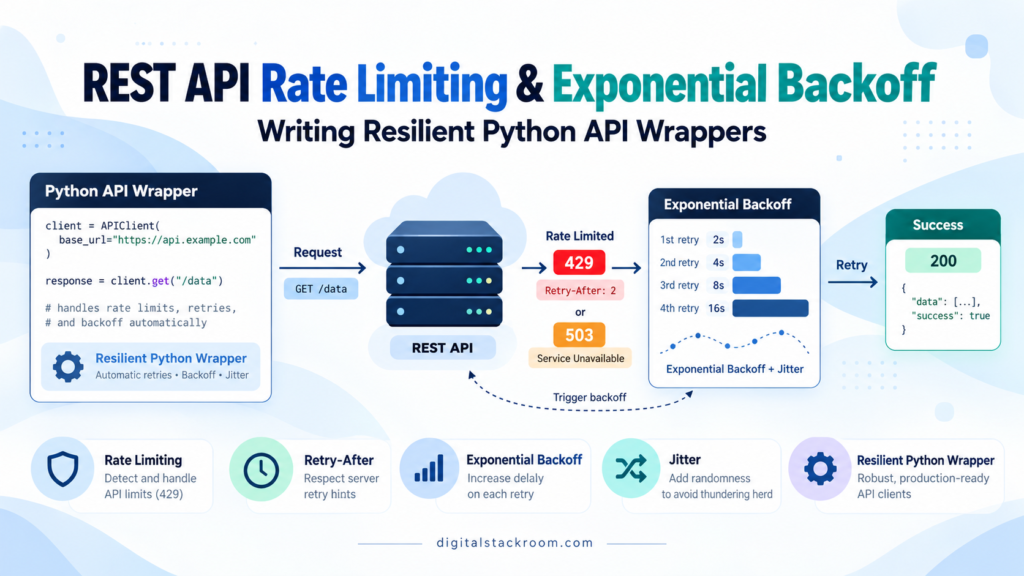
Calling a REST API from Python is easy.
Building a client that keeps behaving correctly when the API is slow, overloaded, rate-limited, partially unavailable, or returning ambiguous failures is a different problem.
The first version often looks like this:
import requests

response = requests.get(
    "https://api.example.com/v1/customers"
)

response.raise_for_status()

data = response.json()
This works until production introduces the conditions that local testing rarely does:
429 Too Many Requests

503 Service Unavailable

502 Bad Gateway

Read timeout

Connection reset

DNS failure

Intermittent upstream outage
The obvious response is:
try:
    call_api()
except Exception:
    call_api_again()
That can be worse than doing nothing.
A badly designed retry loop can:
- send duplicate POST requests
- multiply traffic during an outage
- ignore a server’s
Retry-Afterinstruction - retry permanent 4xx failures
- wait indefinitely
- synchronize hundreds of clients into the same retry pattern
- hide the real failure behind several minutes of retry latency
- consume API quota even faster
- turn one failing dependency into a cascading failure
A resilient API wrapper therefore needs more than a for loop around requests.get().
In this guide, we will build a production-oriented Python API client that handles:
- HTTP 429 rate limits
- transient 5xx responses
- connection failures
- connect and read timeouts
- exponential backoff
- jitter
Retry-After- idempotent HTTP methods
- safe POST retry behavior
- idempotency keys
- connection pooling
- bounded retries
- structured error handling
- observability
- pagination
- concurrency
- multi-worker rate limiting
- testing and failure injection
The central rule is simple:
Retry only when another attempt has a reasonable chance of succeeding and repeating the operation is safe.
Why API Retries Are More Complicated Than They Look
Imagine a payment API.
Your application sends:
POST /paymentsThe remote server receives the request, creates the payment, and begins returning the response.
Then the network connection breaks.
Your Python application sees:
ReadTimeoutWhat happened?
There are at least two possibilities:
Request never completed
→ Payment was not created
or:
Payment was successfully created
→ Response was lost
If the client blindly retries the POST, it may create:
Payment 1
Payment 2
The transport error alone does not tell the client which state exists on the server.
This is why retry behavior must begin with HTTP semantics rather than with exception handling.
The First Question Is Not “How Long Should I Wait?”
The first question should be:
Is this operation safe to repeat?
HTTP distinguishes between safe, idempotent, and non-idempotent operations.
Idempotent Methods
An HTTP method is idempotent when repeating the same request has the same intended effect as performing it once.
Common examples include:
GET
HEAD
OPTIONS
PUT
DELETE
A repeated DELETE may produce a different response:
First:
204 No Content

Second:
404 Not Found
but its intended state remains:
resource does not existThat is why DELETE is still considered idempotent.
POST and PATCH Require More Care
POST is not idempotent by HTTP definition.
Consider:
POST /orderstwice.
The server could legitimately create:
ORDER-1001
ORDER-1002
PATCH also does not automatically guarantee idempotency.
For example:
{
  "increment_balance": 100
}
applied twice clearly differs from applying it once.
Therefore:
Do not automatically retry POST or PATCH merely because the server returned a transient-looking error.
There are exceptions, but the application needs additional guarantees.
We will come back to idempotency keys later.
What Does HTTP 429 Actually Mean?
HTTP status:
429 Too Many Requestsmeans the client has exceeded a rate limit.
A server may rate-limit based on:
- user
- API key
- OAuth identity
- IP address
- endpoint
- resource
- organization
- account
- request cost
- concurrent requests
- rolling time window
The HTTP specification intentionally does not define one universal rate-limit algorithm.
An API might allow:
100 requests / minutewhile another may implement:
10 writes / second
500 reads / minute
50 concurrent requests
Your client therefore cannot infer the entire quota policy from the status code alone.
Respect Retry-After When the Server Provides It
A rate-limited response may include:
HTTP/1.1 429 Too Many Requests
Retry-After: 30
That means the server asks the client to wait approximately:
30 secondsbefore making the follow-up request.
Retry-After can also contain an HTTP date:
Retry-After: Wed, 21 Oct 2026 07:28:00 GMTThe standard therefore allows:
secondsor:
HTTP dateA resilient client should not assume it is always an integer.
Fortunately, urllib3 already implements this behavior, so we do not need to build our own parser for the normal case.
Not Every 4xx Error Should Be Retried
Consider:
400 Bad Request
401 Unauthorized
403 Forbidden
404 Not Found
422 Unprocessable Content
Retrying the identical request several times usually does not fix these problems.
If a request contains:
{
  "email": "not-an-email"
}
then this sequence:
Attempt 1 → 400
Wait
Attempt 2 → 400
Wait
Attempt 3 → 400
does nothing except waste quota and increase latency.
A practical starting policy looks like this:
| Status | Default Retry? | Reason |
|---|---|---|
| 400 | No | Request is invalid |
| 401 | No | Authentication issue; refresh flow may be separate |
| 403 | Usually no | Authorization or provider-specific quota condition |
| 404 | Usually no | Resource does not exist |
| 408 | Yes for idempotent request | Server timed out processing request |
| 409 | API-specific | Conflict may or may not be transient |
| 422 | No | Semantic validation problem |
| 429 | Yes | Rate limiting |
| 500 | Usually yes for idempotent request | Transient server failure may recover |
| 502 | Yes | Gateway/upstream failure |
| 503 | Yes | Service temporarily unavailable |
| 504 | Yes | Gateway timeout |
This is a default policy, not an HTTP law.
The API’s own documentation always wins.
Some APIs, for example, use:
403for certain quota conditions.
That is why a generic wrapper should allow provider-specific customization rather than assume every API uses status codes identically.
Install the Python Dependencies
For the examples in this article:
python -m pip install "requests>=2.32,<3" "urllib3>=2,<3"The explicit urllib3 2.x requirement is useful here because the examples use retry features such as:
backoff_jitterthat should be version-controlled rather than assumed to exist in whatever dependency happens to be installed.
In a production application, pin versions through your normal dependency-management process.
Requests Does Not Apply a Timeout Automatically
This deserves explicit attention.
This code:
requests.get(
    "https://api.example.com"
)
does not have a default application timeout.
A stalled upstream dependency can therefore leave your program waiting far longer than intended.
Always set one.
For example:
response = requests.get(
    "https://api.example.com/v1/customers",
    timeout=(3.05, 30),
)
This specifies:
Connect timeout: 3.05 seconds

Read timeout:    30 seconds
Connect Timeout and Read Timeout Are Different
Connect timeout
The connect timeout controls how long Requests waits while establishing the connection.
Problems here include:
unreachable host
connection refused
network routing problem
Read timeout
The read timeout applies after the connection has been established.
It controls how long the client waits between bytes received from the server.
A slow API might therefore establish a connection successfully but later exceed the read timeout.
One important detail:
A Requests timeout is not automatically a total wall-clock deadline for the entire operation.
Retries, DNS/address attempts, multiple response reads, and backoff sleeps can make total elapsed time much longer.
If your business process has a hard end-to-end deadline, enforce that separately at the workflow or job layer.
Why Exponential Backoff Helps
Imagine 500 application workers call an API.
The API goes down.
Without backoff:
500 requests fail

↓ immediately

500 retries fail

↓ immediately

500 retries fail again
The clients now make recovery harder.
Exponential backoff increases the delay between attempts.
A generic conceptual sequence might be:
0.5 seconds
1 second
2 seconds
4 seconds
8 seconds
until a maximum delay is reached.
The exact sequence depends on the retry implementation.
The purpose is more important than the formula:
Give the dependency time to recover instead of hammering it with immediate retries.
Why Exponential Backoff Alone Is Still Not Enough
Suppose 500 clients fail at exactly:
12:00:00and all calculate exactly:
2 secondsfor their next attempt.
At:
12:00:02all 500 clients retry together.
Then they all wait four seconds.
At:
12:00:06they hit the service together again.
This creates synchronized retry spikes.
The common solution is:
jitterwhich introduces randomness into retry timing.
Instead of every client retrying exactly at:
4.0 secondsthey may retry at:
3.7
4.1
4.3
4.5
...
This spreads load across time.
Start With a Reusable Configuration Object
Create:
from dataclasses import dataclass


@dataclass(frozen=True)
class ApiClientConfig:
    base_url: str

    connect_timeout: float = 3.05
    read_timeout: float = 30.0

    total_retries: int = 4

    backoff_factor: float = 0.5
    backoff_jitter: float = 0.5
    backoff_max: float = 30.0

    pool_connections: int = 10
    pool_maxsize: int = 20
These values are examples.
They are not universal production defaults.
A reporting API that normally responds in two minutes needs a different read timeout from a low-latency payment API.
Define the Retryable HTTP Methods
Create:
SAFE_RETRY_METHODS = frozenset({
    "GET",
    "HEAD",
    "OPTIONS",
    "PUT",
    "DELETE",
})
We intentionally leave out:
POST
PATCH
from the normal automatic retry policy.
We will handle idempotent POST operations separately.
Define the Retryable Status Codes
RETRYABLE_STATUS_CODES = frozenset({
    408,
    429,
    500,
    502,
    503,
    504,
})
Again, this should be adjustable for each API.
Do not blindly add:
every 4xxor:
every 5xxwithout understanding the provider’s semantics.
For example:
501 Not Implementedis generally not something that exponential backoff will fix.
Build the urllib3 Retry Policy
Requests uses urllib3 underneath its HTTP adapter.
Create:
from urllib3.util import Retry


def build_retry_policy(
    config: ApiClientConfig,
    allowed_methods: frozenset[str],
) -> Retry:

    return Retry(
        total=config.total_retries,

        connect=config.total_retries,
        read=config.total_retries,
        status=config.total_retries,

        other=0,

        redirect=3,

        allowed_methods=allowed_methods,

        status_forcelist=
            RETRYABLE_STATUS_CODES,

        backoff_factor=
            config.backoff_factor,

        backoff_jitter=
            config.backoff_jitter,

        backoff_max=
            config.backoff_max,

        respect_retry_after_header=True,

        raise_on_status=False,
    )
With:
total_retries = 4the client may make up to four retries after the original request, depending on which retry budget is consumed.
Retries remain bounded.
That is important.
Never create:
retry foreveras a production resilience strategy.
Why other=0 Is Deliberate
urllib3 distinguishes several retry categories, including:
connect
read
redirect
status
other
Some “other” failures might occur after the request has reached the server.
Automatically replaying them can therefore carry side-effect risk.
Setting:
other=0keeps the generic policy conservative.
If a particular API has additional retry-safe failures, handle them deliberately rather than expanding the policy accidentally.
Build a Requests Session
import requests

from requests import Session
from requests.adapters import HTTPAdapter


def build_session(
    config: ApiClientConfig,
    allowed_methods: frozenset[str],
) -> Session:

    retry_policy =
        build_retry_policy(
            config,
            allowed_methods,
        )

    adapter = HTTPAdapter(
        max_retries=retry_policy,
        pool_connections=
            config.pool_connections,
        pool_maxsize=
            config.pool_maxsize,
    )

    session = requests.Session()

    session.mount(
        "https://",
        adapter,
    )

    session.mount(
        "http://",
        adapter,
    )

    session.headers.update({
        "Accept":
            "application/json",

        "User-Agent":
            "DigitalStackroom-ApiClient/1.0",
    })

    return session
Using a Session also enables connection reuse.
That matters when an application makes many calls to the same service because repeatedly opening new TCP/TLS connections adds unnecessary overhead.
Connection Pool Size Is Not a Rate Limiter
This setting:
pool_maxsize=20does not mean:
maximum 20 API requests per secondIt controls connection-pool behavior.
Rate limiting is a separate concern.
Do not use connection-pool configuration as a substitute for provider-aware request pacing.
Build Explicit API Exceptions
A wrapper becomes easier to use when callers do not have to interpret every Requests exception themselves.
class ApiClientError(Exception):
    pass


class ApiTransportError(ApiClientError):
    pass


class ApiProtocolError(ApiClientError):
    pass


class ApiHttpError(ApiClientError):

    def __init__(
        self,
        response: requests.Response,
    ):

        self.status_code =
            response.status_code

        self.response =
            response

        request_id = (
            response.headers.get(
                "x-request-id"
            )
            or response.headers.get(
                "request-id"
            )
        )

        message = (
            f"API returned HTTP "
            f"{response.status_code}"
        )

        if request_id:
            message += (
                f"; provider_request_id="
                f"{request_id}"
            )

        super().__init__(
            message
        )
x-request-id is not a universal HTTP standard.
Some providers expose it.
Others use different names.
Treat provider request-ID headers as API-specific metadata.
Build the Resilient API Client
from typing import Any, Mapping

import requests


class ResilientApiClient:

    def __init__(
        self,
        config: ApiClientConfig,
        token: str | None = None,
    ):

        self.config =
            config

        self._base_url = (
            config.base_url
            .rstrip("/")
        )

        self._session =
            build_session(
                config,
                SAFE_RETRY_METHODS,
            )

        self._post_retry_session =
            build_session(
                config,
                SAFE_RETRY_METHODS
                | {"POST"},
            )

        if token:

            authorization = (
                f"Bearer {token}"
            )

            self._session.headers[
                "Authorization"
            ] = authorization

            self._post_retry_session.headers[
                "Authorization"
            ] = authorization
Notice that we maintain two sessions:
normal sessionand:
POST-retry sessionThe second one will only be used explicitly when we know POST replay is safe.
Never Accept an Arbitrary Absolute URL Into an Authenticated Wrapper
If the wrapper holds:
Authorization: Bearer ...you should avoid allowing callers to send that session to arbitrary hosts.
Create:
    def _build_url(
        self,
        path: str,
    ) -> str:

        lowered =
            path.lower()

        if lowered.startswith(
            (
                "http://",
                "https://",
            )
        ):
            raise ValueError(
                "API path must be relative."
            )

        return (
            f"{self._base_url}/"
            f"{path.lstrip('/')}"
        )
This keeps calls scoped to the configured API host.
It also reduces the risk of accidentally forwarding API credentials to an unintended endpoint.
Centralize Request Execution
Add:
    def _send(
        self,
        session: requests.Session,
        method: str,
        path: str,
        *,
        params: Mapping[str, Any] | None = None,
        json: Any = None,
        data: Any = None,
        headers:
            Mapping[str, str] | None = None,
        timeout:
            tuple[float, float] | None = None,
    ) -> requests.Response:

        url =
            self._build_url(
                path
            )

        request_timeout = (
            timeout
            if timeout is not None
            else (
                self.config.connect_timeout,
                self.config.read_timeout,
            )
        )

        try:

            response =
                session.request(
                    method=
                        method.upper(),

                    url=
                        url,

                    params=
                        params,

                    json=
                        json,

                    data=
                        data,

                    headers=
                        headers,

                    timeout=
                        request_timeout,
                )

        except requests.exceptions.Timeout as exc:

            raise ApiTransportError(
                f"API request timed out: "
                f"{method.upper()} {path}"
            ) from exc

        except requests.exceptions.ConnectionError as exc:

            raise ApiTransportError(
                f"API connection failed: "
                f"{method.upper()} {path}"
            ) from exc

        except requests.exceptions.RequestException as exc:

            raise ApiTransportError(
                f"API transport failure: "
                f"{method.upper()} {path}"
            ) from exc

        if response.status_code >= 400:

            raise ApiHttpError(
                response
            )

        return response
The retry adapter operates underneath this method.
By the time _send() receives a final response, the configured retry policy has already been applied.
Add a Normal Request Method
    def request(
        self,
        method: str,
        path: str,
        *,
        params:
            Mapping[str, Any] | None = None,
        json: Any = None,
        data: Any = None,
        headers:
            Mapping[str, str] | None = None,
    ) -> requests.Response:

        return self._send(
            self._session,
            method,
            path,
            params=params,
            json=json,
            data=data,
            headers=headers,
        )
If the caller makes:
client.request(
    "POST",
    "/v1/orders",
    json=payload,
)
POST is not in the normal automatic status/read retry allowlist.
That is deliberate.
Add a JSON Convenience Method
    def request_json(
        self,
        method: str,
        path: str,
        **kwargs,
    ):

        response =
            self.request(
                method,
                path,
                **kwargs,
            )

        if (
            response.status_code == 204
            or not response.content
        ):
            return None

        try:

            return response.json()

        except requests.exceptions.JSONDecodeError as exc:

            raise ApiProtocolError(
                "API returned a successful "
                "response that was not "
                "valid JSON."
            ) from exc
Do not automatically assume every successful REST API response contains JSON.
For example:
204 No Contentlegitimately has no response body.
Add Context-Manager Support
    def close(
        self
    ) -> None:

        self._session.close()

        self._post_retry_session.close()


    def __enter__(
        self
    ):

        return self


    def __exit__(
        self,
        exc_type,
        exc_value,
        traceback,
    ):

        self.close()
Now you can use:
config = ApiClientConfig(
    base_url=
        "https://api.example.com"
)


with ResilientApiClient(
    config,
    token="..."
) as client:

    customers = (
        client.request_json(
            "GET",
            "/v1/customers",
        )
    )
What Happens When the API Returns 503?
Suppose:
Attempt 1
→ 503
The retry layer recognizes:
503 ∈ status_forcelistand:
GET ∈ allowed_methodsso the request can be retried.
The wait is based on the configured backoff policy unless a supported server-provided Retry-After instruction applies.
Eventually:
Attempt N
→ 200
and the caller receives the successful response.
If all retry attempts fail, the final unsuccessful response reaches the wrapper and becomes:
ApiHttpErrorThe Server’s Delay Should Usually Beat Your Guess
Suppose your exponential schedule calculates:
4 secondsbut the server replies:
Retry-After: 60The server knows its own availability or quota state better than your generic backoff formula.
For supported retry responses, configure:
respect_retry_after_header=Trueas we did.
The client should not continue aggressively calling the service during the period in which the server explicitly asked it to wait.
A Retry-After Header Is Not Limited to 429
HTTP also defines Retry-After for scenarios such as:
503 Service Unavailableand redirection responses.
Do not implement:
if status == 429:
    parse_retry_after()
and assume that is the complete HTTP model.
Using a mature retry library is preferable to recreating protocol details unnecessarily.
What About Rate-Limit Headers?
Many APIs expose additional metadata such as:
X-RateLimit-Limit
X-RateLimit-Remaining
X-RateLimit-Reset
but these are provider-specific conventions.
Do not write a generic wrapper that assumes every API uses those exact fields.
Instead:
Standard HTTP behavior
→ generic wrapper

Provider-specific quota headers
→ provider adapter
For example:
def parse_provider_rate_limit(
    response: requests.Response,
):

    remaining = (
        response.headers.get(
            "x-ratelimit-remaining"
        )
    )

    reset = (
        response.headers.get(
            "x-ratelimit-reset"
        )
    )

    return {
        "remaining":
            remaining,

        "reset":
            reset,
    }
Only add this behavior when the provider documents those headers.
Reactive Backoff Is Not the Same as Proactive Throttling
Waiting for:
429and then slowing down is reactive.
A high-volume client should often avoid reaching the limit in the first place.
Suppose the provider allows:
600 requests / minuteand your application produces:
5,000 jobsLaunching all 5,000 simultaneously and relying on retries is poor design.
A better architecture may be:
Work Queue
    ↓
Rate-Limited Workers
    ↓
API
Retries handle exceptional failures.
Traffic shaping controls normal throughput.
They solve different problems.
Idempotent POST Requests Need an Explicit Contract
Some APIs support an idempotency mechanism.
For example, the client may send:
Idempotency-Key: payment-ORD-1001The API stores the key and guarantees that repeated requests using the same key do not create duplicate business operations.
Only if the provider explicitly documents such behavior should we enable automatic retries for POST.
Add Safe POST Retry Support
    def post_idempotent(
        self,
        path: str,
        *,
        idempotency_key: str,
        idempotency_header:
            str = "Idempotency-Key",
        json: Any = None,
        data: Any = None,
        headers:
            Mapping[str, str] | None = None,
    ) -> requests.Response:

        if not idempotency_key:
            raise ValueError(
                "idempotency_key is required."
            )

        retry_headers = dict(
            headers or {}
        )

        retry_headers[
            idempotency_header
        ] = idempotency_key

        return self._send(
            self._post_retry_session,
            "POST",
            path,
            json=json,
            data=data,
            headers=retry_headers,
        )
Usage:
response = client.post_idempotent(
    "/v1/orders",
    idempotency_key=
        "order-create-ORD-1001",
    json={
        "order_id":
            "ORD-1001",

        "amount":
            1250.00,
    },
)
There is an important requirement here:
The remote API must document that this idempotency mechanism actually prevents duplicate side effects.
Simply inventing an:
Idempotency-Keyheader does not magically make an API idempotent.
Do Not Generate a New Idempotency Key for Every Retryable Business Attempt
Suppose your job creates:
ORDER-1001Use a stable key such as:
create-order-ORDER-1001or a durable operation ID.
Do not do:
uuid.uuid4()every time the business workflow retries from scratch.
If each new application attempt uses a new idempotency key, the server may correctly treat every attempt as a different operation.
The key needs to represent the same business operation, not merely the current HTTP attempt.
A Read Timeout After POST Is an Ambiguous Failure
This deserves special emphasis.
Suppose:
POST sent
↓
Server creates order
↓
Response delayed
↓
Client read timeout
The client knows:
I did not receive the responseIt does not know:
The server did not process the requestWithout idempotency or reconciliation support, the safe response may be:
UNKNOWN OUTCOMErather than:
RETRYThis is the same class of problem that appears in file-processing workflows when a write succeeds but the completion marker fails.
For another example of that failure model, see Google Apps Script for Data Workflows: Automating Drive-to-Sheets Data Transfers on Triggers, where the workflow deliberately reconciles ambiguous writes instead of blindly replaying them.
If You Implement Your Own Backoff, Use Jitter
Sometimes an API has unusual retry behavior that does not fit a generic adapter.
A common randomized delay function is:
import random


def full_jitter_delay(
    retry_index: int,
    *,
    base: float = 0.5,
    cap: float = 30.0,
) -> float:

    ceiling = min(
        cap,
        base * (2 ** retry_index),
    )

    return random.uniform(
        0.0,
        ceiling,
    )
For:
retry_index = 0the delay is randomly chosen between:
0 and 0.5 secondsThen:
0–1 second
0–2 seconds
0–4 seconds
...
up to the configured cap.
This is one backoff strategy.
It is not the only valid one.
Do Not Stack Two Independent Retry Systems Accidentally
A common mistake is:
urllib3 retries 4 times

inside

application retry loop 4 times
The actual number of requests can become much larger than expected.
For example:
5 HTTP attempts
×
5 outer attempts
=
25 requests
A retry policy should have one clear owner.
Either:
transport adapter owns normal HTTP retryor:
application workflow owns provider-specific retryIf both layers exist, their interaction must be explicitly designed.
Authentication Refresh Is Not the Same as Retry
Suppose the API returns:
401 UnauthorizedIf the application uses an expiring access token, a valid flow may be:
401
↓
refresh access token
↓
retry once
That is not generic exponential backoff.
It is authentication recovery.
Do not put:
401into the generic retry status list and hope waiting fixes it.
Separate:
transient infrastructure failuresfrom:
credential lifecycleA 403 May Not Mean the Same Thing Across APIs
Many APIs use:
403 Forbiddenfor authorization failures.
Some providers also use 403 for particular quota or abuse-protection conditions.
Therefore:
403should not be globally classified as:
always retryor:
never retrywithout reading the provider documentation and response body.
The generic wrapper should remain conservative.
Provider adapters can add specific logic.
Pagination Needs the Same Resilience Policy
A reliable API wrapper also needs to handle paginated retrieval correctly.
Imagine:
Page 1 → success
Page 2 → success
Page 3 → 503
Page 3 retry → success
Page 4 → success
Each individual page request should use the same retry policy.
Example:
def iter_pages(
    client: ResilientApiClient,
    path: str,
):

    cursor = None

    while True:

        params = {}

        if cursor:
            params["cursor"] = cursor

        payload = client.request_json(
            "GET",
            path,
            params=params,
        )

        yield payload["items"]

        cursor = payload.get(
            "next_cursor"
        )

        if not cursor:
            break
Do not restart the entire export from page 1 merely because page 47 had one transient failure.
But Pagination Also Needs Duplicate Awareness
Some APIs use mutable datasets.
Imagine fetching:
Page 1
Page 2
Page 3
while new records are being inserted concurrently.
Offset-based pagination can sometimes produce:
duplicate recordsor:
missed recordsdepending on API semantics.
A resilient HTTP wrapper cannot solve that problem alone.
The integration should understand whether the API supports:
- cursor pagination
- stable snapshots
- timestamp filters
- immutable sequence IDs
- continuation tokens
Retry correctness and dataset consistency are separate concerns.
Bulk Endpoints Are Often Better Than Thousands of Small Requests
Suppose an API supports:
POST /lookupfor one ID at a time.
Your code needs:
50,000 IDsIf a bulk endpoint exists:
POST /bulk-lookupusing batches may dramatically reduce:
- request count
- rate-limit pressure
- network overhead
- connection overhead
Retries should not be used as a substitute for efficient API usage.
Batch Size Should Still Be Bounded
Do not respond to API rate limits by sending:
one request containing 5 GBunless the provider explicitly supports it.
The right batch size depends on:
- payload limits
- latency
- server processing time
- memory
- timeout behavior
- retry cost
A failed batch of 100 records is much cheaper to replay than a failed batch of 100,000 records.
Concurrency Can Defeat a Good Retry Policy
Imagine 50 Python workers.
Each worker is individually polite.
But together they send:
50 × 20 requestsin a short period.
The shared API token receives the combined traffic.
Rate limits often apply to the shared credential, account, or organization rather than to one Python process.
Therefore:
A per-process retry policy does not enforce a distributed rate limit.
For multiple workers or containers, use a shared control mechanism when necessary.
Examples include:
central work queue
distributed semaphore
Redis-backed token bucket
API gateway
shared scheduler
The exact solution depends on infrastructure.
Connection Pools Should Match Concurrency Deliberately
If the application runs:
20 concurrent workersbut only expects:
2 active API requeststhere is little reason to create extremely large connection pools.
Likewise, high-concurrency clients should not repeatedly establish new connections if the same remote host is being called continuously.
Measure:
concurrent requests
connection reuse
latency
rate-limit behavior
rather than simply increasing pool sizes.
Retries Increase Tail Latency
Suppose:
read timeout = 30 secondsand the request is allowed several retries.
The user’s total wait can become much larger than:
30 secondsbecause there may be:
connection time
+
read timeout
+
backoff
+
another request
+
another timeout
+
another backoff
This matters when the wrapper is used behind:
- web requests
- Streamlit applications
- synchronous user workflows
- serverless functions
- upstream services with their own deadlines
Do not configure retry settings in isolation.
Consider the caller’s end-to-end latency budget.
For internal application architecture around this problem, see Building Internal Automation Consoles with Streamlit and Python.
Do Not Retry Forever During a Major Outage
Retries are intended for:
transient failurenot:
dependency unavailable for six hoursIf a downstream service remains unavailable, a more appropriate architecture may involve:
bounded retry
↓
failed/queued state
↓
later recovery job
or a circuit-breaker-style mechanism.
The important principle is:
Stop generating useless load when evidence suggests immediate retries are no longer helping.
Distinguish Interactive Calls From Background Jobs
A user waiting on a web page may tolerate:
2 retriesbut not:
15 minutesA background job may have a much longer recovery window.
That suggests different policies.
Interactive workflow
Short timeout
Few retries
Fail visibly
Background processing
Bounded immediate retries
Persist job state
Retry later
Dead-letter/review on repeated failure
Do not use one universal retry configuration for every workload.
Logging Every Attempt Requires Care
Useful API telemetry includes:
endpoint
method
status_code
elapsed_ms
operation_id
provider_request_id
retry outcome
Do not casually log:
Authorization headers
API keys
access tokens
full customer payloads
personal data
A retry wrapper is a central location through which many API requests flow.
That makes it an excellent observability point and a dangerous place to leak secrets.
Use a Local Operation ID
Even if the provider does not return its own request ID, your business workflow can create one.
import uuid


operation_id = str(
    uuid.uuid4()
)
Pass that through:
job
API wrapper
logs
database update
audit event
Then a production incident can be reconstructed around one stable identifier.
Do not assume a provider will accept a custom request-ID header unless its API supports or tolerates it.
You can always keep the operation ID in your own logs.
Log Final Outcomes, Not Just Exceptions
A useful structured log might contain:
{
    "event":
        "api_request_completed",

    "operation_id":
        operation_id,

    "method":
        "GET",

    "endpoint":
        "/v1/customers",

    "status_code":
        200,

    "elapsed_ms":
        482,
}
A failure:
{
    "event":
        "api_request_failed",

    "operation_id":
        operation_id,

    "method":
        "GET",

    "endpoint":
        "/v1/customers",

    "status_code":
        503,
}
Avoid logging URL query parameters blindly because they may contain sensitive values.
Track Rate Limiting as a Metric
A service can technically succeed while constantly fighting rate limits.
Useful metrics include:
api_requests_total

api_request_failures

http_429_count

http_5xx_count

timeout_count

retry_count

request_latency

rate_limit_wait_time

requests_by_endpoint
Suppose:
99.9% requests eventually succeedbut:
35% require retriesThe system is not healthy merely because the final success rate looks good.
Retries can mask deteriorating dependency behavior.
Monitor Retry Amplification
One useful measure is:
HTTP attempts
─────────────
logical API operations
If:
10,000 logical operationsgenerate:
10,050 HTTP attemptsretry overhead is small.
If they generate:
28,000 HTTP attemptssomething needs investigation.
That could indicate:
- overloaded service
- overly aggressive client policy
- bad timeout settings
- rate-limit saturation
- upstream instability
Avoid Retrying Validation Errors From API Responses
Some APIs return structured errors:
{
  "error": {
    "code": "INVALID_EMAIL",
    "message": "Email address is malformed."
  }
}
That failure is deterministic.
The right flow is:
validate / reject / fix inputnot:
exponential backoffResilience includes knowing when not to retry.
If API data feeds downstream analytical pipelines, pair transport resilience with data-quality checks. The Digital Stackroom guide Automating Data Validation Pipelines with SQL Assertions covers that second layer.
AI APIs Need the Same Fundamentals
LLM and AI APIs still operate over networks.
They can experience:
- rate limits
- quota exhaustion
- timeout
- overloaded models
- transient 5xx failures
- long response times
The same principles apply:
Timeouts
+
Bounded Retries
+
Backoff
+
Server Retry Instructions
+
Observability
But AI workloads add additional concerns such as:
- token budgets
- streaming
- long-running generation
- asynchronous execution
- model-specific quota
For a complete example, see Integrating the Gemini API in Python: Production Error Handling, Token Limits, and Streaming Architectures.
Rate Limiting Is Not Always Request-Count Based
Do not assume:
1 API call = 1 quota unitAn API can rate-limit based on:
- tokens
- compute
- rows
- data volume
- endpoint cost
- concurrency
- CPU time
- write operations
For example:
GET /healthand:
POST /generate-large-reportmay have radically different resource costs.
Read the provider’s quota model.
A generic HTTP wrapper cannot discover it automatically.
Testing Retry Behavior Requires Failure Injection
Do not validate your retry wrapper only against successful API responses.
Test scenarios such as:
| Scenario | Expected Behavior |
|---|---|
| GET → 200 | Return immediately |
| GET → 503 → 200 | Retry then succeed |
| GET → repeated 503 | Stop after bounded retries |
| GET → 429 + Retry-After | Respect server delay |
| GET → 400 | Fail without status retry |
| GET connection failure | Retry according to transport policy |
| GET read timeout | Retry when allowed |
| POST → 500 | Do not automatically status-retry by default |
| Idempotent POST → 500 → 200 | Retry only with provider-supported idempotency |
| POST read timeout | Treat as potentially ambiguous without idempotency |
| Invalid JSON after 200 | Raise protocol error |
| 204 | Return no JSON payload |
| Repeated outage | Stop rather than retry forever |
This is where most API wrappers reveal their real behavior.
Test the Actual Number of Requests
A particularly important test is:
How many network attempts were made?Do not merely assert:
final response == 200If a test intended to make:
3 attemptsactually makes:
15because two retry layers were accidentally combined, the client is not behaving correctly.
Do Not Disable TLS Verification to “Fix” API Errors
Avoid:
requests.get(
    url,
    verify=False,
)
as a production workaround for certificate problems.
Disabling certificate verification makes the connection vulnerable to man-in-the-middle attacks.
Fix:
- certificate trust
- CA configuration
- corporate proxy configuration
- endpoint configuration
rather than bypassing TLS security.
Do Not Put API Keys Directly Into Source Code
Bad:
API_TOKEN = "abc123-secret"Better:
import os


API_TOKEN =
    os.environ[
        "API_TOKEN"
    ]
or use your platform’s secret-management system.
The API wrapper should receive credentials.
It should not own hard-coded production secrets.
Separate Provider Logic From Transport Logic
A mature project may have:
transport.pyhandling:
Requests
Timeouts
Retries
Connections
and:
github_client.py
crm_client.py
billing_client.py
handling:
Endpoints
Provider quotas
Payload schemas
Pagination
Business semantics
That separation keeps your generic retry implementation from filling up with logic such as:
if provider == "x":throughout the code.
A Suggested Project Structure
api_client/
│
├── transport.py
├── exceptions.py
├── config.py
│
├── providers/
│   ├── crm.py
│   ├── billing.py
│   └── reporting.py
│
├── tests/
│   ├── test_transport.py
│   ├── test_rate_limits.py
│   └── test_idempotency.py
│
└── pyproject.toml
The transport layer should know HTTP.
The provider layer should know the API.
The business service should know what the application is trying to accomplish.
What I Would Put in the Generic Transport Layer
Good candidates:
- Requests Session
- connect/read timeout
- connection pooling
- safe-method retry
- backoff
- jitter
Retry-After- transport exceptions
- generic HTTP errors
- basic observability
What I Would Keep Out of the Generic Transport Layer
Usually provider-specific:
- quota reset headers
- custom error codes
- authentication refresh
- endpoint pagination
- idempotency header names
- request payload validation
- business retry semantics
Keeping these separate makes the wrapper reusable without making it dangerously opinionated.
Retries Should Not Hide Dependency Health
Imagine an API call normally takes:
150 msThen the provider begins returning intermittent 503s.
Your wrapper retries successfully and users now see:
3.8 secondsinstead.
Technically:
request succeededOperationally:
dependency is degradingTrack both:
final successand:
retry activityOtherwise retries can hide incidents.
When Should You Stop Retrying?
Stop when one of the following happens:
The request succeeds
2xxThe failure is permanent
For example:
400
404
422
under the provider’s documented semantics.
The retry budget is exhausted
For example:
4 retriesThe business deadline is reached
For example:
request must finish within 20 secondsThe operation is not safely repeatable
For example:
ambiguous POST
without idempotency
Retries should always have a termination condition.
A Production Flow
A practical request lifecycle looks like this:
Business Operation
       ↓
Build Request
       ↓
Validate Idempotency
       ↓
Send HTTP Request
       ↓
 ┌─────┴───────────────┐
 │                     │
 ▼                     ▼
Success             Failure
 │                     │
 ▼                     ▼
Return          Retryable?
                       │
              ┌────────┴────────┐
              │                 │
              ▼                 ▼
             No                Yes
              │                 │
              ▼                 ▼
          Raise Error     Retry-After?
                                │
                       ┌────────┴───────┐
                       │                │
                       ▼                ▼
                     Yes               No
                       │                │
                       ▼                ▼
                 Server Delay     Backoff + Jitter
                       │                │
                       └────────┬───────┘
                                ▼
                           Retry Budget?
                                │
                       ┌────────┴───────┐
                       │                │
                       ▼                ▼
                      Yes              No
                       │                │
                       ▼                ▼
                    Retry           Raise Error
The important part is that retryability is a policy decision, not a reaction to every exception.
Production Checklist
Before deploying a Python API wrapper, verify:
- every external request has a timeout
- connect and read timeouts are chosen deliberately
- timeout values are not mistaken for total wall-clock deadlines
- retries are bounded
- retryable status codes are documented
- permanent 4xx errors are not blindly retried
- 429 handling respects the API’s instructions
Retry-Afteris supported- exponential backoff is enabled
- jitter is enabled
- POST is not automatically retried by default
- PATCH is not assumed to be idempotent
- idempotency-key behavior is provider-supported before retrying writes
- stable idempotency keys represent business operations
- ambiguous write failures have a reconciliation strategy
- connection pooling is used appropriately
- pool size is not confused with rate limiting
- distributed workers coordinate shared quotas when necessary
- provider-specific quota headers are parsed only where documented
- authentication refresh is separate from generic retry
- TLS verification remains enabled
- credentials are not hard-coded
- authorization headers are not logged
- response payloads are not logged indiscriminately
- retries are observable
- retry amplification is measured
- tests verify the actual number of HTTP attempts
- prolonged outages eventually leave the retry loop
- background workflows can persist failures for later recovery
Common Mistakes to Avoid
Retrying Every Exception
Not every failure is transient.
Retrying Every 4xx
Most 4xx responses require the client to change something.
Waiting usually changes nothing.
Retrying POST Automatically
A lost response does not mean the server did not execute the request.
Ignoring Retry-After
The server may already be telling you when it is safe to come back.
Using Exponential Backoff Without Jitter
Many synchronized clients can still create retry spikes.
Having No Timeout
A retry policy cannot help while one request waits indefinitely.
Treating Timeout as a Total Request Deadline
Requests’ connect/read timeout behavior is more specific than that.
Layering Multiple Retry Loops
Nested retry mechanisms can multiply traffic unexpectedly.
Using Retries as Rate Limiting
Retries respond to failure.
Rate limiting controls request generation before failure.
Assuming One Process Represents the Entire API Load
Several services may share the same API credential or quota.
Logging Authorization Headers
A resilience layer should not become a credential-leak layer.
Final Takeaway
A basic API integration looks like:
Request
↓
Response
A production integration looks more like:
Business Operation
        ↓
Timeout Policy
        ↓
Idempotency Decision
        ↓
HTTP Request
        ↓
Rate Limit / Failure Classification
        ↓
Retry-After
   or
Backoff + Jitter
        ↓
Bounded Retry
        ↓
Success / Reconciliation / Failure
        ↓
Metrics + Logs
The important part of resilient API engineering is not how many times the client retries.
It is knowing:
what can be retriedwhen it should be retriedand:
when retrying is dangerousUse HTTP semantics before retry logic.
Set explicit timeouts.
Respect server instructions.
Apply exponential backoff with jitter.
Keep retry budgets finite.
Treat non-idempotent operations conservatively.
Use documented idempotency mechanisms for write retries.
Coordinate rate limits across workers when quota is shared.
And monitor retries rather than allowing them to silently hide upstream instability.
A good API wrapper does not merely make failing requests succeed more often.
It makes failure predictable, observable, bounded, and safe.
Related Digital Stackroom Guides
Useful for applying these same timeout, retry, quota, streaming, and error-handling patterns to a production AI API integration.
Building Internal Automation Consoles with Streamlit and Python: Architecture and Best Practices
Useful when resilient API calls sit behind an internal application and need to coexist with background jobs, audit logs, service layers, and user-facing latency constraints.
Google Apps Script for Data Workflows: Automating Drive-to-Sheets Data Transfers on Triggers
Shows a related reliability problem: distinguishing safe retries from ambiguous writes when a workflow spans several external systems.
Automating Data Validation Pipelines: Writing SQL Assertion Checks Before Running Production Reports
Useful for the layer after transport reliability, where API responses and ingested data still need schema, completeness, freshness, and business-rule validation.
Official Sources and Further Reading
Requests — Quickstart: Timeouts and Exceptions
Official Requests documentation covering explicit timeouts, Timeout, ConnectionError, HTTPError, and other request exceptions.
Requests — Advanced Usage: Timeouts, Sessions and Transport Adapters
Explains connect versus read timeouts, Sessions, transport adapters, connection reuse, and automatic retry configuration.
Official API reference for HTTPAdapter, connection pools, and the max_retries integration with urllib3.
Official reference for retry counts, allowed_methods, status_forcelist, backoff_factor, backoff_jitter, backoff_max, and Retry-After behavior.
urllib3 — Configuring Exponential Backoff
Explains urllib3’s exponential backoff behavior, jitter, and why immediate repeated retries can overload a recovering service.
The core HTTP semantics specification covering idempotent methods and the Retry-After response header.
RFC 6585 — 429 Too Many Requests
Defines HTTP 429 and explains that a rate-limited response may include Retry-After.
A useful real-world example of provider-specific primary and secondary rate limits, quota headers, 403/429 behavior, Retry-After, and exponential-backoff recommendations.
Implementation note: The timeout values, four-retry budget, retryable status list, backoff factor, jitter amount, connection-pool size, and 30-second backoff cap in this article are example settings rather than universal recommendations. Production values should be derived from the API provider’s documented behavior, request latency, idempotency guarantees, quota policy, workload criticality, concurrency, and the application’s end-to-end latency budget.