
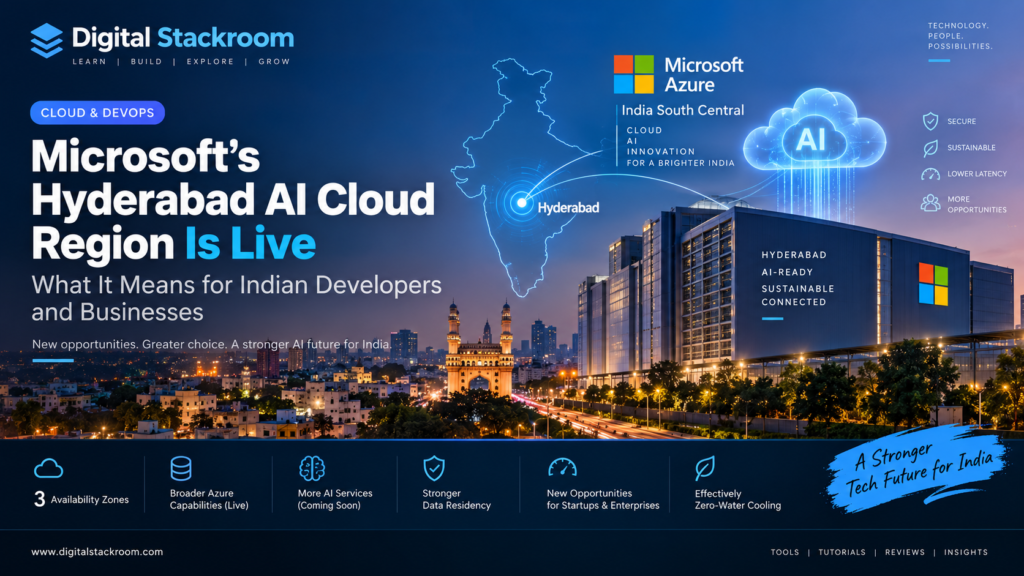
Microsoft has officially brought its new India South Central Azure region in Hyderabad online, adding another major piece of cloud and AI infrastructure to India.
The launch matters for more than simple capacity expansion.
India South Central gives Azure customers a new three-zone region in Hyderabad, additional options for keeping eligible workloads in India, and a closer infrastructure location for organizations operating in southern and central parts of the country. Microsoft is also positioning Hyderabad as a strategic cloud and AI hub serving India, Asia, and parts of the Global South.
But there is an important detail hidden behind the headlines:
not every Azure or AI service is available in the new region on day one.
Microsoft says the region has launched with a broad portfolio of Azure services, while additional Azure and AI capabilities—including Microsoft Foundry—are expected to roll out progressively.
So the practical question for developers and businesses is not simply:
“Should we move to Hyderabad?”
It is:
“Which workloads actually benefit from India South Central, and which ones should stay where they are?”
That is what this guide examines.
Table of Contents
What Exactly Did Microsoft Launch in Hyderabad?
Microsoft’s new region is officially called:
India South Central
Its Azure region identifier is:
indiasouthcentral
Microsoft’s Azure region documentation places the region in Hyderabad, India, with support for Availability Zones and a regional pairing with Central India, Microsoft’s Pune region.
The Hyderabad launch makes India South Central Microsoft’s fourth cloud region in India, alongside infrastructure associated with Pune, Chennai, and Mumbai. Microsoft says the region is part of its broader $20.5 billion India investment commitment.
The architecture is particularly important.
India South Central launches with three Availability Zones, meaning organizations can design applications across physically separated infrastructure locations within the same Azure region rather than depending on a single datacenter location.
That creates new options for high-availability architectures in southern India.
Microsoft’s Azure Regions in India
Microsoft’s current region documentation lists the following major Azure locations in India:
| Azure region | Location | Availability Zones shown in Microsoft region list | Regional pair |
|---|---|---|---|
| Central India | Pune | Yes | South India |
| South India | Chennai | Not marked as zonal in the current region list | Central India |
| West India | Mumbai | Not marked as zonal in the current region list | South India |
| India South Central | Hyderabad | Yes | Central India |
Microsoft’s reliability documentation currently identifies India South Central as a zonal region and pairs it with Central India.
This does not mean every Azure service behaves identically across these regions.
Service availability, zone support, replication options, quotas, VM families, AI models, and managed-service features can differ by region.
That distinction is critical when deciding where to deploy.
What Is Actually Available Today—and What Is Still Coming?
This is one of the most important parts of Microsoft’s Hyderabad announcement.
India South Central is live, but the full Azure and AI catalog is not necessarily available there yet.
Microsoft says the region launches with a broad Azure portfolio and is designed to support the wider Azure and AI service portfolio as capabilities roll out over the coming months. Microsoft specifically mentions Microsoft Foundry among the services expected as the region expands.
This means developers should avoid assuming:
“The region exists, therefore every service my current architecture uses exists there.”
Before migrating a production workload, verify each dependency individually.
For example, check:
- required Azure VM families
- GPU availability
- Azure OpenAI / Foundry availability
- Azure Kubernetes Service capabilities
- database SKUs
- storage redundancy models
- Key Vault support
- confidential-computing options
- networking services
- monitoring and security services
- quotas and capacity limits
A migration should begin with a service-availability audit, not a region switch.
Why Three Availability Zones Matter
A cloud region and an Availability Zone are not the same thing.
A region is the broader geographic location.
An Availability Zone is an isolated infrastructure location within that region, designed so a failure in one zone does not necessarily take down workloads in the others.
With three zones in India South Central, architects can potentially distribute application components across zones.
For example:
Zone 1
- application instances
Zone 2
- additional application instances
Zone 3
- additional resilient capacity
A zonally designed system can continue operating when an individual infrastructure location experiences disruption.
However, simply deploying to India South Central does not automatically make an application highly available.
The application still has to be designed correctly.
Teams need to evaluate:
- whether each service supports zones
- zonal vs zone-redundant deployment
- load-balancing configuration
- database replication
- storage redundancy
- failure detection
- automated failover
- capacity reservations
- recovery testing
Availability Zones provide infrastructure options. They do not replace architecture.
The Biggest Change May Be Workload Placement
Before Hyderabad, Azure teams in India often selected a region based on a combination of:
- service availability
- compliance requirements
- customer location
- latency
- disaster recovery
- organizational standards
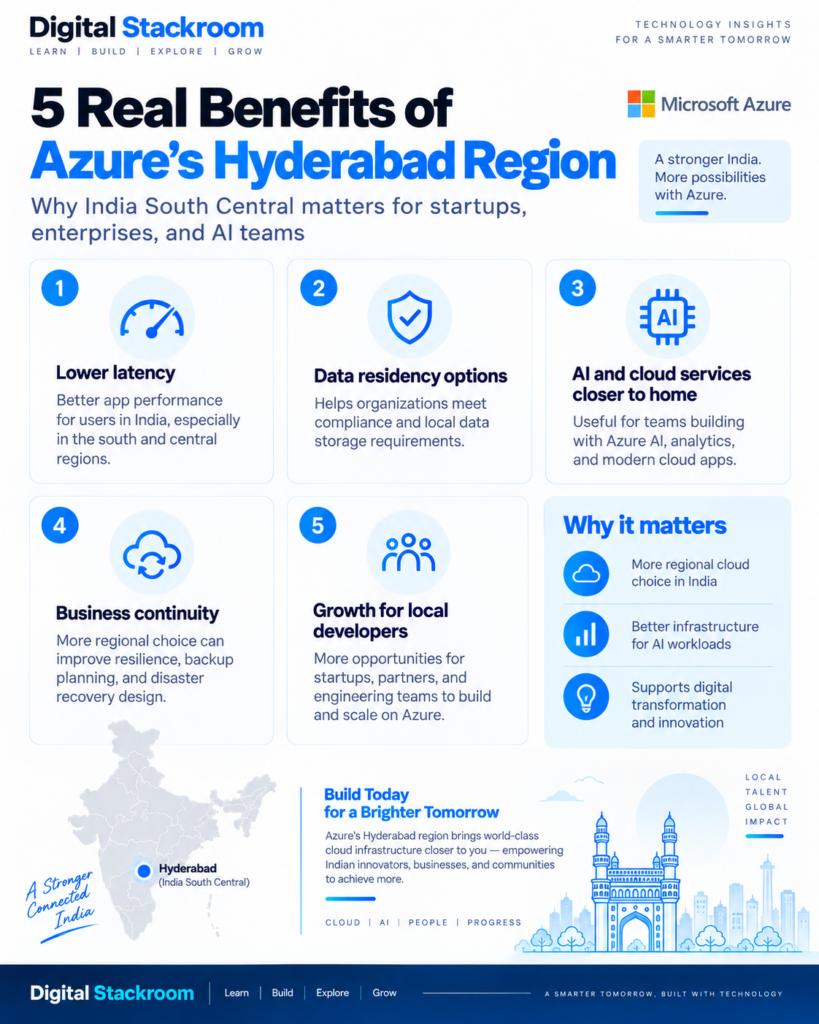
India South Central adds another variable.
For organizations with users, offices, systems, or operational workloads concentrated around Hyderabad and surrounding regions, the new location may reduce network distance compared with deployments located farther away.
But lower geographic distance does not automatically guarantee better application performance.
Actual latency depends on:
- ISP routing
- private connectivity
- application design
- database location
- API dependencies
- CDN architecture
- cross-region calls
- corporate networks
- service architecture
Instead of assuming Hyderabad will be faster, teams should benchmark it.
A useful test would measure:
Current region → user latency
versus
India South Central → user latency
while also checking database calls, external APIs, and cross-region dependencies.
Data Residency Becomes More Flexible—but Not Automatic Compliance
Microsoft is emphasizing sovereignty and data residency as part of the India South Central launch.
The company says its Indian regions provide controls intended to help organizations address requirements related to India’s data protection, cybersecurity, and sector-specific frameworks, including expectations connected with MeitY, the Digital Personal Data Protection framework, RBI requirements, and CERT-In guidance.
That can be particularly relevant for organizations in areas such as:
- financial services
- insurance
- healthcare
- government
- critical infrastructure
- regulated enterprise environments
But there is an important distinction:
choosing an Indian Azure region does not automatically make an application compliant.
Microsoft itself notes that customers remain responsible for determining which requirements apply to their workloads.
Compliance depends on the complete architecture, including:
- where data is stored
- where backups reside
- encryption
- key ownership
- identity controls
- operational access
- logs
- disaster recovery
- third-party processors
- cross-border data movement
Region selection is one control among many.
Hyderabad Is Becoming a Multi-Cloud Infrastructure Location
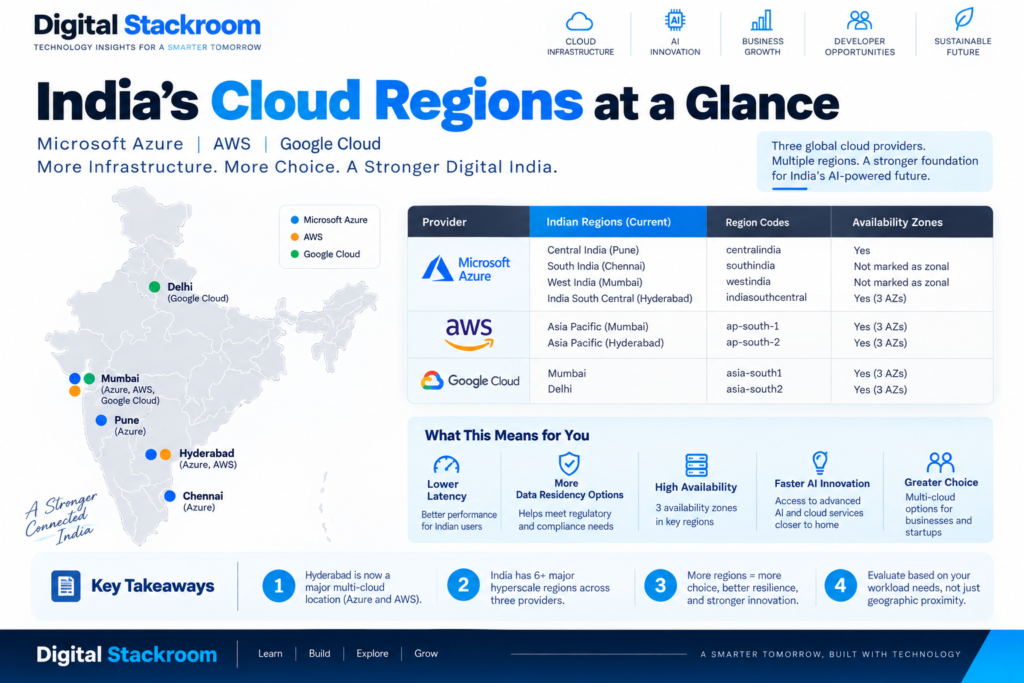
One particularly interesting development is that Microsoft is not the first hyperscaler to establish a major cloud region in Hyderabad.
AWS already operates its Asia Pacific (Hyderabad) region, identified as ap-south-2.
AWS documentation currently lists both:
- Mumbai —
ap-south-1 - Hyderabad —
ap-south-2
with three Availability Zones in each region.
That means Hyderabad now gives enterprises another local hyperscale choice.
Azure
India South Central — Hyderabad
AWS
Asia Pacific Hyderabad — ap-south-2
Google Cloud’s current Indian regional footprint is different. Its primary regions remain:
- Mumbai —
asia-south1 - Delhi —
asia-south2
with three zones documented for each.
So the Indian hyperscale map increasingly looks like this:
| Provider | Major current India regions |
|---|---|
| Microsoft Azure | Pune, Chennai, Mumbai, Hyderabad |
| AWS | Mumbai, Hyderabad |
| Google Cloud | Mumbai, Delhi |
This does not tell us which provider is “better.”
It shows something more important:
Indian organizations increasingly have meaningful architectural choices without automatically placing primary workloads outside the country.
What Changes for Indian Startups?
The new region could be useful for startups whose customers or operations are concentrated in southern India.
But startups should resist migrating simply because the region is new.
A small company should prioritize:
- service availability
- engineering simplicity
- pricing
- available credits
- team expertise
- latency
- reliability
If the application already runs efficiently in another Indian region, migration may create more engineering effort than benefit.
But for a new system, India South Central becomes another deployment option worth benchmarking.
This could be particularly interesting for startups building:
- AI applications
- SaaS platforms
- fintech services
- real-time APIs
- enterprise platforms
- analytics systems
- developer tools
especially when their customer base has strong south-central India usage.
What Changes for Enterprise AI Teams?
AI infrastructure is where the Hyderabad launch could become particularly important over time.
Microsoft says its Indian cloud infrastructure is increasingly AI-enabled and that additional AI capabilities will continue rolling out in India South Central.
For enterprise AI teams, that raises several possibilities:
- placing AI applications closer to Indian enterprise data
- reducing unnecessary cross-border data movement
- integrating AI services with locally deployed enterprise workloads
- improving architecture options for regulated workloads
- creating zonally resilient AI applications
- reducing long-distance dependencies between applications and AI infrastructure
But teams should verify model and GPU availability before designing around the region.
AI capacity is often more constrained than ordinary CPU infrastructure.
The correct question is not:
“Does Azure AI exist in Hyderabad?”
It is:
“Does the exact model, GPU, SKU, capacity, quota and service version our system requires exist there?”
Teams building generative AI applications can also read our beginner’s guide to generative AI for a broader explanation of how these systems work.
Should Existing Azure Workloads Move to Hyderabad?
Not automatically.
A new region is an infrastructure option, not a migration instruction.
Consider migration when there is a measurable reason.
Migration may make sense if:
- most users are geographically closer to Hyderabad
- regulations favor a particular Indian deployment design
- your workload needs zonal architecture available there
- a new application is being built from scratch
- disaster-recovery requirements benefit from additional Indian-region options
- required services are available
- testing demonstrates a meaningful latency improvement
Staying where you are may make sense if:
- the application already meets latency requirements
- key services are not yet available in India South Central
- migration would create significant downtime or engineering cost
- the existing region has mature capacity and quotas
- cross-region dependencies would offset any latency gain
- compliance requirements are already satisfied
Migration decisions should be evidence-based.
A Practical Region-Selection Framework
Instead of selecting a region based only on proximity, evaluate these seven factors.
1. Service Availability
Check every service the application needs.
One unavailable managed service can invalidate the entire architecture.
2. User Latency
Measure real user latency rather than assuming geographic proximity equals performance.
3. Availability-Zone Support
Determine which services can actually use the region’s three-zone architecture.
4. Data Residency
Identify what data must remain in India and whether connected services preserve those requirements.
5. Disaster Recovery
Determine where the secondary environment will operate.
Microsoft’s current reliability documentation pairs India South Central with Central India, but replication behavior remains service-specific.
6. Capacity and Quotas
AI accelerators, high-end VM families and specialized SKUs can have capacity constraints.
7. Cost
Compare:
- compute
- storage
- database
- networking
- inter-region data transfer
- backup
- observability
- disaster recovery
A closer region can sometimes increase costs if it causes additional cross-region traffic.
The Hidden Cost: Cross-Region Architecture
One mistake teams can make is moving only part of an application.
Imagine:
Application layer: Hyderabad
Database: Pune
Analytics: Mumbai
AI model: another region
The application may now generate additional cross-region traffic and network latency.
Instead of becoming faster, the system could become more complex.
Before migration, map every dependency:
User → CDN → Application → Database → Cache → AI service → Storage → Analytics → Third-party APIs
Then identify which components would remain outside Hyderabad.
A region migration should optimize the complete request path.
Hyderabad vs Pune: A More Important Comparison Than It Appears
Microsoft’s documentation currently pairs India South Central with Central India, located in Pune.
That creates an interesting architecture pattern.
A business could potentially use:
Primary workload: Hyderabad
and
Disaster-recovery strategy: another Indian region such as Pune, depending on service-specific replication support.
This can help organizations design resilience while maintaining an India-focused infrastructure footprint.
But teams should never assume the regional pair automatically replicates every service.
For each platform component, verify:
- replication options
- recovery point objective
- recovery time objective
- failover procedure
- backup location
- DNS switching
- dependency recovery
Disaster recovery is an application capability, not simply a checkbox attached to a paired region.
Sustainability Is Becoming an Infrastructure Requirement
Microsoft says India South Central uses high-efficiency mechanical cooling designed for effectively zero water use for cooling.
The company is also working on groundwater recharge, rainwater harvesting, and watershed projects around Hyderabad.
This matters because AI infrastructure has significantly increased attention on:
- electricity consumption
- cooling requirements
- water usage
- local grid capacity
- datacenter sustainability
For large enterprises, sustainability metrics are increasingly part of cloud procurement decisions rather than simply corporate reporting.
The environmental efficiency of AI infrastructure may eventually become another region-selection criterion alongside latency, cost and compliance.
Microsoft’s Bigger India Infrastructure Strategy
The Hyderabad launch is not an isolated datacenter announcement.
Microsoft says India South Central forms part of a broader $20.5 billion commitment to India.
It is also participating in the planned India–Southeast Asia I-2SEA submarine cable, a proposed 3,600-kilometre system connecting India with Malaysia and Singapore. Microsoft says the cable is targeted for service in 2029.
Google is also investing heavily in Indian AI infrastructure and connectivity. Earlier in 2026, Google announced its America-India Connect initiative and a five-year $15 billion India AI infrastructure investment that includes new subsea connectivity centered on Visakhapatnam.
The larger pattern is clear:
India is becoming not just a consumer of global cloud infrastructure, but an increasingly important location for building AI capacity and regional network infrastructure.
What Developers Should Test Before Using India South Central
Before committing a production system to the Microsoft Hyderabad AI cloud region, run a practical validation.
Service test
Confirm all required services exist.
Zone test
Determine whether each critical component supports Availability Zones.
Latency test
Measure response time from actual user locations.
AI availability test
Confirm:
- required AI service
- required model
- quota
- capacity
- region support
Network test
Measure dependencies between Hyderabad and other regions.
Failure test
Simulate:
- instance failure
- zone failure
- database failover
- regional dependency failure
Cost test
Estimate the complete application—not just compute.
Compliance test
Review storage, logs, backups, encryption keys, identity and data movement.
A 30-Day Evaluation Plan for Enterprise Teams
Organizations interested in India South Central do not need to migrate immediately.
A safer approach is a controlled evaluation.
Week 1 — Inventory
Document:
- applications
- dependencies
- required Azure services
- regulatory requirements
- current latency
Week 2 — Build a Small Pilot
Deploy a non-critical application or representative workload in India South Central.
Week 3 — Benchmark
Compare:
- latency
- reliability
- cost
- service availability
- developer experience
- connectivity
Week 4 — Decide
Classify workloads into:
Move now
Move later
Remain in current region
This approach avoids making an infrastructure decision based on announcement momentum.
What This Means for India’s Cloud Competition
The most important consequence of the Hyderabad launch may not be any single Azure feature.
It is increased infrastructure choice.
AWS already operates a three-zone Hyderabad region. Microsoft now has its own three-zone Hyderabad region. Google operates three-zone regions in Mumbai and Delhi.
That increases pressure on cloud providers to compete on more than global service catalogs.
In India, competition increasingly includes:
- local AI capacity
- availability zones
- pricing
- GPU access
- data residency
- network connectivity
- compliance capabilities
- sovereign-cloud controls
- local support
- sustainability
For customers, that competition can create more architectural options.
Frequently Asked Questions
What is Microsoft India South Central?
India South Central is Microsoft Azure’s new Hyderabad cloud region.
Microsoft’s region documentation identifies it as indiasouthcentral.
Is the Microsoft Hyderabad cloud region live?
Yes.
Microsoft announced India South Central as live on September 21, 2026.
Does the Hyderabad Azure region have Availability Zones?
Yes.
Microsoft documentation currently lists Availability Zone support for India South Central.
Does Microsoft Foundry already run completely from Hyderabad?
Do not assume the full service portfolio is available immediately.
Microsoft says additional Azure and AI capabilities, including Microsoft Foundry, will roll out progressively.
Will Hyderabad automatically provide lower latency?
Not necessarily.
Physical proximity can reduce network distance, but real latency depends on networking, user location, application architecture, database placement and external dependencies.
Benchmark before migrating.
Does using an Indian Azure region guarantee compliance?
No.
Local infrastructure can support data-residency and governance strategies, but organizations remain responsible for determining and implementing their applicable regulatory requirements.
Does AWS also have a Hyderabad region?
Yes.
AWS operates ap-south-2, its Asia Pacific Hyderabad region, with three Availability Zones.
Does Google Cloud have a Hyderabad region?
Google Cloud’s currently documented India regions are Mumbai (asia-south1) and Delhi (asia-south2).
Final Thoughts
Microsoft’s Hyderabad launch is significant, but the most useful way to look at it is not as another cloud announcement.
It changes the workload-placement options available inside India.
The Microsoft Hyderabad AI cloud region gives developers and enterprises a new three-zone Azure location, additional India-based infrastructure capacity, and a foundation for expanding AI services.
But a new region should not trigger automatic migration.
Teams should evaluate:
service availability → latency → resilience → residency → capacity → cost → disaster recovery
before making a decision.
For some workloads, Hyderabad could become the obvious deployment location.
For others, Pune, Chennai, Mumbai—or even another cloud provider—may remain the better architecture.
The real value of India South Central is therefore not that every workload should move to Hyderabad.
The Microsoft Hyderabad AI cloud region expands the infrastructure choices available to Indian cloud and AI teams, but each workload still needs its own technical evaluation.
It is that Indian technology teams now have one more serious infrastructure option when deciding where their next generation of cloud and AI systems should run.