
Updated October 2026
For much of the generative AI race, the industry focused on one question:
Which company has the smartest model?
That question still matters.
But developers building real products increasingly face another question:
How much useful intelligence can I afford to run millions of times?
That question becomes especially important once AI stops being an occasional assistant and starts becoming part of everyday software infrastructure.
An AI agent may inspect files, search information, call tools, write code, verify results, revise its plan, and repeat those steps several times before completing one user request.
At that point, model economics matter almost as much as raw intelligence.
OpenAI’s GPT-6 family makes this trade-off unusually clear.
On September 22, 2026, OpenAI introduced GPT-6 Sol and GPT-6 Luna alongside its higher-end GPT-6 Astra model.
Then, only one week later, OpenAI released GPT-6.1 Sol, a significantly improved Sol model designed to approach Astra-level performance on demanding coding, computer-use, and professional tasks while retaining Sol’s much lower standard token prices.
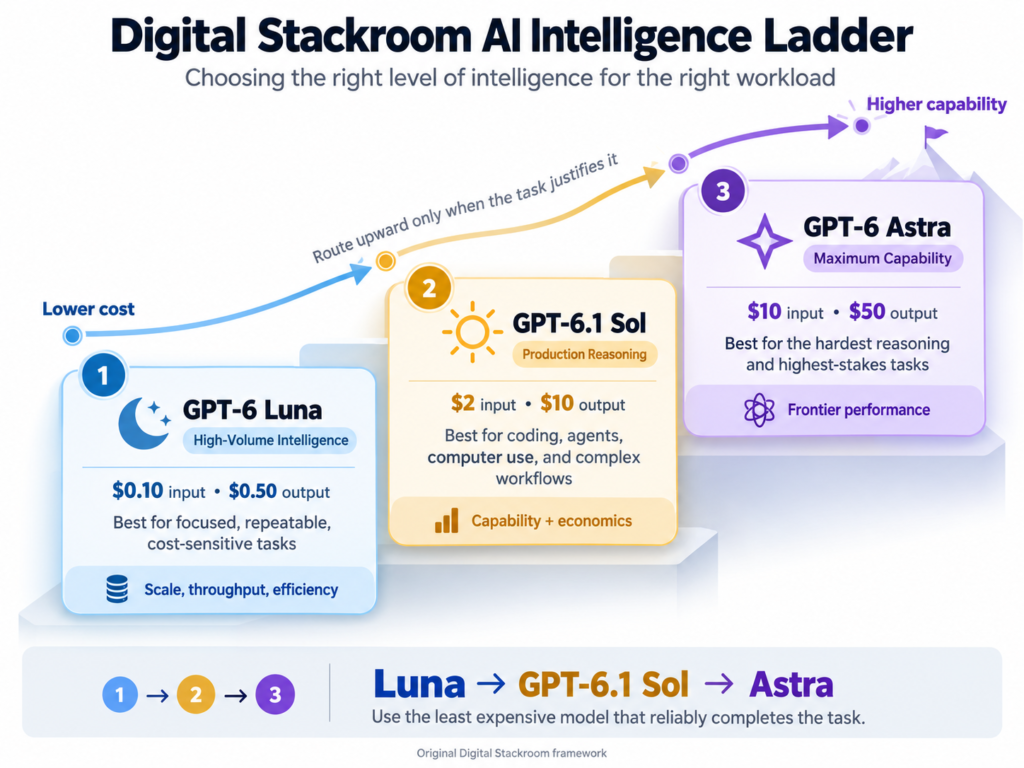
The current GPT-6 lineup therefore gives developers three broad economic tiers:
GPT-6 Luna for efficient high-volume work.
GPT-6.1 Sol for demanding production workloads where capability and economics both matter.
GPT-6 Astra for the hardest tasks where maximum capability justifies the additional cost.
The important change is not simply that OpenAI now offers several models.
It is that developers can increasingly treat model intelligence as something that can be routed according to task difficulty.
That has major implications for AI application architecture.
The Short Answer
OpenAI’s current GPT-6 model strategy can be summarized like this:
| Model | Standard Input / 1M Tokens | Standard Output / 1M Tokens | Best Fit |
|---|---|---|---|
| GPT-6 Luna | $0.10 | $0.50 | Focused, high-volume tasks |
| GPT-6.1 Sol | $2.00 | $10.00 | Complex coding, computer use, agents, professional work |
| GPT-6 Astra | $10.00 | $50.00 | Hardest reasoning and highest-capability workloads |
This means GPT-6.1 Sol costs roughly one-fifth of Astra’s standard input and output prices, while Luna costs a small fraction of either.
That does not mean every task should automatically use Luna.
The correct question is:
What is the least expensive model that completes this task reliably enough for production?
That is a very different optimization problem from simply choosing the smartest available model.
Table of Contents
What Changed Since the Original GPT-6 Sol Launch?
The original GPT-6 Sol remains available.
But OpenAI now identifies GPT-6.1 Sol as the newer Sol model.
The upgrade is important because OpenAI reports meaningful improvements in areas that matter heavily for agentic software:
software engineering
computer use
professional document work
multi-step business workflows
The pricing story is equally important.
Original GPT-6 Sol:
$2 input
$0.20 cached input
$10 output
per million tokens under standard short-context pricing.
GPT-6.1 Sol:
$2 input
$0.10 cached input
$10 output
The headline input and output prices remain unchanged.
But cached input is now 50% cheaper than it was on the original Sol.
For agent systems that repeatedly reuse instructions, repository context, business rules, tool descriptions, or other stable information, that difference can matter substantially.
GPT-6 Astra vs GPT-6.1 Sol vs GPT-6 Luna
The current family can be understood as three different economic operating points.
GPT-6 Luna
Luna is OpenAI’s most efficient current GPT-6 model for focused, high-volume work.
It is suitable for workloads where the task is well-defined and the application may need to execute the same class of operation thousands or millions of times.
Examples include classification, extraction, routine summarization, structured transformation, simple routing, and other repeatable tasks.
The priority is:
cost + throughput
GPT-6.1 Sol
GPT-6.1 Sol occupies the middle of the family.
It is intended for more difficult work such as coding, computer use, document reasoning, multi-step workflows, and sophisticated agents.
The priority is:
capability + economics
This may be the most interesting tier for many production AI applications because it sits between inexpensive high-volume inference and maximum-capability frontier reasoning.
GPT-6 Astra
Astra remains OpenAI’s highest-capability GPT-6 model.
It is intended for the most demanding reasoning, coding, computer-use, research, and professional workflows.
The priority is:
capability first
The important idea is that these models do not need to compete for one universal role.
They can operate together inside the same application.
Digital Stackroom Framework: The AI Intelligence Ladder
A useful way to think about the GPT-6 family is as an intelligence ladder.
Level 1 — High-Volume Intelligence
GPT-6 Luna
Use when the task is predictable, repeatable, and highly sensitive to cost.
The question is:
Can we complete this task reliably at very large scale?
Level 2 — Production Reasoning
GPT-6.1 Sol
Use when the task needs stronger reasoning, coding, tool use, computer interaction, or multi-step execution.
The question is:
Can we achieve near-frontier capability without paying frontier-model prices on every request?
Level 3 — Maximum Capability
GPT-6 Astra
Use when failure is expensive or the problem is difficult enough that the strongest available reasoning materially improves the outcome.
The question is:
Does this task justify maximum capability?
The application can therefore move work upward only when necessary.
Luna
↓
GPT-6.1 Sol
↓
Astra
This makes model selection part of software architecture rather than simply a configuration setting.
GPT-6.1 Sol Strengthens the Case for Agentic Software
Agents consume models differently from ordinary chat applications.
A chatbot interaction may involve:
one question
↓
one answer
An agentic task may involve:
objective
↓
planning
↓
file inspection
↓
tool call
↓
observation
↓
reasoning
↓
second tool call
↓
verification
↓
revision
↓
final response
One user request can therefore produce many model turns.
That means small differences in inference cost can become large infrastructure differences once the system is operating continuously.
GPT-6.1 Sol is especially relevant in this environment because OpenAI positions it for complex coding, computer use, and professional work while charging one-fifth of Astra’s standard input and output token prices.
Why Cached Input Matters More for Agents
Caching may sound like a technical pricing detail.
For agentic systems, it can become an architectural consideration.
Imagine an agent repeatedly receiving:
- long system instructions
- application policies
- API documentation
- repository context
- tool schemas
- company procedures
- product catalogs
Much of that context may remain stable across requests.
If the platform can reuse cached context instead of processing the same content at the full uncached rate each time, repeated workflows become cheaper.
GPT-6.1 Sol reduces cached input pricing from the original Sol’s $0.20 per million tokens to $0.10.
That means developers should evaluate not only:
input price
and:
output price
but also:
how much of the workload can be reused efficiently across repeated agent runs?
GPT-6 Luna Makes Always-On AI More Practical
Luna’s pricing changes a different part of the design space.
At:
$0.10 per million input tokens
and:
$0.50 per million output tokens
the model can potentially support workloads where calling a stronger frontier model on every event would be economically difficult.
Examples might include:
classifying every support request
extracting metadata from every incoming document
triaging every application event
summarizing large streams of routine information
routing work to other models
performing inexpensive first-pass analysis
That creates the possibility of using AI continuously rather than selectively.
Model Routing May Become a Core AI Architecture Pattern
One of the most useful consequences of a multi-tier model family is routing.
Instead of choosing one model for an entire product, the system can select a model according to the task.
Consider customer support.
A routine request such as:
“Where is my order?”
may be handled by Luna.
A complicated billing dispute may be routed to GPT-6.1 Sol.
A highly unusual enterprise account problem involving extensive contracts and complex reasoning might justify Astra.
The architecture becomes:
Request
↓
Evaluate complexity and risk
↓
Choose model
↓
Complete task
↓
Escalate if confidence or performance is insufficient
This approach can reduce cost without forcing every request onto the weakest model.
Digital Stackroom Model-Routing Framework
A practical routing strategy can use three stages.
Start With the Lowest-Cost Viable Model
Ask:
Can Luna complete this class of task with the required reliability?
If yes, use Luna.
If no, escalate.
Escalate for Complexity
Ask:
Can GPT-6.1 Sol complete the task reliably?
If yes, use Sol.
For many production applications, this may become the primary reasoning tier.
Escalate for Exceptional Difficulty
Use Astra when the additional intelligence materially improves the outcome enough to justify the additional cost.
The important word is materially.
Developers should not pay five times more simply because one model is theoretically stronger.
They should measure whether that strength actually changes the success rate for their workload.
Route by Task, Not by User
A common mistake would be assigning models according to organizational status.
For example:
executives → Astra
employees → Sol
customers → Luna
That is usually the wrong abstraction.
A simple executive request may be easy.
A difficult engineering problem from a junior developer may require the strongest available reasoning.
Route according to:
task difficulty
risk
latency requirements
cost
quality requirements
—not job title.
Prompt Length Is Not the Same as Task Difficulty
Large prompts can contain simple work.
Small prompts can hide extremely difficult reasoning.
Consider:
“Extract every invoice number from these documents.”
The context may be very large.
The reasoning may be straightforward.
Now compare:
“Find the concurrency bug in this small function.”
The input could be only a few hundred tokens.
The reasoning could be extremely difficult.
Model routing should therefore avoid assuming:
large context = strong model
or:
small context = cheap model
Context size and reasoning complexity are different dimensions.
The Million-Token Context Window Changes Architecture
GPT-6 Astra, GPT-6.1 Sol, and GPT-6 Luna each support context windows of approximately 1.05 million tokens in OpenAI’s current model catalog.
That is a huge amount of context.
But a large context window should not become permission to send everything into every request.
More context can increase:
- cost
- latency
- irrelevant information
- retrieval noise
In many applications, the better architecture remains:
search
↓
retrieve relevant information
↓
send the useful context
A million-token window is valuable when the task genuinely needs it.
It should not replace good retrieval design.
Long Context Costs More
Another detail developers should account for is long-context pricing.
For these GPT-6 models, requests exceeding 272,000 input tokens are priced at higher rates for the full request.
That means a large context window expands what is technically possible, but it does not make huge prompts economically free.
Developers should therefore evaluate:
Do we really need the entire repository?
Do we need all historical messages?
Can retrieval narrow the context?
Can caching help?
Context engineering remains an important part of AI cost optimization.
Cost per Token Is Not the Best Metric
Suppose Model A costs half as much as Model B.
If Model A succeeds only 70% of the time while Model B succeeds 98% of the time, the cheaper token price may not translate into a cheaper business outcome.
Failures can create:
- retries
- human review
- tool-call repetition
- customer frustration
- incorrect automation
- escalation costs
A better metric is:
cost per successful task
For example:
Total model + tool + retry cost
÷
successfully completed workflows
This gives teams a much more realistic view of model economics.
Build an Evaluation Set Before Switching Models
Teams should avoid migrating workloads simply because a newly released model looks cheaper or scores well on public benchmarks.
Start with representative production tasks.
Evaluate each candidate model on:
| Metric | What to Measure |
|---|---|
| Task success | Did it complete the job correctly? |
| Accuracy | Was the output factually or logically correct? |
| Tool use | Did it select and call tools correctly? |
| Latency | How long did the workflow take? |
| Token use | How much inference did it consume? |
| Retries | How often did it fail and need another attempt? |
| Human correction | How much manual work remained? |
| Total cost | What did a successful task actually cost? |
Then compare Luna, GPT-6.1 Sol, and Astra where appropriate.
The correct model may differ by workflow.
Vendor Benchmarks Are Useful—but Production Workloads Matter More
OpenAI reports meaningful improvements for GPT-6.1 Sol over the original Sol across coding, professional document work, computer use, and multi-step automation.
Those results are useful.
But a production team may care about something completely different.
Your application may depend on:
structured JSON reliability
SQL correctness
customer tone
tool selection
specific languages
latency
domain terminology
rare edge cases
Public benchmarks help identify candidates.
Your own evaluation determines the production model.
What This Means for Startups
Lower inference costs change what small teams can attempt.
A startup can experiment with:
document processing
customer support automation
coding assistants
internal agents
workflow automation
without automatically requiring frontier-model pricing for every interaction.
That shifts the competitive question.
Instead of:
“Can we afford enough AI?”
the more important question becomes:
“Can we design a product that uses the right intelligence efficiently?”
Cheap inference reduces one barrier.
It does not replace good product design.
What This Means for Enterprises
Enterprises operate at a different scale.
A tiny cost difference multiplied across millions of transactions can become a significant infrastructure budget.
Imagine AI used across:
support
sales
operations
software engineering
finance
document processing
internal search
workflow automation
The organization may generate enormous model consumption.
Model routing therefore becomes similar to cloud resource optimization.
Not every workload needs the most expensive compute tier.
The objective becomes matching capability to workload.
AI Cost Optimization Is Becoming a Systems Problem
Model price is only one component.
A production AI system may also pay for:
tool calls
web search
storage
vector retrieval
code execution
computer use
data transfer
retries
human review
The real optimization problem is therefore:
How much does the entire workflow cost to complete successfully?
A model that costs more per token may sometimes save money if it completes the task faster and more reliably.
A cheaper model may be better when volume is enormous and the task is simple.
There is no universal winner.
Processing Tiers Add Another Dimension
OpenAI also offers different processing modes for certain API workloads.
Depending on the model and availability, developers may trade cost against speed using options such as Batch, Flex, Fast, or Ultrafast processing.
This adds another routing dimension.
The application may eventually choose both:
which model
and:
which processing tier
according to the workload.
For example:
A nightly offline classification job may prioritize cost.
An interactive coding assistant may prioritize latency.
A mission-critical workflow may prioritize capability and responsiveness.
Model selection is becoming multidimensional.
What Changed in ChatGPT?
The GPT-6 family is no longer limited to API and specialist experiences.
On October 7, 2026, OpenAI began rolling GPT-6 into the standard ChatGPT experience globally.
Paid ChatGPT tiers use GPT-6 Sol for normal GPT-6 Chat experiences, while Free and Go use GPT-6 Luna.
OpenAI also introduced Intelligent UI, allowing ChatGPT to combine normal text responses with visual and interactive elements when useful.
This matters because Sol and Luna are no longer merely infrastructure models developers need to understand.
They are becoming part of the everyday GPT-6 experience for a much broader user base.
For API developers, however, OpenAI’s current model catalog points to GPT-6.1 Sol as the newer balanced Sol model.
That distinction is worth keeping clear:
ChatGPT product model selection and API model selection are related, but they are not always identical.
A Practical Model-Selection Strategy
A production team can use a simple process.
First, define the workflow and what successful completion means.
Then create a representative evaluation set.
Test Luna first where the task appears structured and repetitive.
Measure quality, latency, and cost.
If reliability is insufficient, evaluate GPT-6.1 Sol.
Use Astra only when the stronger model meaningfully improves the outcome.
Then monitor production results continuously.
The objective is not:
always use the cheapest model.
Nor is it:
always use the smartest model.
The objective is:
use the least expensive architecture that reliably achieves the required outcome.
Digital Stackroom Framework: Intelligence per Dollar
A useful way to think about modern AI economics is not simply:
intelligence
or:
price
but:
useful intelligence per dollar
A model becomes economically valuable when it produces an acceptable result with:
- low failure rate
- appropriate latency
- manageable token usage
- reliable tool execution
- minimal human correction
That leads to a simple principle:
Model cost should be evaluated at the task level, not the token level.
The cheapest token can still produce an expensive workflow.
The expensive token can sometimes produce the cheaper completed task.
Why This Matters for the Future of Software
For years, advanced AI was treated like a scarce computational resource.
Developers had to decide carefully where intelligence justified the cost.
Lower-cost models change that assumption.
Once inference becomes inexpensive enough, developers can begin asking whether intelligence should exist:
on every support request
inside every document workflow
behind every application event
inside every internal search
across every repetitive business process
That moves AI from:
feature
toward:
infrastructure
And when intelligence becomes infrastructure, routing becomes essential.
Frequently Asked Questions
What is GPT-6.1 Sol?
GPT-6.1 Sol is OpenAI’s newer Sol model released on September 29, 2026. It is designed for complex coding, computer use, professional work, and agentic workflows while maintaining substantially lower standard token prices than GPT-6 Astra.
Is GPT-6.1 Sol replacing GPT-6 Sol?
The original GPT-6 Sol remains available, but OpenAI’s model documentation points developers to GPT-6.1 Sol as the newer Sol model.
How much does GPT-6.1 Sol cost?
For standard short-context API usage, GPT-6.1 Sol costs $2 per million input tokens, $0.10 per million cached input tokens, and $10 per million output tokens.
How is GPT-6.1 Sol pricing different from GPT-6 Sol?
Standard input and output prices remain the same. Cached input is reduced from $0.20 per million tokens on GPT-6 Sol to $0.10 on GPT-6.1 Sol.
How much does GPT-6 Luna cost?
GPT-6 Luna costs $0.10 per million standard input tokens, $0.01 per million cached input tokens, and $0.50 per million output tokens for short-context requests.
How much does GPT-6 Astra cost?
GPT-6 Astra’s standard short-context pricing is $10 per million input tokens and $50 per million output tokens.
Which GPT-6 model should developers use?
OpenAI currently positions Astra for the hardest work, GPT-6.1 Sol for balancing intelligence and cost, and Luna for focused high-volume workloads. Production teams should validate the choice using their own workload.
What context window do GPT-6.1 Sol and Luna support?
OpenAI’s current model catalog lists a context window of approximately 1.05 million tokens and maximum output of 128,000 tokens for both.
Does GPT-6.1 Sol support tool use?
Yes. OpenAI’s current documentation lists support through the Responses API for tools including functions, web search, file search, computer use, code execution, and other supported tool capabilities.
Is Luna always the cheapest choice?
Not necessarily. Luna has the lowest token price, but a stronger model may be cheaper at the workflow level if it reduces failures, retries, or human intervention.
Should developers always start with Luna?
Luna is a good candidate for well-defined high-volume tasks, but teams should route according to task complexity and quality requirements rather than applying one model universally.
Which GPT-6 models are used in ChatGPT?
As of October 2026, OpenAI says paid ChatGPT plans use GPT-6 Sol for standard GPT-6 Chat experiences while Free and Go use GPT-6 Luna. API developers should separately consult the current model catalog, which recommends GPT-6.1 Sol as the newer balanced Sol model.
Final Thoughts
The most important story behind GPT-6 Luna and GPT-6.1 Sol is not simply that OpenAI released cheaper AI models.
It is that AI application architecture is beginning to resemble other forms of computing infrastructure.
Different workloads require different levels of resources.
You would not use the most expensive cloud machine for every background job.
Similarly, developers increasingly do not need the most expensive model for every AI request.
The emerging architecture looks like:
Luna
for high-volume structured work
↓
GPT-6.1 Sol
for complex production reasoning
↓
Astra
for exceptional difficulty
This creates an economic hierarchy for machine intelligence.
As intelligence becomes cheaper, developers can use it more frequently.
As they use it more frequently, routing, caching, evaluation, context design, and cost monitoring become increasingly important.
The question is therefore shifting from:
“Which AI model is the smartest?”
toward:
“What level of intelligence does this task actually require?”
That may be one of the most important design questions for the next generation of AI software.
Because once intelligence becomes cheap enough to run continuously, the competitive advantage will not come from using the strongest model everywhere.
It will come from using the right intelligence, at the right time, for the right cost.
Official Sources & Further Reading
OpenAI — Introducing GPT-6 Sol and Luna
Original September 22, 2026 announcement introducing the Sol and Luna model tiers.
OpenAI — Introducing GPT-6.1 Sol
September 29, 2026 announcement covering the newer Sol model, performance improvements, and updated cached-input economics.
OpenAI API — GPT-6.1 Sol Model Documentation
Current API capabilities, pricing, reasoning settings, context window, tools, and processing tiers.
OpenAI API — GPT-6 Luna Model Documentation
Current Luna pricing, context window, supported tools, and API capabilities.
OpenAI — GPT-6 and Intelligent UI in ChatGPT
October 2026 product update covering the broader GPT-6 rollout across ChatGPT.