

Updated October 2026
A few years ago, choosing an AI model was mostly a capability decision.
You looked for the smartest model you could afford, connected it to your application, and moved on.
That approach is becoming harder to justify.
Modern AI applications may call a model dozens of times during a single task. Coding agents inspect files, search repositories, write code, run tests, read failures, revise their approach, and try again. Enterprise agents may search documents, call APIs, update systems, and ask other agents for help.
In that environment, a model that is slightly better but twice as expensive can dramatically change the economics of a product.
That is why the comparison between OpenAI’s GPT-6.1 Sol and Anthropic’s Claude Opus 5.5 is more interesting than a simple benchmark contest.
Both are built for serious work.
Both target coding and agentic workflows.
Both can handle complex professional tasks.
But they occupy surprisingly different positions economically.
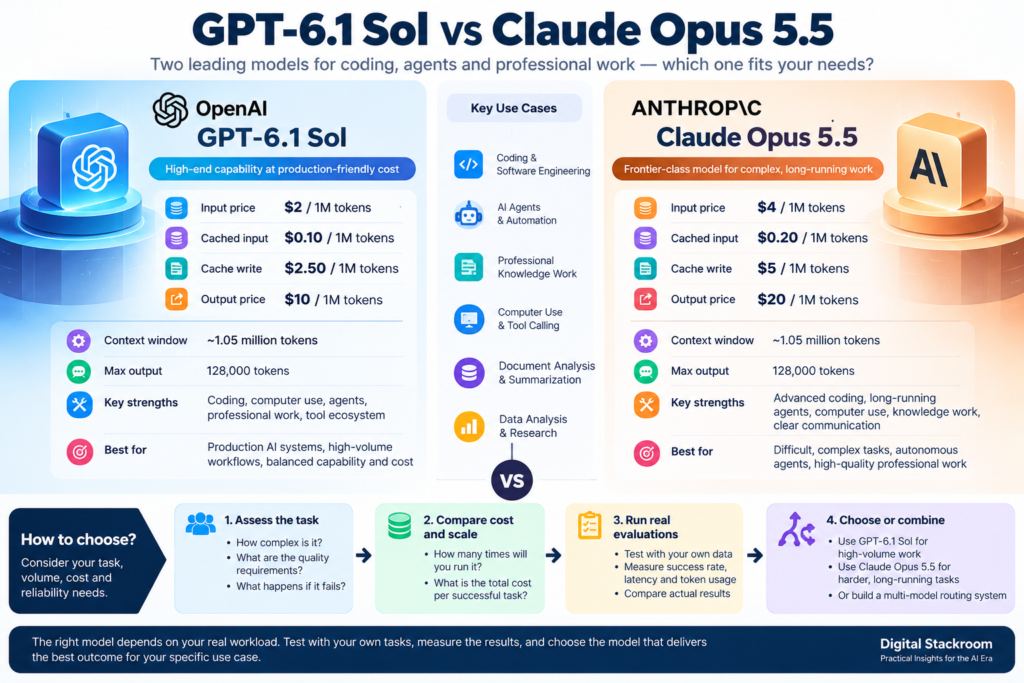
GPT-6.1 Sol currently costs $2 per million input tokens and $10 per million output tokens under OpenAI’s standard short-context pricing.
Claude Opus 5.5 costs $4 per million input tokens and $20 per million output tokens.
On the pricing page alone, Claude is exactly twice as expensive.
That sounds like an easy decision.
It isn’t.
The model that charges fewer dollars per token is not automatically the model that costs less to complete your work.
And that is where this comparison becomes useful.
First, an important update: this is no longer GPT-6 Sol vs Opus 5.5
When I originally wrote this comparison in September, GPT-6 Sol was OpenAI’s current Sol model.
That changed quickly.
OpenAI released GPT-6.1 Sol on September 29, 2026, only a week after the original Sol launch.
OpenAI now describes GPT-6.1 Sol as delivering near-Astra performance for complex work at a lower cost and specifically positions it for coding, computer use, professional work, and agentic systems.
The headline token prices stayed the same as the original Sol:
$2 input / $10 output per million tokens
but cached input dropped from $0.20 to $0.10 per million tokens.
Anthropic’s side of the comparison has evolved too.
Since launching Opus 5.5, Anthropic has also released Sonnet 5.5 and Haiku 5.5. But Opus 5.5 remains the company’s top Opus model and is positioned as its strongest option for difficult coding, long-running agents, computer use, and professional knowledge work.
So the useful comparison today is:
GPT-6.1 Sol vs Claude Opus 5.5
—not the original GPT-6 Sol.
The comparison in one table
Before getting into the details, here is the part most developers will want first.
| GPT-6.1 Sol | Claude Opus 5.5 | |
|---|---|---|
| Standard input price | $2 / 1M tokens | $4 / 1M tokens |
| Cached input / cache read | $0.10 / 1M | $0.20 / 1M |
| Cache write | $2.50 / 1M | $5 / 1M |
| Standard output price | $10 / 1M | $20 / 1M |
| Positioning | High-end production reasoning at lower cost than Astra | Anthropic’s strongest Opus model for coding and knowledge work |
| Coding | Strong focus | Strong focus |
| Long-running agents | Yes | Yes |
| Computer use | Yes | Yes |
| Professional work | Yes | Yes |
| Model philosophy | Strong capability with aggressive production economics | Frontier-class work with emphasis on coding, autonomy, and clear communication |
The first thing that jumps out is obvious:
Opus 5.5’s published token prices are roughly 2× GPT-6.1 Sol’s.
But I would not choose a model based on that table alone.
The $2 vs $4 Question Is Too Simple
Suppose an agent processes:
- 1 million input tokens
- 200,000 output tokens
and we ignore caching, tools, long-context premiums, and other fees for a moment.
With GPT-6.1 Sol:
Input: $2.00
Output: 0.2 × $10 = $2.00
Approximate model cost: $4
With Claude Opus 5.5:
Input: $4.00
Output: 0.2 × $20 = $4.00
Approximate model cost: $8
At that usage pattern, Claude costs twice as much.
Now imagine Sol needs three attempts to complete a difficult task while Opus completes it once.
The calculation changes immediately.
This is why I increasingly dislike comparisons based only on price per million tokens.
The better question is:
How much does it cost to get one correct, usable result?
That includes more than tokens.
It includes failed attempts, retries, tool calls, latency, human corrections, and sometimes the cost of an engineer cleaning up a bad result.
Table of Contents
Where GPT-6.1 Sol Makes the Strongest Case
The most compelling thing about GPT-6.1 Sol is not that it is OpenAI’s smartest model.
It isn’t.
Astra occupies that role.
The interesting part is how much capability OpenAI is trying to put into the middle price tier.
GPT-6.1 Sol supports a context window of roughly 1.05 million tokens, up to 128,000 output tokens, image input, structured outputs, function calling, web search, file search, computer use, and other tooling through OpenAI’s Responses API.
OpenAI positions it as the model to use when you want to balance intelligence and cost.
That makes Sol attractive for systems where the model is not used occasionally but constantly.
Think about:
- coding agents running all day
- internal enterprise assistants
- document-processing systems
- research agents
- computer-use workflows
- multi-agent systems
- operational automation
If each workflow contains ten or twenty model calls, a 2× token-price difference becomes difficult to ignore.
For many teams, Sol may be strong enough that the right question is no longer:
“Can it beat every frontier model?”
It is:
“Is it good enough that paying substantially more does not improve our actual outcome?”
That is a very different standard.
Where Claude Opus 5.5 Makes Its Case
Anthropic is selling Opus 5.5 on a different idea.
It is not trying to be the inexpensive model.
It is trying to be a model you trust with hard, long-running work.
Anthropic describes Opus 5.5 as its strongest Opus model for agentic coding and as a daily driver for serious coding and knowledge work.
The company highlights codebase-wide migrations, long autonomous sessions, multi-tool agents, professional document creation, financial analysis, computer use, and sustained work that may continue for hours.
There is also one characteristic that is difficult to capture in a pricing table: communication quality.
Anthropic specifically says it redesigned Opus 5.5 to communicate more naturally, put important information earlier, use less unnecessary jargon, and produce work that requires less editing.
That may sound cosmetic until you use an agent for several hours.
In long sessions, readability becomes part of performance.
A technically correct model that produces confusing progress updates, oversized explanations, or difficult-to-review changes creates work for the person supervising it.
So when evaluating Opus, I would measure more than whether it eventually reaches the right answer.
I would look at:
How understandable is the work while it is happening?
Coding Is Where the Comparison Gets Interesting
Both companies are clearly competing for developers.
But coding model comparisons are unusually difficult.
A benchmark may tell you whether a model solved a predefined task.
Production software work looks different.
A real coding agent may need to:
read an unfamiliar repository,
understand architecture,
identify the correct files,
change several components,
respect existing conventions,
run tests,
notice that its first approach failed,
debug the failure,
update documentation,
and avoid breaking something elsewhere.
What matters is not just code generation.
It is software-engineering persistence.
Anthropic has published impressive results for Opus 5.5 on agentic coding evaluations and reports from early customers running large migrations and long autonomous sessions.
OpenAI positions GPT-6.1 Sol specifically for complex coding and professional work and describes it as approaching Astra-level capability at a much lower price.
What we do not yet have is enough independent, apples-to-apples production evidence to declare that one model universally wins.
And I don’t think pretending otherwise helps anyone.
If your product depends heavily on coding agents, run both models against your repositories.
Public benchmarks are useful for deciding what to test.
Your codebase decides what to deploy.
I Would Test Them With Real Engineering Work
If I were choosing between these models for a development team, I would not start with:
“Write a Python function that sorts a list.”
Both models should handle that without difficulty.
I would build an evaluation set from real work:
Bug investigation
Give the model an actual defect where the root cause is not obvious.
Multi-file feature
Require coordinated changes across several components.
Regression avoidance
Check whether the change passes existing tests without breaking unrelated behavior.
Code review
Give it a realistic pull request containing subtle problems.
Repository navigation
Measure how efficiently it finds the relevant code.
Recovery
Deliberately include a failing test or misleading clue and see whether the model changes direction intelligently.
Then measure:
- completion rate
- number of tool calls
- tokens consumed
- elapsed time
- test success
- human corrections
- cost per successful task
That last metric is the one I care about most.
Agents Change the Economics More Than Chat Does
The difference between $2 and $4 per million input tokens may not matter much if a person asks ten questions a day.
It matters much more when an agent is running continuously.
Consider a software agent working on a feature.
It may:
- inspect the repository
- read several files
- search for related code
- propose a plan
- modify files
- run tests
- inspect failures
- change the implementation
- run tests again
- review its own diff
One “task” may actually contain dozens of inference events.
This is why agent economics are different from chatbot economics.
The important cost unit stops being:
price per message
and becomes:
price per completed workflow
GPT-6.1 Sol’s lower pricing can become a major advantage at scale.
Opus 5.5 can still be cheaper at the workflow level if it takes fewer steps, makes fewer mistakes, or requires less human supervision.
There is no shortcut around measuring both.
Caching Deserves More Attention Than It Gets
Both models are designed for workloads where significant context may be reused.
That matters for agents.
A coding agent may repeatedly receive:
- repository instructions
- architecture documents
- coding standards
- tool schemas
- project context
An enterprise agent may repeatedly receive:
- policies
- workflow instructions
- customer context
- product documentation
GPT-6.1 Sol currently prices cached input at $0.10 per million tokens.
Anthropic lists Opus 5.5 cache reads at $0.20 per million tokens.
The same 2× relationship appears again.
But caching is not merely a pricing feature.
It can influence how you design prompts and agent memory.
If a large block of stable context can be reused efficiently, an architecture that initially appears expensive can become much cheaper over repeated runs.
Teams building serious agents should track cache hit rates alongside ordinary token usage.
One Area Where Sol Has a Very Clear Architectural Appeal: Tooling
GPT-6.1 Sol sits inside OpenAI’s Responses API ecosystem and supports built-in capabilities including functions, web search, file search, and computer use.
That makes it attractive if your application already relies heavily on the OpenAI agent stack.
You can keep planning, reasoning, retrieval, browsing, files, tool execution, and computer interaction inside a relatively unified environment.
This does not mean Claude lacks agent tooling.
Anthropic has invested heavily in Claude Code, tool use, subagents, memory, computer use, and long-running agent workflows.
The difference is more architectural than simply “Model A has tools and Model B doesn’t.”
The important question is:
Which ecosystem matches the rest of the system you are building?
Model quality matters.
Platform fit matters too.
Claude’s Strongest Argument May Be Long-Horizon Work
There is a type of task that does not fit nicely into benchmark tables:
“Take responsibility for this complicated project and keep working until it is actually finished.”
This is where Anthropic is pushing Opus 5.5 particularly hard.
The model is designed for long-running, multi-step work where it needs to plan, coordinate tools or subagents, check itself, and continue without constant human intervention.
If your workload involves large migrations, difficult debugging sessions, research projects, detailed financial work, or agents operating for hours rather than seconds, I would test Opus 5.5 very seriously.
Paying more per token can be reasonable if you need less supervision.
The expensive model is not necessarily expensive if it gives an engineer several hours back.
Sol’s Strongest Argument May Be Production Scale
Now flip the situation.
Imagine your company handles:
50,000 agent workflows every day.
At that point, token economics stop being an interesting spreadsheet exercise.
They become part of your infrastructure budget.
Even a small difference in average workflow cost can translate into meaningful monthly spend.
GPT-6.1 Sol looks particularly compelling here because OpenAI is explicitly trying to deliver high-end capability without Astra-level pricing.
For high-volume products, I would likely begin evaluation with Sol and ask:
“Where does this model fail badly enough that we need to escalate?”
rather than automatically putting the most expensive model on every request.
The Best Architecture May Use Both
This is the part of AI model comparisons that is often missed.
You may not actually need to choose one model.
Imagine an engineering agent.
Most tasks go to GPT-6.1 Sol.
The system monitors:
- repeated failures
- unusually complex repositories
- confidence signals
- number of retries
- task duration
If a task becomes unusually difficult, it can be escalated to Claude Opus 5.5.
Or the architecture could be reversed if Opus performs better on your primary workload and Sol becomes the cheaper worker for simpler sub-tasks.
A multi-model system might look like:
Incoming task
↓
Estimate complexity
↓
Default production model
↓
Check outcome
↓
Escalate difficult cases
That is much more interesting than declaring a single permanent winner.
A Better Way to Choose: Four Questions
Instead of asking “Which model is better?”, I would ask four questions.
1. How difficult is the task?
Routine extraction and straightforward coding do not need the same intelligence as architecture decisions, difficult debugging, or open-ended research.
2. How many times will you run it?
A model used 100 times per month can be evaluated differently from one used 10 million times.
3. How expensive is failure?
A poor internal summary is annoying.
A bad production deployment, financial analysis, or customer-facing action can be much more costly.
4. How much human supervision is available?
If a developer reviews every step, slightly weaker automation may be acceptable.
If the agent is expected to work for hours unattended, reliability and self-correction become much more valuable.
Those four questions tell me more than a benchmark leaderboard.
My Practical Starting Point
If I were building a new application today, I would use this approach.
For high-volume production agents, I would start by evaluating GPT-6.1 Sol.
The economics are simply too attractive to ignore.
For the hardest coding or long-running autonomous work, I would test Claude Opus 5.5 alongside it.
For extremely difficult tasks where maximum OpenAI capability is required, Astra belongs in the evaluation too.
Then I would build a routing policy from actual results.
Not from brand preference.
Not from a single benchmark.
Not from whichever model happened to trend on social media that week.
A Small Cost Experiment
Here is a simple way to make the decision more concrete.
Suppose your team processes 100,000 tasks.
Each task averages:
20,000 input tokens
and:
4,000 output tokens
Ignoring caching, tools, long-context pricing, retries, and discounts:
GPT-6.1 Sol
Input:
100,000 × 20,000 = 2 billion tokens
2,000 × $2 = $4,000
Output:
100,000 × 4,000 = 400 million tokens
400 × $10 = $4,000
Approximate model-token cost:
$8,000
Claude Opus 5.5
Input:
2,000 × $4 = $8,000
Output:
400 × $20 = $8,000
Approximate model-token cost:
$16,000
The raw difference is:
$8,000
Now ask the question that actually matters.
Could Opus save more than $8,000 by:
- reducing failures
- reducing retries
- using fewer tokens
- requiring less developer review
- completing work faster
If yes, the more expensive model may actually be the better economic choice.
If not, Sol has a strong advantage.
This is the calculation I would rather see teams make.
What About Writing and Knowledge Work?
Coding gets most of the attention because it is easy to benchmark.
But both models are being positioned for professional work beyond software development.
Anthropic specifically highlights Opus 5.5 for professional documents, financial analysis, spreadsheets, slides, and complex knowledge tasks. It also emphasizes clearer, more natural communication compared with previous Opus releases.
GPT-6.1 Sol is positioned by OpenAI for broader professional work as well as coding and computer use.
For writing-heavy workflows, I would avoid trying to decide from a sample prompt such as:
“Write an article about cybersecurity.”
That tells you very little.
Instead, test them on your actual style guide.
Give each model:
- the same background material
- the same factual sources
- the same tone requirements
- the same length constraint
- the same editing rules
Then evaluate how much human editing remains.
The model whose first draft requires less cleanup may be cheaper even if its token bill is higher.
Benchmarks Are Useful. They Are Not the Decision.
Anthropic publishes impressive benchmark results for Opus 5.5 and says the model leads or performs strongly across several coding and knowledge-work evaluations.
OpenAI positions GPT-6.1 Sol as approaching Astra-level performance for complex work.
Those claims are useful signals.
But even Anthropic notes that benchmark margins become less informative once models reach very high capability levels.
That matches what developers increasingly observe in practice.
Two models can score similarly on a benchmark and behave very differently on:
- your repository
- your prompts
- your tools
- your data
- your edge cases
The closer frontier models become, the more valuable private evaluation becomes.
Don’t Ignore the Rest of Each Model Family
There is another reason not to treat this comparison as a permanent two-model battle.
Neither GPT-6.1 Sol nor Opus 5.5 exists alone.
OpenAI currently offers:
GPT-6 Luna for inexpensive high-volume work,
GPT-6.1 Sol for balanced production reasoning,
and:
GPT-6 Astra for maximum capability.
Anthropic now offers:
Claude Haiku 5.5 for fast, inexpensive work,
Claude Sonnet 5.5 as a faster lower-cost everyday model,
and:
Claude Opus 5.5 for the most difficult work in the Opus tier.
That tells us something important about where the market is going.
The future is probably not:
“Choose the best model.”
It is:
“Choose the right model tier for each task.”
Both companies are converging on that architecture.
What I’d Watch Over the Next Few Months
Three things will matter more to me than another round of leaderboard screenshots.
First: independent cost-per-task evaluations.
Token prices are easy to compare. Real workflow economics are not.
Second: long-running reliability.
How often can an agent work for an hour or more without drifting, repeating itself, or breaking the task?
Third: model routing.
As companies offer larger model families, intelligent routing may become one of the most important parts of AI infrastructure.
A system that sends every request to the strongest available model will probably be unnecessarily expensive.
A system that sends everything to the cheapest model will probably produce unnecessary failures.
Finding the middle is the engineering challenge.
So, Which One Should You Use?
There is no honest universal answer.
But there is a useful starting point.
Start with GPT-6.1 Sol when:
cost matters substantially,
you expect high request volume,
you are building production agents,
you already use OpenAI’s tool ecosystem,
or you want strong reasoning without Astra-level prices.
Put Claude Opus 5.5 high on your test list when:
the task is unusually difficult,
the agent needs to work for long periods,
complex coding dominates your workload,
human supervision is limited,
or the clarity and quality of the model’s working output materially affects your team.
And if the workload matters enough, test both.
A two-hour evaluation can save months of infrastructure cost or developer frustration.
The Decision Framework I Would Actually Use
For every important workflow, create 25 to 100 representative tasks.
Run the same tasks through both models.
Track:
Success rate
Did the model actually complete the task?
Cost per successful task
Include retries—not merely first-attempt token cost.
Time to completion
Especially important for interactive systems.
Human correction time
How much work remained afterward?
Tool reliability
Were APIs, browsers, terminals, and functions used correctly?
Consistency
Does the same task produce dependable results repeatedly?
Then choose the model based on your numbers.
That sounds less exciting than declaring a winner.
It is also much more useful.
Final Thoughts
GPT-6.1 Sol and Claude Opus 5.5 represent two slightly different answers to the same problem.
How do we make AI capable enough to take on serious work without making every task prohibitively expensive?
OpenAI’s answer with GPT-6.1 Sol is aggressive economics.
Bring high-end reasoning, coding, computer use, and agent capability down into a production-friendly price tier.
Anthropic’s answer with Opus 5.5 emphasizes difficult, sustained work: long-running coding, autonomous agents, professional workflows, and clearer collaboration.
Neither strategy makes the other irrelevant.
For many businesses, GPT-6.1 Sol may be the more economical default.
For some of the hardest tasks, Opus 5.5 may justify its higher price if it produces better outcomes with fewer steps and less supervision.
And in mature AI systems, both may exist in the same architecture.
That leads to the conclusion I find more useful than naming a winner:
Don’t choose an AI model by reputation. Choose it by the cost of successfully completing your work.
The token price is only the beginning of that calculation.
Frequently Asked Questions
Is GPT-6.1 Sol newer than GPT-6 Sol?
Yes. OpenAI released GPT-6.1 Sol on September 29, 2026 and points developers using the original Sol model toward GPT-6.1 Sol as the newer version.
How much does GPT-6.1 Sol cost?
Under OpenAI’s current standard short-context API pricing, GPT-6.1 Sol costs $2 per million input tokens, $0.10 per million cached input tokens, $2.50 per million cache-write tokens, and $10 per million output tokens.
How much does Claude Opus 5.5 cost?
Anthropic currently lists Opus 5.5 at $4 per million input tokens, $0.20 per million cache-read tokens, $5 per million cache-write tokens, and $20 per million output tokens.
Is GPT-6.1 Sol cheaper than Claude Opus 5.5?
At published standard token rates, yes. Opus 5.5’s input and output prices are twice GPT-6.1 Sol’s. Actual workflow cost can differ because models may use different numbers of tokens, retries, and tool calls.
Which model is better for coding?
Both are designed for advanced coding and agentic software work. Claude Opus 5.5 is strongly positioned around difficult, long-running agentic coding, while GPT-6.1 Sol is positioned for complex coding at lower production cost. The best choice should be determined using your own repositories and engineering tasks.
Which model is better for AI agents?
Both are suitable for agentic systems. GPT-6.1 Sol has particularly attractive economics for high-volume agents, while Opus 5.5 deserves serious evaluation for difficult, long-running workflows where autonomy and reduced supervision are valuable.
Is Claude Opus 5.5 still Anthropic’s latest Opus model?
Yes. Anthropic has since released Sonnet 5.5 and Haiku 5.5, but Opus 5.5 remains the latest and strongest model in the Opus tier.
Should I use only one AI provider?
Not necessarily. Multi-model architectures can route routine tasks to a lower-cost model and escalate difficult work to another model or provider when needed.
What is the most important metric when comparing models?
For production systems, cost per successful task is often more useful than price per million tokens because it captures reliability, retries, token consumption, and sometimes human correction.
Official Sources & Further Reading
OpenAI — GPT-6.1 Sol Model Documentation
Current specifications, pricing, context limits, reasoning settings, and supported tools.
OpenAI — GPT-6 Sol Model Documentation
Shows the original Sol model and OpenAI’s recommendation to use GPT-6.1 Sol as the newer Sol version.
OpenAI — API Model Comparison
Current comparison of GPT-6 Astra, GPT-6.1 Sol, and GPT-6 Luna.
Anthropic — Introducing Claude Opus 5.5
Official launch announcement covering pricing, performance, coding, communication, efficiency, and availability.
Anthropic — Claude Opus
Current product information describing Opus 5.5’s use cases, pricing, availability, coding capabilities, and agentic positioning.
Anthropic — Claude Sonnet 5.5 and Claude Haiku 5.5
Useful context for understanding where Opus 5.5 now sits within Anthropic’s broader model family.