
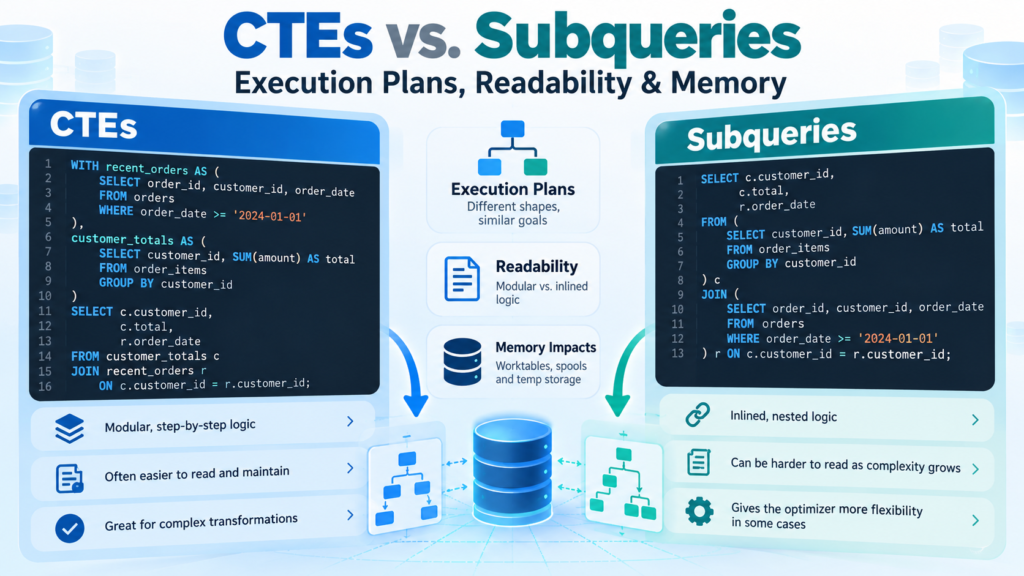
Data analysts and backend engineers frequently debate whether to structure complex queries using Common Table Expressions (WITH blocks) or nested subqueries (derived tables).
A common misconception is that CTEs are purely syntactic sugar—an aesthetic choice to make code readable. In modern relational database engines like PostgreSQL, MySQL, and SQL Server, the decision directly impacts:
- Whether the query optimizer can push down filters and predicates.
- If intermediate result sets are evaluated once or evaluated redundantly.
- Memory pressure and disk spillage inside temporary buffer spaces.
Understanding the internal execution mechanics of CTEs versus subqueries prevents silent performance degradation across enterprise analytics pipelines.
Table of Contents
1. Problem Statement & The Analytical Readability Dilemma
Consider an analytical reporting requirement: calculate customer acquisition cost against total lifetime revenue, but only for active enterprise clients whose average monthly order value exceeds $500.
Writing this logic using deeply nested derived tables creates an inside-out layout:
SQL
-- Nested Subquery Approach (Inside-Out Reading Order)
SELECT
    d.company_name,
    d.lifetime_spend,
    d.avg_monthly_spend
FROM (
    SELECT
        c.company_name,
        SUM(o.amount) AS lifetime_spend,
        AVG(o.amount) AS avg_monthly_spend
    FROM customers c
    JOIN (
        SELECT customer_id, amount, order_date
        FROM orders
        WHERE order_status = 'COMPLETED'
    ) o ON c.id = o.customer_id
    WHERE c.tier = 'ENTERPRISE'
    GROUP BY c.company_name
) d
WHERE d.avg_monthly_spend > 500;
While functional, nested subqueries suffer from significant structural limitations:
- Inverted Mental Model: A reader must locate the innermost subquery on line 12 before understanding the outer projection on line 1.
- Zero Code Reusability: If another calculation requires the completed orders dataset, the subquery must be duplicated verbatim or refactored into a temporary table.
- Debugging Overhead: Isolating an intermediate step requires manually extracting the nested code block and executing it as a standalone query.
A Common Table Expression linearizes the workflow from top to bottom:
SQL
-- Common Table Expression (Top-Down Logical Flow)
WITH completed_orders AS (
    SELECT customer_id, amount, order_date
    FROM orders
    WHERE order_status = 'COMPLETED'
),
enterprise_metrics AS (
    SELECT
        c.company_name,
        SUM(co.amount) AS lifetime_spend,
        AVG(co.amount) AS avg_monthly_spend
    FROM customers c
    JOIN completed_orders co ON c.id = co.customer_id
    WHERE c.tier = 'ENTERPRISE'
    GROUP BY c.company_name
)
SELECT company_name, lifetime_spend, avg_monthly_spend
FROM enterprise_metrics
WHERE avg_monthly_spend > 500;
While CTEs clearly win on readability and maintainability, the critical architectural question remains: Does readability come at the cost of execution performance?
2. Execution Mechanics: Inlining vs. Optimization Fences
How database engines execute CTEs has evolved substantially.
Traditional CTE Engine (Optimization Fence / Materialization):
CTE Block ──► [Materialize Full Dataset in RAM/Disk] ──► Block External Indexes/Predicates ──► Outer Query

Modern Inlining Engine (Transparent Merging):
CTE Block ──► [Inlined into AST] ◄── [Predicates Pushed Down] ──► Optimized Unified Plan
The Optimization Fence (Pre-PostgreSQL 12 & Legacy Engines)
Historically, databases treated CTEs as optimization fences. The engine executed the CTE query in isolation, materialized the full result set into memory (or temporary disk buffers), and only then executed the outer query against that materialized dataset.
This created significant performance hazards:
- Predicate Pushdown Disabled: If the outer query included a strict filter (e.g.,
WHERE customer_id = 42), the engine could not push that condition inside the CTE. It evaluated the entire CTE first, then filtered the materialized result. - Index Neglect: Indexes on underlying tables could not be used efficiently across the boundary of the materialized intermediate relation.
Optimizer Inlining (PostgreSQL 12+, Modern SQL Server, SQLite 3.30+)
Modern query planners inline non-recursive CTEs by default if they are referenced only once in the outer query. The optimizer flattens the CTE directly into the main Abstract Syntax Tree (AST), making the execution plan identical to an inlined subquery.
However, behavioral differences arise when:
- A CTE is referenced more than once in the outer query.
- Explicit materialization controls are invoked.
- Complex window calculations or sorting steps are wrapped inside the CTE block.
For analytical queries computing running totals or rankings inside CTE blocks, check our tuning guide on Optimizing Window Functions in SQL for Analytics
3. Comparison Matrix
| Feature | Common Table Expression (CTE) | Subquery / Derived Table |
| Code Structure | Sequential, modular, top-down flow | Nested, inside-out reading hierarchy |
| Reusability | Defined once; reusable multiple times in query scope | Must be duplicated if needed across multiple joins |
| Recursive Queries | Native support (WITH RECURSIVE) | Not supported |
| Predicate Pushdown | Supported when inlined; blocked if materialized | Supported out of the box by modern optimizers |
| Memory Behavior | Can spill to disk if materialized over millions of rows | Evaluated dynamically within standard pipeline memory |
| Performance Overhead | Identical to subqueries when inlined; slower if fence-materialized unnecessarily | Consistent execution plan alignment |
4. Hands-On Benchmarking: Execution Plans in PostgreSQL
Let’s test optimizer behavior across both structures using a 5-million row transaction table.
Step 1: Set Up the Benchmark Schema
SQL
-- 1. Create table structure
CREATE TABLE sales_transactions (
    transaction_id BIGINT GENERATED ALWAYS AS IDENTITY,
    account_id INT NOT NULL,
    transaction_date DATE NOT NULL,
    amount NUMERIC(10, 2) NOT NULL,
    region VARCHAR(30) NOT NULL
);

-- 2. Populate 5 million rows
INSERT INTO sales_transactions (account_id, transaction_date, amount, region)
SELECT
    (random() * 50000)::INT,
    '2025-01-01'::DATE + (random() * 365)::INT,
    (random() * 1500)::NUMERIC(10, 2),
    (ARRAY['NORTH', 'SOUTH', 'EAST', 'WEST'])[floor(random() * 4 + 1)]
FROM generate_series(1, 5000000);

-- 3. Create covering index for account filtering
CREATE INDEX idx_sales_acc_date ON sales_transactions(account_id, transaction_date);
ANALYZE sales_transactions;
Step 2: Compare Inlined CTE vs. Nested Subquery
Suppose an API requests aggregated stats for a single account (account_id = 1204):
Approach A: Subquery Implementation
SQL
EXPLAIN ANALYZE
SELECT
    sub.region,
    COUNT(*) AS total_txs,
    SUM(sub.amount) AS total_amount
FROM (
    SELECT account_id, region, amount, transaction_date
    FROM sales_transactions
) sub
WHERE sub.account_id = 1204
GROUP BY sub.region;
Approach B: Modern Inlined CTE Implementation
SQL
EXPLAIN ANALYZE
WITH transaction_pool AS (
    SELECT account_id, region, amount, transaction_date
    FROM sales_transactions
)
SELECT
    region,
    COUNT(*) AS total_txs,
    SUM(amount) AS total_amount
FROM transaction_pool
WHERE account_id = 1204
GROUP BY region;
Plan Comparison & Results
Both queries produce an identical execution plan:
Plaintext
HashAggregate  (cost=420.50..422.50 rows=4 width=48) (actual time=0.85..0.86 rows=4 loops=1)
  Group Key: sales_transactions.region
  ->  Bitmap Heap Scan on sales_transactions  (cost=4.80..415.20 rows=105 width=22) (actual time=0.08..0.45 rows=98 loops=1)
        Recheck Cond: (account_id = 1204)
        ->  Bitmap Index Scan on idx_sales_acc_date  (cost=0.00..4.78 rows=105 width=0) (actual time=0.05..0.05 rows=98 loops=1)
Planning Time: 0.18 ms
Execution Time: 0.92 ms
Observation: In modern PostgreSQL (version 12+), the query planner flattened the CTE and pushed the account_id = 1204 condition directly into the B-Tree index scan. The execution times and costs are identical down to the millisecond.
Step 3: The Pitfall — Forced Materialization (MATERIALIZED)
PostgreSQL provides explicit control keywords: WITH ... AS MATERIALIZED and WITH ... AS NOT MATERIALIZED.
If we force materialization on the CTE:
SQL
EXPLAIN ANALYZE
WITH transaction_pool AS MATERIALIZED (
    SELECT account_id, region, amount, transaction_date
    FROM sales_transactions
)
SELECT
    region,
    COUNT(*) AS total_txs,
    SUM(amount) AS total_amount
FROM transaction_pool
WHERE account_id = 1204
GROUP BY region;
Execution Plan Analysis:
Plaintext
HashAggregate  (cost=125430.50..125432.50 rows=4 width=48) (actual time=1420.25..1420.26 rows=4 loops=1)
  Group Key: transaction_pool.region
  ->  CTE Scan on transaction_pool  (cost=0.00..125430.00 rows=105 width=22) (actual time=1418.10..1419.80 rows=98 loops=1)
        Filter: (account_id = 1204)
        Rows Removed by Filter: 4999902
  CTE transaction_pool
    ->  Seq Scan on sales_transactions  (cost=0.00..82500.00 rows=5000000 width=22) (actual time=0.04..480.12 rows=5000000 loops=1)
Planning Time: 0.22 ms
Execution Time: 1,425.40 ms
What happened?
- Full Sequential Scan: The engine scanned all 5,000,000 rows off disk.
- Buffer Allocation: The intermediate dataset was materialized in memory/temporary disk buffers.
- Filter Scan Failure: The predicate
account_id = 1204was evaluated after loading 5 million rows into the CTE buffer, discarding 4,999,902 rows manually. - Latency Jump: Execution time spiked from 0.92 ms to 1,425.40 ms (over a 1,500x performance penalty).
5. When CTE Materialization is Actually Beneficial
Forced materialization is not inherently flawed; it is a tactical tool when used deliberately:
1. Preventing Redundant Execution of Expensive Logic
If an intermediate calculation is computationally heavy (e.g., regex matching, complex string manipulation, or multi-table geographic joins) and is referenced multiple times in the outer query:
SQL
WITH expensive_prep AS MATERIALIZED (
    SELECT id, complex_transform_function(raw_payload) AS parsed_data
    FROM audit_logs
    WHERE created_at >= NOW() - INTERVAL '1 day'
)
SELECT a.id, a.parsed_data, b.parsed_data
FROM expensive_prep a
JOIN expensive_prep b ON a.id = b.id + 1;
Using MATERIALIZED ensures complex_transform_function executes once, caching the results for both join sides rather than re-evaluating twice.
2. Guarding Against Volatile Side Effects
In queries interacting with volatile user-defined functions or random() generators, materialization locks the result set so subsequent joins read consistent, frozen records.
6. Recursive CTEs and Memory Hazards
One area where subqueries cannot substitute for CTEs is recursive queries (traversing organizational charts, bill-of-materials, or graph paths):
SQL
-- Hierarchical Department Tree Traversal
WITH RECURSIVE org_hierarchy AS (
    -- Anchor member
    SELECT employee_id, manager_id, full_name, 1 AS depth
    FROM employees
    WHERE manager_id IS NULL

    UNION ALL

    -- Recursive member
    SELECT e.employee_id, e.manager_id, e.full_name, h.depth + 1
    FROM employees e
    INNER JOIN org_hierarchy h ON e.manager_id = h.employee_id
)
SELECT employee_id, full_name, depth
FROM org_hierarchy;
The Memory Danger
A cyclic reference in your source data (e.g., Employee A manages Employee B, who manages Employee A) creates an infinite loop.
Because recursive CTEs accumulate working tables until an empty step occurs, runaway recursion will exhaust PostgreSQL’s work_mem and crash the transaction with an out-of-memory error.
Production Defense: Always enforce a termination depth:
SQL
-- Safe recursive loop guard
WITH RECURSIVE org_hierarchy AS (
    SELECT employee_id, manager_id, full_name, 1 AS depth
    FROM employees
    WHERE manager_id IS NULL

    UNION ALL

    SELECT e.employee_id, e.manager_id, e.full_name, h.depth + 1
    FROM employees e
    INNER JOIN org_hierarchy h ON e.manager_id = h.employee_id
    WHERE h.depth < 10 -- Hard recursion barrier
)
SELECT * FROM org_hierarchy;
7. Decision Framework: When to Use Which
Need a recursive graph or hierarchical tree query?
├── YES ───► Use Recursive CTE (Subqueries cannot perform recursion).
└── NO  ───► Is the query referenced only once in the statement?
             ├── YES ───► Use CTE for clean readability (Planner inlines it identically to a subquery).
             └── NO  ───► Is the shared logic computationally heavy?
                          ├── YES ───► Use CTE with MATERIALIZED (Calculates once, reuses cache).
                          └── NO  ───► Use Subqueries or standard CTE (Allow optimizer to evaluate join order).
Summary Checklist for Production Systems
- Default to CTEs for Readability: On PostgreSQL 12+, MySQL 8.0+, and SQL Server, single-use CTEs are automatically inlined. Optimize for code clarity first.
- Watch Multiple References: If referencing a CTE multiple times, check your
EXPLAIN ANALYZEoutput. In older PostgreSQL versions, it will automatically materialize and prevent index scans. - Use Explicit Keywords When Needed: In PostgreSQL 12+, use
AS NOT MATERIALIZEDif you want to ensure the planner flattens a multi-referenced CTE, orAS MATERIALIZEDif you want to cache expensive computations. - Guard Recursive Queries: Always add a depth safeguard (
WHERE depth < N) to prevent infinite memory leaks from data cycles.