
For most of the SaaS era, software pricing has been remarkably simple.
A company buys:
100 employees × 100 software seats × monthly price
The employee is the unit of software consumption.
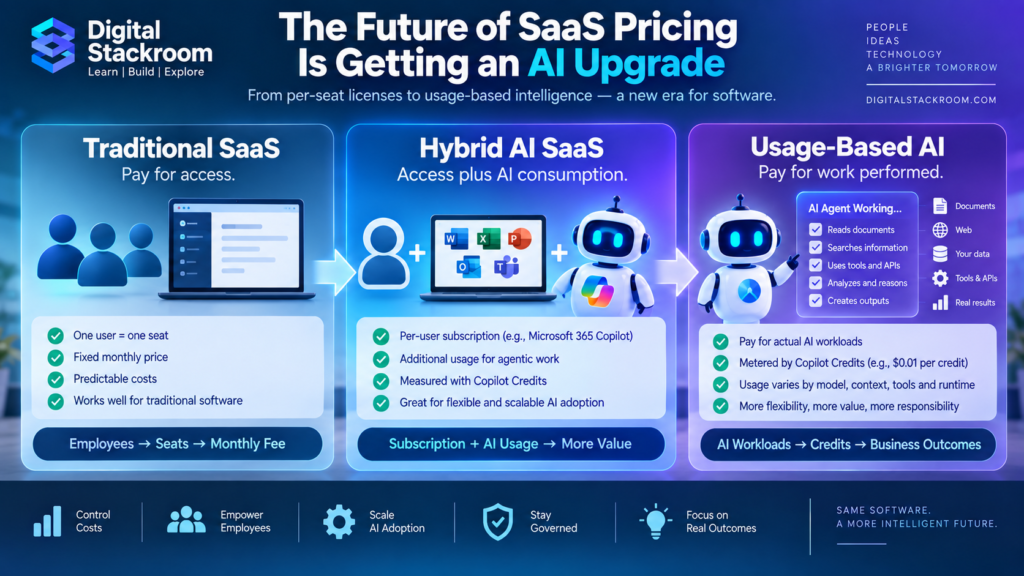
Whether someone uses an application for ten minutes or eight hours, the pricing model often looks roughly the same.Microsoft 365 Copilot usage-based billing is an early sign that enterprise AI pricing is moving beyond simple per-user subscriptions toward hybrid models that combine seats with AI consumption.
That model worked because traditional software primarily sold access.
AI software increasingly sells something different.
It performs computational work.
An AI agent may:
- reason for several minutes
- retrieve large amounts of organizational context
- invoke multiple AI models
- call external tools
- browse websites
- modify documents
- execute multi-step workflows
- run autonomously for extended periods
Two employees with identical Microsoft 365 Copilot licenses could therefore create very different levels of infrastructure consumption.
That creates an economic problem.
How should software vendors price a product when one user asks:
“Summarize this email.”
while another asks:
“Research these 200 documents, compare five suppliers, browse their latest information, build a financial model, create a presentation, and draft the recommendation.”
Both users occupy one seat.
But their underlying AI workloads are dramatically different.
Microsoft’s emerging answer provides an important clue about where SaaS pricing may be heading.
Starting November 2, 2026, new Microsoft 365 Copilot Business purchases through Cloud Solution Provider partners will have usage-based billing configured by default for eligible experiences including Copilot Cowork, Work IQ APIs, and GitHub Copilot Harness.
That does not mean Microsoft 365 Copilot is becoming entirely pay-as-you-go.
Instead, Microsoft is increasingly combining:
fixed subscription access
with:
metered AI consumption.
And that hybrid may become one of the defining business models of agentic software.
Table of Contents
The Short Answer
Per-seat SaaS pricing is probably not disappearing.
But it is becoming incomplete for AI-heavy software.
Microsoft’s model increasingly looks like:
Base subscription
Predictable price per employee.
Provides the core Microsoft 365 Copilot experience.
Metered agentic workload
Additional consumption based on how much computational work certain AI experiences perform.
For Copilot Cowork, Microsoft says task consumption depends on four broad components:
- model usage
- context retrieval
- tool calls
- runtime
Usage is measured using Copilot Credits.
That creates a new SaaS equation:
Software Cost = Seats + AI Consumption
instead of simply:
Software Cost = Seats
The important question therefore is not:
“Is Microsoft killing per-seat pricing?”
It isn’t.
The more useful question is:
Will hybrid seat-and-consumption pricing become normal as SaaS products become increasingly agentic?
There are strong reasons to think it could.
What Microsoft Is Actually Changing on November 2, 2026
Microsoft announced the change through its September Partner Center updates.
Beginning November 2:
new Microsoft 365 Copilot Business purchases through CSP
will have:
pay-as-you-go usage billing configured by default.
The eligible experiences Microsoft names include:
- Copilot Cowork
- Work IQ APIs
- GitHub Copilot Harness
Microsoft says the purpose is to remove additional billing setup and make it easier for customers to begin using consumption-based AI experiences.
There are three details worth emphasizing.
1. It applies to new CSP purchases
This is not a blanket conversion of every existing Microsoft 365 Copilot customer to pay-as-you-go billing.
The November change specifically concerns new Copilot Business purchases made through the Cloud Solution Provider channel.
2. The base Copilot license still exists
Microsoft continues to sell Microsoft 365 Copilot through user-based subscription licensing.
The subscription includes capabilities across applications such as Word, Excel, PowerPoint, Outlook, and Teams, along with Copilot Chat, Work IQ, and other included features.
3. Some AI workloads are separately metered
Experiences such as Copilot Cowork involve variable computational work and therefore use Copilot Credits.
That means a customer may pay:
subscription fee
usage charges
for certain experiences.
This distinction is the heart of the story.
Why Copilot Cowork Needs a Different Pricing Model
Copilot Cowork is not simply another chat window.
Microsoft describes it as an agentic environment for complex, long-running, multi-tool work.
A Cowork task may involve:
AI model
enterprise context
tool calls
cloud runtime
over multiple steps.
Microsoft says Cowork credit consumption is determined using four major cost categories:
Models
Different AI models can have different computational requirements.
Context
Cowork may retrieve information from organizational data, documents, emails, meetings, and other sources.
Tools
The task may perform actions using applications and connected systems.
Runtime
Longer autonomous workflows require orchestration infrastructure to remain active while the task executes.
That creates an economic reality that traditional SaaS pricing did not need to handle.
The cost of serving the user becomes partially dependent on what the user asks the software to do.
Traditional SaaS Economics
Consider a conventional project-management application.
A company buys:
500 seats
at:
$20 per user/month
Software revenue:
500 × $20 = $10,000/month
The vendor does have infrastructure costs.
But one employee creating five tasks instead of four usually does not create a dramatic change in cost.
The seat is therefore a useful approximation of customer value and vendor cost.
AI Changes the Cost Curve
Now imagine an enterprise AI platform.
Employee A:
- summarizes 5 emails
- asks 10 simple questions
Employee B:
- researches thousands of documents
- executes long-running agents
- calls external APIs
- invokes premium reasoning models
- runs workflows throughout the day
Both are:
one employee
but their computational consumption may differ enormously.
The traditional equation:
1 user = roughly similar economic unit
starts to weaken.
The real unit becomes some combination of:
user + tokens + model + context + tools + runtime + actions.
That makes pure seat pricing harder to sustain for unlimited agentic workloads.
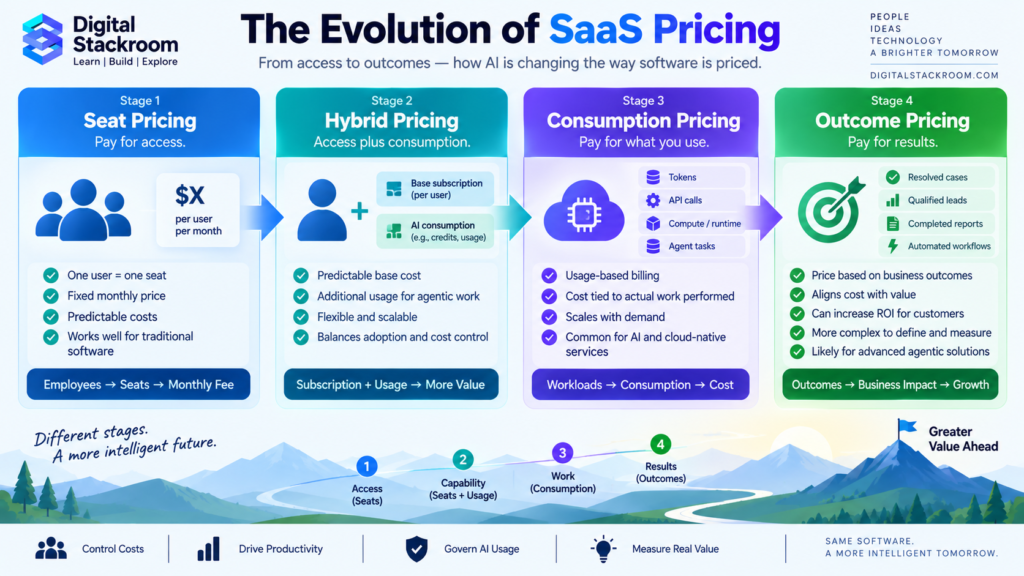
Digital Stackroom Framework: The Evolution of SaaS Pricing
A useful way to understand the transition is through four stages.
Stage 1 — Seat Pricing
You pay for access.
100 employees
×
$X per employee
Simple and predictable.
Stage 2 — Hybrid Pricing
You pay for:
base access
variable consumption
Example:
Copilot subscription + Copilot Credits
This is where many AI products may converge.
Stage 3 — Consumption Pricing
You primarily pay for actual work performed.
Common units could include:
- tokens
- API calls
- compute
- credits
- workflows
- tasks
- agent runtime
Stage 4 — Outcome Pricing
This is more speculative.
Rather than paying for:
software
or:
compute
the customer pays for:
business result.
Examples could eventually include:
- resolved support case
- qualified lead
- completed research report
- processed invoice
- automated compliance review
This model is much harder technically and commercially, but agentic software makes it increasingly imaginable.
So the possible evolution becomes:
Seat
→
Seat + Consumption
→
Consumption
→
Outcome
Not every product will move through every stage.
But AI increases the pressure to move beyond stage one.
Seat Pricing vs Usage Pricing
| Area | Per-Seat Pricing | Usage-Based Pricing |
|---|---|---|
| Billing unit | User | Consumption |
| Budget predictability | High | Variable |
| Best suited for | Traditional applications | Compute-intensive AI |
| Cost tied to activity | Weakly | Strongly |
| Easy to understand | Yes | Less so |
| Vendor infrastructure risk | Vendor | More shared with customer |
| Low-use employees | Potentially expensive | Potentially cheaper |
| Heavy users | Predictable | Can become costly |
| Cost governance | License management | Usage management |
| Procurement focus | Number of users | Users + workload intensity |
Neither model is universally better.
They solve different economic problems.
Microsoft’s Answer: Hybrid Pricing
Microsoft’s strategy is particularly interesting because it does not choose between the two.
The core Microsoft 365 Copilot subscription remains predictable.
Cowork adds variable billing.
Conceptually:
Employee
↓
Microsoft 365 Copilot Subscription
Provides:
- productivity AI
- application integration
- chat
- enterprise context
- included agents/capabilities
↓
Advanced Agentic Work
Uses:
- models
- context
- tools
- runtime
↓
Copilot Credits
Measures consumption
This keeps basic budgeting relatively straightforward while allowing computationally expensive workloads to scale separately.
Microsoft explicitly describes its usage-based model as complementing fixed subscription licensing rather than universally replacing it.
That may prove to be an important pattern for the wider SaaS market.
What Exactly Is a Copilot Credit?
A Copilot Credit is Microsoft’s common unit for measuring consumption across eligible AI experiences.
Instead of showing customers the raw complexity of:
- tokens
- model inference
- orchestration
- tool execution
- runtime
Microsoft can translate that activity into:
Copilot Credits.
Microsoft currently supports usage-based services including Cowork, Work IQ API, and additional eligible Copilot services, while the coverage can expand over time.
This makes credits an abstraction layer.
The customer does not necessarily need to understand every infrastructure component.
They need to understand:
How many credits does our AI activity consume?
Why Credits Are Attractive to Vendors
Credits solve several commercial problems.
Imagine telling a finance team:
“Your AI costs depend on token counts across four different models, retrieval volume, orchestration runtime, and API tool calls.”
That is technically accurate.
It is commercially painful.
Credits allow the vendor to translate several technical inputs into one billing unit.
This simplifies:
- invoicing
- packaging
- quotas
- prepaid plans
- budget allocation
But it introduces another challenge.
Customers now need to understand the value represented by each credit.
How Much Does Copilot Cowork Cost?
Microsoft currently lists pay-as-you-go Copilot Credits at $0.01 per credit for Cowork.
It also offers prepaid purchasing options for organizations that want more predictable committed usage.
The important detail is that a Cowork task does not necessarily consume a fixed number of credits.
Consumption varies based on:
- model choice
- context volume
- runtime
- tools used
Microsoft also provides a /cost command inside Cowork that users can use to see approximate credit consumption for their current task.
That means two prompts can have dramatically different costs.
A Simple Example
Imagine two Cowork tasks.
Task A
“Summarize these two documents.”
Requirements:
- small context
- simple model
- few steps
- short runtime
Task B
“Review all supplier proposals, research each company, compare financial terms, identify contractual risks, create an Excel analysis, and prepare a PowerPoint recommendation.”
Requirements:
- larger context
- multiple models
- web/tools
- many execution steps
- longer runtime
Traditional seat pricing treats both tasks as:
one user using Copilot.
Consumption pricing recognizes that they are economically different workloads.
Why Agents Break the Seat Model Even More Than Chatbots
Chatbots usually operate interactively.
User asks.
Model answers.
Agentic systems can continue working after the initial prompt.
A sophisticated agent might:
- create a plan
- search internal documents
- inspect emails
- retrieve external data
- call an API
- analyze results
- revise the plan
- call another tool
- create a spreadsheet
- generate a presentation
One employee can effectively initiate a large amount of machine labor.
That changes the relationship between:
employee count
and:
software workload.
The future enterprise could have:
10,000 employees
but:
100,000 active AI workflows.
Pricing only by employee count may become increasingly disconnected from actual usage.
The Important New Unit: Work
Traditional SaaS monetized:
access to capability
Agentic SaaS increasingly monetizes:
execution of work
That is a profound difference.
Consider Microsoft Word.
Traditional model:
Pay for access to Word.
Agentic model:
Ask the system to research, write, analyze, format, coordinate and deliver something.
The software is no longer only waiting for the employee to operate it.
It performs more of the work itself.
That makes work performed a natural candidate for pricing.
Why Microsoft Still Needs the Seat
If consumption billing fits AI so naturally, why keep the subscription?
Because the seat still represents several things:
- user identity
- application access
- security
- enterprise integration
- baseline AI functionality
- support
- organizational context
- collaboration features
The subscription creates a predictable relationship between the company and the software platform.
Consumption then handles the variable workload on top.
This is why hybrid pricing may be more durable than pure usage pricing.
Pure Consumption Pricing Has Its Own Problems
Imagine employees being told:
“Every AI request costs money.”
They may begin thinking:
“Should I ask Copilot this question?”
That creates friction.
Employees may avoid experimentation because they fear increasing costs.
Pure consumption pricing can therefore undermine adoption.
A base subscription solves part of this by providing an included productivity experience.
Usage charges can be reserved for more expensive agentic workloads.
That creates a psychological and economic division:
everyday AI
versus
advanced AI work.
The New Software Budget Equation
Traditional budgeting:
Employees × Licenses
AI-era budgeting may require:
Employees × Licenses
Active Agent Users × Tasks
×
Average Consumption per Task
A simplified equation:
Total AI Software Cost
=
Base Subscription Cost
Agent Consumption Cost
Where:
Agent Consumption
≈
Users × Tasks/User × Average Credits/Task × Credit Price
This is much closer to cloud-computing economics than traditional SaaS economics.
SaaS Is Starting to Look Like Cloud Infrastructure
Cloud infrastructure changed enterprise technology purchasing by introducing:
pay for what you consume.
Companies stopped purchasing only fixed server capacity.
They started paying for:
- compute
- storage
- network
- database usage
AI software may be bringing similar economics into everyday productivity applications.
Instead of only managing:
licenses
companies increasingly need to manage:
AI consumption.
This creates a new intersection between:
SaaS management
and:
FinOps.
Welcome to AI FinOps
FinOps originally developed around cloud infrastructure costs.
Teams needed to understand:
- who consumed resources
- why
- how much
- whether the consumption created business value
Agentic AI creates almost exactly the same problem.
Finance and IT may increasingly ask:
Which departments consume the most AI?
Which agents are expensive?
Which workflows create measurable value?
Which models are unnecessarily expensive?
Should this task use a premium reasoning model?
Are employees running redundant agents?
That creates a new discipline we could call:
AI FinOps.
Microsoft Is Already Building Cost Controls Around This Problem
Microsoft provides cost-management capabilities for usage-based Copilot experiences.
Administrators can create spending policies at different scopes and monitor consumption across:
- users
- groups
- agents/services
The Microsoft 365 admin center can show credit usage, sessions, limits, and consumption patterns.
Microsoft also supports customizable usage alerts and user credit requests for Cowork.
That is telling.
Once AI becomes metered, cost governance becomes a product feature.
A New Role for IT Administrators
Traditional SaaS administration focuses on:
- assigning licenses
- removing licenses
- controlling application access
- managing SSO
- enforcing security policies
AI administration adds:
- allocating credits
- setting spending limits
- choosing models
- monitoring agent usage
- analyzing cost per workflow
- deciding who receives advanced agent capabilities
The admin becomes partially responsible for computational economics.
A New Role for Procurement
Procurement can no longer evaluate only:
“How much is the license?”
They increasingly need to ask:
Base cost
What is included with the seat?
Metered experiences
Which features trigger additional usage?
Unit economics
What does each unit cost?
Consumption drivers
What increases usage?
Controls
Can we establish limits?
Visibility
Can we attribute spending to groups or users?
Commitment discounts
Can predictable usage be prepaid?
Overage behavior
What happens when limits are reached?
These questions will become standard if hybrid AI pricing spreads.
The Hidden Problem: Comparing AI Software Becomes Harder
Imagine comparing two products.
Product A
$25/user/month
plus usage.
Product B
$40/user/month
with higher included limits.
Which is cheaper?
You cannot answer from the list price alone.
You need to know:
- how many users
- workload intensity
- task complexity
- model choice
- usage limits
- overage pricing
This makes AI procurement much more similar to evaluating cloud services.
The headline price becomes less useful.
The AI Pricing Iceberg
A useful Digital Stackroom framework is the AI Pricing Iceberg.
Above the water:
Seat Price
The easy number everyone sees.
Below the water:
Agent Usage
Premium Models
Context Retrieval
Tool Calls
Runtime
API Calls
Storage
Integrations
Overage
Governance
The visible subscription price may become only part of the true total cost of ownership.
Cost per Seat Is No Longer Enough
Traditional SaaS metric:
Cost per employee
AI-era metric:
Cost per useful outcome
That could mean measuring:
- cost per report generated
- cost per support case resolved
- cost per research task
- cost per automated workflow
- cost per sales proposal
- cost per engineering task
This is potentially much more meaningful.
Suppose one agent task costs $8 but saves three hours of employee work.
That could be excellent economics.
Another task may cost $8 and save two minutes.
That is very different.
Consumption needs to be compared with value created, not just dollars spent.
Digital Stackroom’s AI Unit Economics Formula
A practical formula:
Agent ROI
=
Human Cost Avoided + Business Value Created − AI Consumption Cost
divided by:
AI Consumption Cost
For example:
An autonomous research task costs:
$5
and saves:
2 hours of analyst time worth $80
Then, ignoring other costs:
Value = $80
Cost = $5
The AI workload makes economic sense.
This type of calculation may eventually become common in enterprise AI programs.
Not Every Task Should Use the Best Model
Agentic platforms increasingly offer multiple AI models.
A common mistake will be:
Use the most powerful model for everything.
That is similar to running every cloud workload on the largest available machine.
It works.
But it can be economically inefficient.
Microsoft notes that higher reasoning effort can increase credit usage and that model choice can influence cost.
An organization may eventually classify workloads:
Low complexity
Summaries
Formatting
Classification
Medium complexity
Research
Data analysis
Document generation
High complexity
Complex reasoning
Strategy
Engineering investigation
Legal review support
Different tasks may justify different models.
AI Cost Optimization Will Become a Software Feature
Future AI platforms may automatically optimize for:
quality
speed
cost.
Imagine an orchestration system deciding:
Simple extraction → cheaper model
Complex reasoning → premium model
Large retrieval → narrow context first
Expensive agent workflow → ask for approval
The user may eventually specify:
“Optimize for cost.”
or:
“Use the strongest reasoning available.”
Cost becomes another parameter of AI execution.
The Seat Isn’t Dead—It’s Becoming the Membership Fee
A useful analogy:
The seat increasingly resembles:
membership.
It gives the employee access to the platform.
Usage billing then covers:
additional work performed.
Think:
subscription + utilities
rather than:
subscription alone.
That may be easier for customers to understand than saying per-seat SaaS is disappearing.
What Happens to Software With Very Low AI Usage?
Some products may remain pure subscription SaaS.
If AI consumption represents only a small percentage of vendor cost, usage metering may create unnecessary complexity.
For example:
- lightweight writing assistance
- occasional summaries
- simple autocomplete
could potentially remain bundled.
Hybrid pricing becomes most compelling when workloads can vary dramatically.
What Happens to Agent-First Software?
Agent-first products face a different challenge.
Imagine a product where almost all value comes from autonomous work.
Charging purely by employee seat makes less sense.
The real units might be:
- task
- workflow
- runtime
- action
- outcome
Those products may move much further toward consumption pricing.
A Future Customer-Service Example
Traditional customer-service SaaS:
500 agents × monthly seat price
AI-assisted model:
300 human seats
AI agent consumption
Future autonomous model:
human supervisors
AI cases resolved
The pricing unit moves closer and closer to business activity.
This is where outcome pricing becomes interesting.
What Is Outcome-Based Pricing?
Outcome-based pricing charges for the result rather than the software resource.
Examples:
Instead of:
$100 per month
or:
1,000 AI credits
you pay:
$X per resolved support ticket
or:
$X per processed invoice
or:
$X per qualified lead.
This aligns pricing closely with value.
But it creates difficult questions.
Who receives credit for the outcome?
What if the human contributed?
What counts as successful?
Who bears the risk of poor performance?
Outcome pricing is therefore harder than it first appears.
Why Hybrid Pricing Is Likely to Dominate First
Hybrid pricing solves several competing requirements.
Customers want:
predictable baseline costs.
Vendors need:
protection from unlimited compute usage.
Users want:
freedom to experiment.
Finance wants:
visibility and controls.
A model combining:
base subscription + controlled consumption
can satisfy all four reasonably well.
Microsoft’s Copilot architecture is a clear example of this balance.
What SaaS Vendors Should Learn From Microsoft’s Move
Software companies adding AI should think carefully before simply bundling unlimited AI into existing subscriptions.
Questions include:
How variable is inference cost?
Can one user consume 100× another?
Do agents run autonomously?
Are premium models available?
Do tools and external services create additional costs?
Can customers control consumption?
Can usage be attributed?
If these answers point toward high variability, hybrid pricing may be more sustainable.
But Vendors Must Avoid “Token Anxiety”
There is a danger.
If customers need a calculator before every prompt, the product experience suffers.
Users should think about:
work
not:
tokens.
Good pricing abstraction should therefore translate infrastructure consumption into something customers understand.
Microsoft is attempting this with Copilot Credits.
Other vendors may use:
- tasks
- automation runs
- agent minutes
- actions
- AI credits
The winning billing unit may be the one customers can connect most clearly to business value.
Transparency Will Matter
Customers should be able to answer:
What did this task cost?
Why did it cost that much?
Which department consumed it?
Was the task successful?
Microsoft already allows Cowork users to inspect approximate task-level credit usage with /cost, while administrators can examine consumption at broader organizational levels.
That type of transparency will become increasingly important.
Spending Limits Are Also Access Controls
There is another important Microsoft detail.
For Copilot Cowork, Microsoft says a spending policy is not merely a budget mechanism—it also participates in determining who can access Cowork.
A user included in an applicable policy can receive access even if the credit limit is extremely small, so administrators need to manage policy scope carefully rather than treating tiny limits as a way to block usage.
This illustrates how:
billing
and:
access governance
are beginning to overlap in agentic software.
AI Pricing and AI Agent Identity Will Converge
Blog #8 discussed why AI agents increasingly need their own identities.
Pricing introduces another reason.
Imagine 100 agents consuming AI resources.
Finance wants to know:
Which agent spent this money?
Security wants to know:
Which agent performed this action?
Operations wants to know:
Which agent delivered value?
The identity becomes useful for:
security + audit + cost allocation.
Future AI governance systems may combine:
Agent Identity
↓
Permissions
↓
Consumption
↓
Business Outcome
That is a powerful architecture.
AI Chargeback Could Become Normal
Large enterprises commonly use internal cloud chargeback.
For example:
Marketing cloud cost → Marketing
Data platform cost → Analytics
Agentic AI may create similar structures.
Example:
| Team | Monthly AI Consumption | Business Purpose |
|---|---|---|
| Sales | 1.2M credits | Account research |
| Finance | 700K credits | Reporting |
| Operations | 2.8M credits | Workflow automation |
| HR | 300K credits | Document analysis |
Then organizations can ask:
Does each department’s AI consumption justify the value?
That is pure FinOps thinking entering SaaS.
Shadow AI Could Become Shadow Spend
Traditional shadow IT occurs when employees purchase unapproved software.
AI introduces another form:
uncontrolled consumption inside approved software.
The product itself may be approved.
But thousands of users could independently create expensive agent workflows.
Companies therefore need to govern not only:
which AI platforms are allowed
but:
how they are used.
Five Metrics Every AI Buyer Should Track
1. Cost per Active AI User
Useful for adoption analysis.
2. Cost per Agent Task
Shows workload economics.
3. Cost per Successful Outcome
Much more valuable than raw consumption.
4. Savings per Automated Task
Measures efficiency.
5. AI ROI by Business Function
Answers whether usage actually creates value.
Without these metrics, AI budgets can grow while nobody knows whether productivity improved.
A Practical Procurement Checklist
Before signing an AI SaaS agreement, ask:
Subscription
What does the base seat include?
Consumption
Which features are metered?
Unit
What does one credit/action/task represent?
Limits
Can spending caps be configured?
Reporting
Can consumption be attributed to users and groups?
Models
Do different models cost differently?
Overage
What happens when committed usage is exhausted?
Prepayment
Are volume discounts available?
Administration
Who can enable usage-based features?
Value
How will ROI be measured?
This checklist may become as normal as reviewing storage limits in traditional SaaS.
When Pay-As-You-Go Makes Sense
Usage billing can be attractive when:
- adoption is uncertain
- workloads fluctuate
- organizations are piloting AI
- only some users need advanced agents
- usage varies dramatically
A company does not need to commit large amounts before understanding its consumption pattern.
Microsoft itself describes pay-as-you-go as useful for flexible or variable usage.
When Prepaid Credits Make More Sense
Once usage becomes predictable, organizations may prefer prepaid capacity.
Advantages can include:
- easier budgeting
- volume economics
- committed capacity
- predictable annual planning
The common lifecycle may become:
Pilot with PAYG
↓
Measure consumption
↓
Identify workload baseline
↓
Purchase committed credits
That is extremely similar to cloud infrastructure purchasing.
What This Means for Small Businesses
For small businesses, hybrid pricing has both benefits and risks.
Benefit:
They may access powerful agentic tools without large upfront commitments.
Risk:
Unexpected usage could create variable bills.
Small businesses therefore need:
- limits
- alerts
- usage reporting
- careful rollout
The ability to start small is valuable—but only when spending remains visible.
What This Means for Enterprise Finance Teams
CFO organizations may increasingly need to understand AI infrastructure.
Traditional budgeting categories such as:
Software licenses
may need to separate into:
AI subscriptions
and:
AI consumption.
Forecasting then requires behavioral assumptions.
For example:
5,000 licensed users
does not automatically tell finance:
expected AI spend.
They must estimate:
active users × usage frequency × workload complexity.
What This Means for CIOs
CIOs will need to answer both:
“Who should have Copilot?”
and:
“Which workloads deserve advanced consumption?”
The first is license management.
The second is portfolio management.
AI budgets may increasingly be allocated based on business use cases rather than employee headcount alone.
What This Means for Employees
Employees themselves may eventually gain more cost visibility.
Instead of treating AI as unlimited magic, they may learn:
Simple task = lightweight compute.
Complex autonomous task = significant resources.
This does not mean employees should obsess over every credit.
But cost-aware AI use could become a workplace skill.
What This Means for SaaS Valuation
There is an interesting business-model implication for software companies.
Traditional SaaS investors love:
Annual Recurring Revenue.
Usage models introduce more variability.
But they can also create expansion revenue without requiring additional employees.
A company might maintain:
10,000 seats
while its AI consumption triples.
That allows vendors to grow revenue through increased workload rather than increased headcount.
In an economy where companies increasingly use AI instead of hiring additional employees, this could become strategically important.
AI Could Break the Link Between Customer Headcount and SaaS Growth
Traditional SaaS often benefits when customers hire more employees.
More employees:
↓
More seats
↓
More revenue
AI changes that relationship.
A customer may keep headcount flat while dramatically increasing:
digital labor.
If vendors relied only on seats, their revenue might not reflect the increased value delivered.
Consumption pricing gives vendors a way to monetize:
machine work
even when:
human headcount stays flat.
That may be one of the deepest reasons agentic software pushes toward usage pricing.
The New SaaS Growth Equation
Traditional:
Revenue Growth ≈ Customer Growth + Seat Growth
Agentic:
Revenue Growth ≈ Customers + Seats + AI Consumption
Eventually:
Customers + Human Seats + Digital Workers + Outcomes
That is a very different software economy.
Could Agents Become “Seats”?
Another possible pricing model is to license AI agents almost like employees.
For example:
$X per digital worker/month.
That could work for predictable agents performing stable tasks.
But highly variable workloads still create compute-cost differences.
So even digital-worker subscriptions may eventually include usage limits or overages.
Why This Matters Beyond Microsoft
Microsoft provides a useful case study because its productivity software is used at enormous enterprise scale.
But the pricing challenge is universal.
Any vendor offering:
- autonomous agents
- premium reasoning
- long-running tasks
- tool use
- large context retrieval
faces the same economic question:
Who pays when machine work expands dramatically?
There are only a few broad options:
- vendor absorbs it
- prices rise
- usage is capped
- usage is metered
- customers buy committed capacity
Hybrid models are therefore a logical outcome.
The Future SaaS Pricing Stack
A mature AI product may eventually have several layers.
Layer 1 — Platform Fee
Access to the software.
Layer 2 — Human Seats
Users and collaboration.
Layer 3 — AI Consumption
Models, context, runtime and tools.
Layer 4 — Agent Capacity
Dedicated automation or digital workers.
Layer 5 — Outcomes
Premium pricing linked to measurable results.
This would make future pricing far more sophisticated than the simple user-seat model that defined the first SaaS era.
Frequently Asked Questions
Is Microsoft 365 Copilot switching entirely to usage-based pricing?
No.
Microsoft continues to offer Microsoft 365 Copilot through per-user subscription licensing. Usage-based billing applies to eligible metered experiences such as Copilot Cowork and Work IQ APIs rather than replacing the entire base subscription.
What changes on November 2, 2026?
For new Microsoft 365 Copilot Business purchases through Cloud Solution Provider partners, pay-as-you-go billing will be configured by default for eligible usage-based experiences.
What is Microsoft Copilot Cowork?
Copilot Cowork is Microsoft’s agentic Microsoft 365 experience for complex, multi-step work that can use models, enterprise context and tools over longer-running tasks. It became generally available in June 2026.
How is Copilot Cowork billed?
Cowork requires the appropriate Microsoft Copilot subscription and uses Copilot Credits for usage-based billing. Credit consumption varies according to factors including model usage, context, tools and runtime.
How much is a Copilot Credit?
Microsoft currently lists pay-as-you-go pricing for Cowork at $0.01 USD per Copilot Credit. Prepaid options are also available.
Can organizations limit Copilot spending?
Yes. Microsoft provides cost-management features including spending policies, limits, usage reporting and organizational controls across users, groups and supported services.
Can users see how many credits a Cowork task used?
Microsoft provides a /cost command in Cowork that shows approximate task consumption and remaining credit allowance.
Does a more powerful AI model cost more credits?
It can. Microsoft says credit usage varies according to model choice and reasoning effort along with context volume, orchestration and tool usage.
Is per-seat SaaS pricing disappearing?
There is no evidence that it is disappearing broadly.
A more realistic trend is the emergence of hybrid pricing, combining predictable user subscriptions with metered AI consumption for workloads whose compute requirements vary substantially.
What is AI FinOps?
AI FinOps is an emerging way of thinking about the financial governance of AI consumption: measuring which teams, users and agents consume resources, what those workloads cost, and whether they generate sufficient business value.
Final Thoughts
The most important thing about Microsoft 365 Copilot usage-based billing is not the credit price.
It is what the pricing model tells us about the economics of AI software.
Traditional SaaS was built around a simple assumption:
The human user is the primary unit of consumption.
Agentic software challenges that assumption.
One employee can now initiate:
- multiple agents
- hundreds of model calls
- large context retrievals
- autonomous workflows
- hours of machine execution
Human headcount no longer accurately represents the amount of work the software performs.
That is why the emerging pricing model increasingly looks like:
Human Seat
Digital Work
Microsoft 365 Copilot provides a particularly clear example.
The seat remains.
The subscription remains.
But advanced agentic work increasingly carries its own consumption economics.
That suggests per-seat SaaS is not necessarily breaking.
It is becoming only the first layer of the bill.
The next generation of enterprise software may increasingly combine:
Seat Pricing
↓
Hybrid Pricing
↓
Consumption Economics
↓
eventually, in some categories:
Outcome Pricing
And that transition could reshape far more than Microsoft Copilot.
It could change how software is purchased, how IT budgets are managed, how AI agents are governed, how SaaS companies grow, and how businesses calculate the value of digital labor.
The first SaaS era monetized access to software.
The agentic SaaS era may increasingly monetize work performed by software.
That is a much bigger change than a new pricing page.