
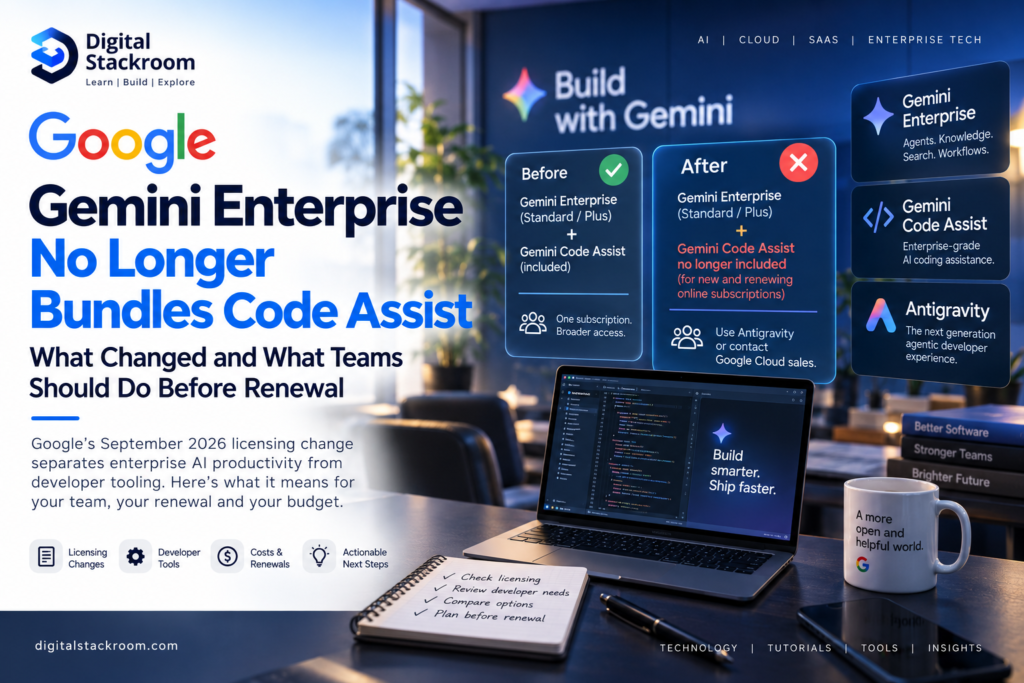
Google quietly made an important change to Gemini Enterprise Code Assist licensing in September 2026.
If an organization buys a new Gemini Enterprise Standard or Plus subscription online—or renews one online—Gemini Code Assist is no longer automatically included.
Existing Gemini Enterprise subscriptions that already include Code Assist can continue using it until the end of their current subscription term. Organizations that still want Gemini Code Assist bundled with Gemini Enterprise can obtain an eligible subscription through Google Cloud sales.
At first glance, this may look like a simple licensing adjustment.
It is more significant than that.
Google is increasingly separating two ideas that were previously easy to treat as one:
enterprise AI productivity
and
AI-assisted software development.
Gemini Enterprise is evolving into a broader enterprise AI platform with agents, search, workflows, connectors and organizational knowledge.
Meanwhile, Google is moving its next-generation developer experience toward Antigravity, while continuing to sell Gemini Code Assist Standard and Enterprise as separately licensed products for organizations that specifically need the traditional Code Assist feature set.
For IT administrators, engineering leaders and procurement teams, that creates a new question before renewal:
Are you actually buying Gemini Enterprise for knowledge work, developer tooling, or both?
That distinction now matters financially and technically.
Table of Contents
What Changed on September 17, 2026?
Google’s Gemini Enterprise release notes state that new Gemini Enterprise Standard or Plus subscriptions purchased online—and existing subscriptions renewed online—no longer include Gemini Code Assist features.
Existing subscriptions that already include Code Assist remain unaffected until the end of their subscription term.
Google gives customers two main paths after that:
Use Antigravity as the AI developer-tool option, or contact Google Cloud sales if the organization still wants a Gemini Enterprise subscription that includes Gemini Code Assist.
That distinction is important.
Google did not announce:
“Gemini Code Assist is shutting down for enterprises.”
Instead, it changed how access is packaged and purchased.
Gemini Enterprise Code Assist: Before vs After
Use a four-column table here:
| Scenario | Before the change | After the change | What teams should do |
|---|---|---|---|
| Existing Gemini Enterprise subscription with Code Assist | Code Assist included | Remains available until current term ends | Review renewal before term expires |
| New Standard/Plus subscription purchased online | Could include Code Assist under previous packaging | Code Assist no longer automatically included | Evaluate Antigravity or contact sales |
| Standard/Plus renewal completed online | Previous bundle could continue under old structure | Code Assist no longer included through normal online renewal path | Check developer requirements first |
| Organization specifically needs Gemini Code Assist | Could rely on Gemini Enterprise bundle | Separate sales-assisted path may be required | Contact Google Cloud sales |
| Team wants Google’s newer agentic developer tooling | Code Assist / Gemini CLI were central | Google is directing teams toward Antigravity | Evaluate Antigravity against current workflow |
This is why teams should avoid treating an upcoming Gemini Enterprise renewal as an administrative formality.
A renewal can now change the developer experience available to engineers.
Gemini Code Assist Is Not Being Discontinued for Enterprise Customers
This is one of the most important clarifications.
Gemini Code Assist Standard and Enterprise remain active products.
Google currently documents both editions for organizational use and continues to support features such as IDE coding assistance, code generation, local codebase awareness, code transformation, agent mode and Gemini CLI. Gemini Code Assist Enterprise additionally supports capabilities such as code customization based on an organization’s private repositories and deeper integrations with Google Cloud services.
New Gemini Code Assist subscriptions now generally require customers to contact Google Cloud sales, while organizations with existing Code Assist subscriptions can continue managing and renewing those subscriptions through Google Cloud.
So Google currently has two enterprise developer-tool paths, not one.
There is:
Gemini Code Assist Standard / Enterprise
and
Antigravity through Gemini Enterprise and related Google Cloud offerings.
The decision increasingly depends on how a development organization works.
Why Is Google Pushing Antigravity?
Google has been consolidating its agentic developer tooling around Antigravity.
Earlier in 2026, Google announced that consumer access through Gemini Code Assist for individuals, Google AI Pro and Google AI Ultra would transition toward Antigravity. Google’s documentation now describes Antigravity as a unified multi-agent development platform, with Antigravity 2.0, Antigravity CLI and IDE integrations.
Gemini Enterprise now provides AI developer tools that include:
Antigravity 2.0
Antigravity CLI
Antigravity for IDEs
and supported Android Studio developer tooling.
Google describes the platform as supporting autonomous agents that can perform multi-step engineering activities such as feature implementation, refactoring, API migrations and test generation.
That represents a broader shift from:
AI helps me write this function
toward:
AI handles a larger engineering task while I supervise the outcome.
Gemini Code Assist still supports agentic workflows, but Google’s strategic messaging around Antigravity is clearly broader.
Gemini Code Assist vs Antigravity
The products overlap, but they are not identical.
| Area | Gemini Code Assist | Antigravity |
|---|---|---|
| Primary model | AI coding assistant integrated into developer workflows | Multi-agent development environment |
| IDE assistance | Yes | Yes, through Antigravity for IDEs |
| Code completion | Core capability | Available within broader agent workflow |
| Code generation | Yes | Yes |
| Agentic development | Agent mode supported | Central design principle |
| Multi-step engineering tasks | Supported | Strongly emphasized |
| Terminal workflow | Gemini CLI | Antigravity CLI |
| Enterprise licensing | Gemini Code Assist Standard / Enterprise | Available through eligible Gemini Enterprise developer-tool offerings |
| Private code customization | Enterprise edition supports code customization | Different context/security architecture depending on deployment |
| Best fit | Teams wanting conventional enterprise AI coding assistance | Teams moving toward delegated agentic development |
Google itself describes Antigravity as the choice when users want a complete agent-management and IDE experience, while command-line workflows remain available through its evolving CLI tooling.
The important point is that organizations should not assume the two products are interchangeable simply because both generate code.
The Hidden Requirement: Invoiced Cloud Billing
There is another detail teams may miss.
Google’s documentation says Gemini Enterprise AI developer tools require a project connected to an invoiced Cloud Billing account that receives an active monthly invoice.
Supported editions include Gemini Enterprise Standard, Plus, Standard Emerging Market and Pay-as-you-go, subject to availability and account requirements.
That matters because a team may read:
“Antigravity is included with Gemini Enterprise.”
and assume every Gemini Enterprise customer can immediately activate it.
The actual eligibility depends on billing configuration, edition, location and administrator settings.
This is exactly the kind of licensing detail procurement teams should test before cancelling an existing Code Assist arrangement.
Antigravity Usage Is Also Quota-Based
Moving from Gemini Code Assist to Antigravity does not automatically mean unlimited developer-agent usage.
Gemini Enterprise uses pooled quotas for several features.
Google’s current quota documentation shows AI developer-tool allowances that can be pooled across licensed seats, and those developer-tool quotas operate on a rolling seven-day basis rather than the daily reset used for many other Gemini Enterprise features.
Organizations with invoiced billing can also enable overages and configure project-level spend controls where supported.
This means engineering leaders should evaluate:
seat cost + included developer-tool usage + expected overages
rather than comparing only headline license prices.
For heavy agentic development teams, consumption patterns may matter as much as the subscription fee.
Why This Change Matters to Procurement Teams
Previously, a company could treat Gemini Enterprise as a broader bundle.
The new packaging creates a more explicit decision.
Suppose a company has:
500 Gemini Enterprise users
but only:
80 software developers.
Bundling developer tooling across the broader subscription may not always make economic sense.
Separating enterprise productivity from developer tooling can allow licensing to better match actual user groups.
But the reverse can also happen.
If an organization assumed its developers would continue receiving Gemini Code Assist after an online renewal, it could suddenly discover that the new subscription no longer provides the same experience.
The procurement question therefore changes from:
How many Gemini Enterprise seats do we need?
to:
Which employees need enterprise AI, which need developer AI, and which need both?
A Better Way to Segment Gemini Licenses
Organizations can think about users in three groups.
Knowledge Workers
These users primarily need:
- enterprise search
- summarization
- research
- agents
- workflow assistance
- connected business data
Gemini Enterprise itself may satisfy most of their requirements.
Developers
These users need:
- coding assistance
- IDE integration
- code generation
- codebase understanding
- agents
- CLI workflows
- refactoring
- testing
These users need closer evaluation of Antigravity versus Gemini Code Assist.
Developer Power Users
These teams may need:
- private repository customization
- advanced administrative controls
- heavy agent usage
- engineering governance
- high quotas
- code-focused security controls
For them, Gemini Code Assist Enterprise or another enterprise coding platform may remain more appropriate than simply relying on the standard Gemini Enterprise experience.
Gemini Code Assist Still Has Advantages
Antigravity being newer does not automatically make it better for every enterprise.
Gemini Code Assist Enterprise currently supports code customization, which allows suggestions to incorporate an organization’s private source repositories.
It also includes integrations across several Google Cloud development surfaces and enterprise-oriented controls.
Current Code Assist quotas also differ by edition. Google documents daily request limits of approximately 1,500 requests per user for Standard and 2,000 for Enterprise, although actual feature behavior and additional limits can vary.
An organization that already has Code Assist integrated into:
- VS Code
- JetBrains
- internal repositories
- IAM
- organizational policies
- developer onboarding
should calculate migration cost before switching platforms.
Changing developer tools is rarely just a licensing exercise.
Antigravity Has a Different Security Profile
This is especially important for regulated organizations.
Google documents a broad collection of security and compliance controls for Gemini Enterprise Standard and Plus.
However, its current compliance documentation specifically notes that Antigravity does not support several certifications or controls available elsewhere in Gemini Enterprise, including certain ISO, SOC, FedRAMP, ITAR and Access Transparency scenarios.
That does not mean Antigravity is inherently insecure.
It means organizations should not assume:
Gemini Enterprise compliance = every feature inside Gemini Enterprise has identical compliance coverage.
For banks, healthcare organizations, governments, defense contractors and other regulated enterprises, this could become the deciding factor.
Before replacing Code Assist with Antigravity, security teams should verify the exact compliance requirements of the developer workflow.
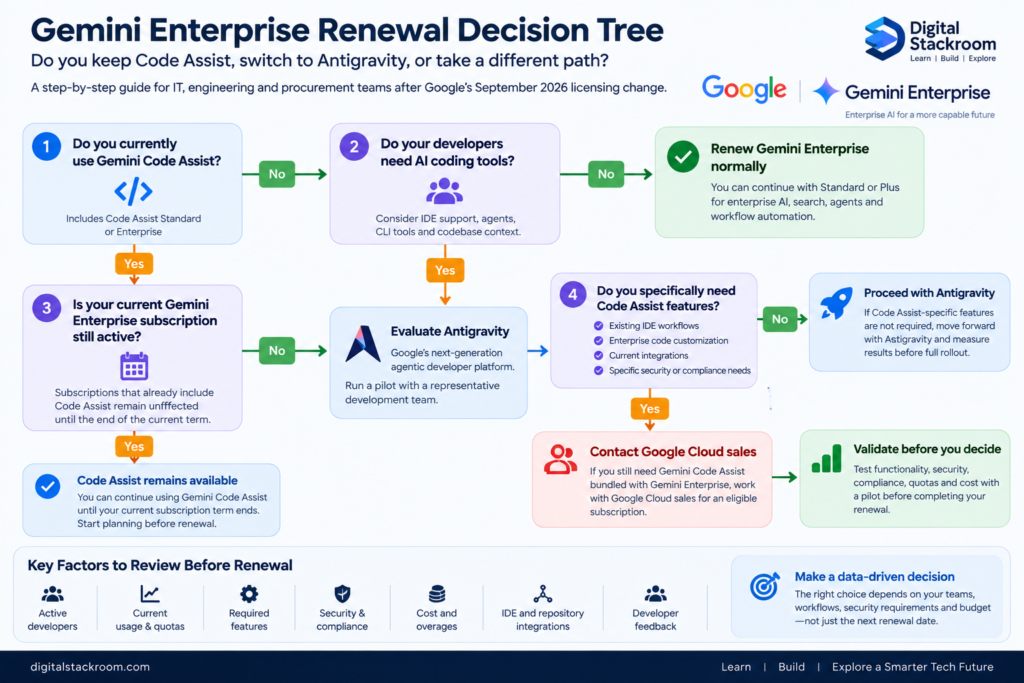
A Renewal Decision Tree
Use this as a visual callout or simple decision tree inside the article:
Does your organization currently use Gemini Code Assist?
↓
No
→ Do your developers need AI coding tools?
No → renew Gemini Enterprise normally.
Yes → evaluate Antigravity first.
↓
Yes, we use Code Assist
→ Is your current Gemini Enterprise subscription still active?
Yes → Code Assist remains available until the current term ends.
↓
Before renewal, ask:
Do we specifically need Code Assist features such as current IDE workflows or Enterprise code customization?
Yes → contact Google Cloud sales before renewal.
No → test Antigravity with a pilot development team.
↓
Only migrate after validating:
functionality → security → compliance → quotas → cost → developer experience
What Teams Should Do 60 Days Before Renewal
A Gemini Enterprise renewal should now include a developer-tool review.
Start by identifying how many developers actually use Gemini Code Assist today.
Then measure:
active developers
request volume
most-used IDEs
Gemini CLI usage
Code Assist Enterprise-only features
code customization usage
repository integrations
security requirements
After that, run an Antigravity pilot.
Do not migrate every developer at once.
Choose a representative team and compare:
| Metric | Current Code Assist | Antigravity Pilot |
|---|---|---|
| Code completion usefulness | Measure | Measure |
| Multi-file changes | Measure | Measure |
| Refactoring quality | Measure | Measure |
| Test generation | Measure | Measure |
| Agent task completion | Measure | Measure |
| Developer acceptance | Survey | Survey |
| Security fit | Review | Review |
| Monthly cost | Calculate | Estimate |
This gives procurement evidence instead of assumptions.
The Bigger Strategic Shift: AI Coding Is Becoming Agentic
The most interesting aspect of the Gemini Enterprise Code Assist change is not licensing.
It is where developer tooling is headed.
Early AI coding assistants focused on:
autocomplete
then:
chat
then:
code generation
then:
agent mode.
The industry is now moving toward agents capable of operating across:
- files
- repositories
- terminals
- browsers
- test environments
- deployment systems
Google’s Antigravity strategy reflects that shift.
Google describes Antigravity as an environment for orchestrating autonomous agents, and its broader Gemini developer platform now includes managed agents that can execute tools and code in cloud sandboxes.
The developer may increasingly move from:
writing every code change
to:
specifying the outcome, supervising agents, reviewing implementation and validating results.
That is a much larger product category than traditional autocomplete.
Gemini Code Assist Is Becoming More Sales-Assisted
There is another signal in Google’s September updates.
On September 4, Google announced that billing accounts without an existing Gemini Code Assist subscription can no longer purchase new Code Assist subscriptions directly through the Cloud console.
Those customers are directed to Google Cloud sales.
Existing subscriptions remain unaffected.
Combined with the September 17 Gemini Enterprise bundle change, this suggests a clearer product segmentation:
Antigravity → broader self-service agentic developer experience
while
Gemini Code Assist Standard/Enterprise → enterprise product with a more sales-assisted purchasing motion.
That is an interpretation of Google’s packaging changes rather than an explicit statement from Google, but the purchasing paths increasingly point in that direction.
How Gemini Code Assist Pricing Compares
Google continues to list separate Gemini Code Assist Standard and Enterprise licensing.
Its pricing documentation currently provides monthly and annual commitment rates rather than treating Code Assist as simply an automatic Gemini Enterprise entitlement.
Meanwhile Gemini Enterprise Standard/Plus starts at $30 per seat per month on Google’s public product page, though actual enterprise pricing, commitments and regional terms can vary.
This makes a direct one-line cost comparison difficult.
Companies need to compare:
Gemini Enterprise licenses
plus potentially
Code Assist licenses
or
Antigravity usage and overages
depending on the architecture they choose.
The cheapest license is not necessarily the cheapest developer platform.
What About GitHub Copilot?
Organizations evaluating the change do not have to limit themselves to Google products.
GitHub currently offers Copilot Business and Enterprise for organizations, with centralized administration, policy controls, coding agents and access to multiple AI models.
As of September 2026, GitHub lists Copilot Business at $19 per user per month and Copilot Enterprise at $39 per user per month, with usage allowances based on GitHub AI Credits.
For companies already standardized on GitHub, that ecosystem integration can be important.
The key question is not simply which model produces better code.
It is which platform integrates best with:
source control → identity → policies → review → agents → billing → developer workflow.
What About Cursor?
Cursor has also become a significant alternative, especially for teams prioritizing agentic development.
Its current team offering includes centralized administration, shared context, cloud agents, automations, privacy controls and SSO, while Enterprise adds features such as SCIM, audit logs, repository/model/MCP access controls and service accounts.
For developers in India, Cursor also launched a localized Start plan in July 2026 priced at ₹649 per month, including agentic-development features and local payment support.
That could make the developer-tool market increasingly competitive in India.
The Wrong Way to Choose an AI Coding Tool
Do not choose based only on benchmark screenshots or a single prompt comparison.
Enterprise developer-tool selection should consider:
| Area | Question |
|---|---|
| Coding quality | Does it understand your actual repositories? |
| Agents | Can it reliably complete multi-step work? |
| IDE support | Does it work where developers already work? |
| Governance | Can admins control models, usage and permissions? |
| Security | What code/data leaves the environment? |
| Compliance | Does the feature meet organizational requirements? |
| Cost | How do seats, credits and overages behave? |
| Repository integration | Can it access relevant private context? |
| Observability | Can administrators understand usage? |
| Developer adoption | Will engineers actually use it? |
The answer may differ across teams inside the same organization.
Should Teams Immediately Move From Code Assist to Antigravity?
Not necessarily.
For some teams, Antigravity will be the natural next step.
Especially those wanting:
- autonomous agents
- long-running engineering tasks
- integrated agent orchestration
- a more agent-first developer experience
But organizations already depending heavily on Code Assist Enterprise features should test carefully.
Migration makes sense when the workflow improvement outweighs switching cost.
The correct approach is:
pilot → measure → compare → migrate
rather than:
renewal changed → immediately switch everyone.
What Existing Customers Should Know
If your current Gemini Enterprise subscription includes Gemini Code Assist, there is no immediate need to panic.
Google says those features remain available until the end of the existing subscription term.
Use that window strategically.
Instead of waiting until the renewal date, organizations can use the remaining term to:
- inventory Code Assist usage
- evaluate Antigravity
- review compliance
- model developer-tool cost
- contact Google sales
- compare competitors
- build a migration plan
The worst time to discover a licensing difference is the week before renewal.
Frequently Asked Questions
Is Gemini Code Assist being discontinued?
No.
Gemini Code Assist Standard and Enterprise remain documented and supported enterprise products. The September change primarily affects how Code Assist is bundled with new and renewing online Gemini Enterprise Standard/Plus subscriptions.
Will existing Gemini Enterprise users lose Code Assist immediately?
No.
Existing Gemini Enterprise subscriptions that already include Gemini Code Assist can continue using the features until the current subscription term ends.
Can a new Gemini Enterprise customer still get Code Assist?
Yes, but Google says customers seeking a Gemini Enterprise subscription that includes Gemini Code Assist should contact Google Cloud sales.
Can organizations still buy Gemini Code Assist separately?
Yes.
Google maintains Gemini Code Assist Standard and Enterprise subscriptions, although new purchases increasingly use a sales-assisted purchasing path.
What is Google recommending instead?
Google specifically directs Gemini Enterprise customers toward Antigravity for AI developer tooling.
Is Antigravity included with every Gemini Enterprise subscription?
Not universally under every configuration.
Google documents edition, billing-account, region and administrative requirements for AI developer tools. In particular, the feature currently requires an eligible Gemini Enterprise edition and an invoiced Cloud Billing account.
Is Antigravity the same as Gemini Code Assist?
No.
They overlap in developer assistance, but Antigravity is positioned as a broader agentic-development platform, whereas Gemini Code Assist remains an enterprise AI coding assistant with Standard and Enterprise editions.
Should developers switch immediately?
Only after evaluating functionality, governance, compliance, cost and workflow compatibility.
Final Thoughts
The Gemini Enterprise Code Assist licensing change looks small on paper.
It is actually a useful signal about where Google believes enterprise developer tooling is headed.
Gemini Enterprise is becoming a broad platform for enterprise AI, agents, knowledge and business workflows.
Antigravity is emerging as Google’s agent-first developer environment.
Gemini Code Assist remains available for organizations that need its established enterprise coding capabilities.
The result is no longer one simple bundle.
Organizations now need to decide deliberately which layer they are buying.
For many companies, the smartest renewal question is no longer:
“Do we renew Gemini Enterprise?”
It is:
“Which users need Gemini Enterprise, which developers need Antigravity, which teams still require Gemini Code Assist—and what will that combination cost us?”
Teams that answer that question before renewal will have more negotiating leverage, fewer licensing surprises and a clearer AI developer-tool strategy.
The future of Gemini Enterprise Code Assist now depends more on how organizations separate enterprise AI productivity from dedicated developer tooling.
And that may ultimately be the most important consequence of Google’s September 2026 change.