
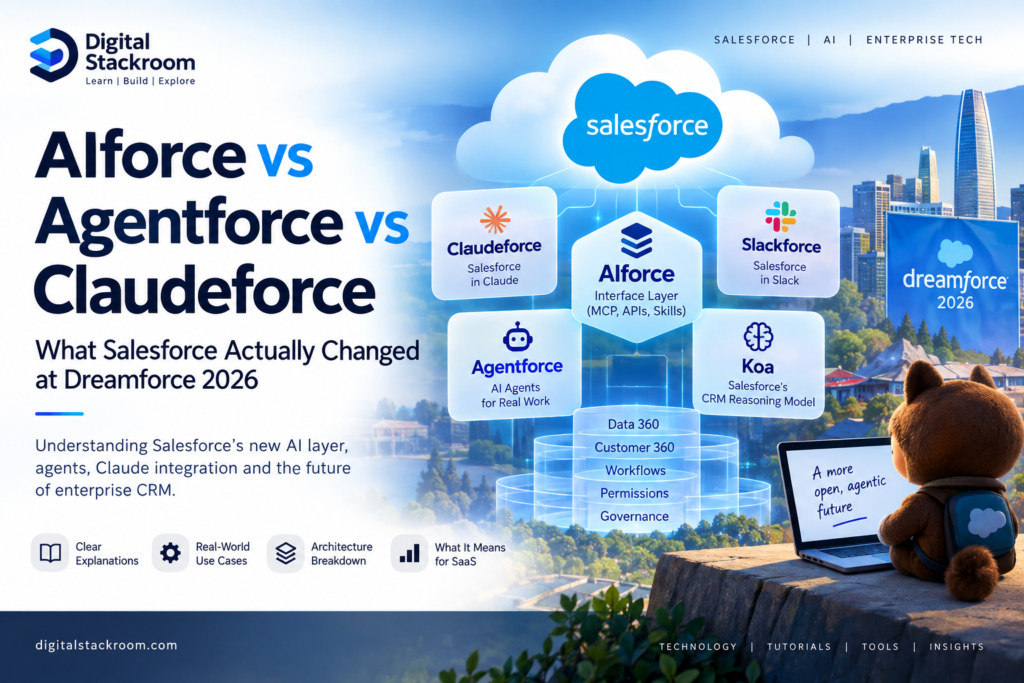
Salesforce introduced a wave of AI products and names around Dreamforce 2026: AIforce, Agentforce, Claudeforce, Slackforce, Agentforce Coworker, and Koa.
For customers trying to understand the strategy, the naming can make the platform look more complicated than it actually is.
The key to understanding AIforce vs Agentforce vs Claudeforce is to stop thinking of them as competing products.
They operate at different layers.
AIforce exposes Salesforce capabilities to AI interfaces.
Agentforce builds and runs agents that perform work.
Claudeforce connects Salesforce capabilities directly into Claude.
Salesforce is also introducing Koa, its own CRM-focused reasoning model for Agentforce, while Slackforce brings Salesforce context and actions into Slack.
The deeper change at Dreamforce 2026 is therefore not simply that Salesforce launched more AI products.
It is that Salesforce is trying to move from:
AI inside the CRM
to:
the CRM becoming a governed capability layer available inside any AI interface.
That could significantly change how enterprise software is used.
Table of Contents
The Short Answer: AIforce vs Agentforce vs Claudeforce
Here is the simplest way to understand the new Salesforce AI stack.
| Product | What it primarily does | Where it operates |
|---|---|---|
| AIforce | Exposes Salesforce data, workflows, permissions, actions, and business logic to AI interfaces | Platform/interface layer |
| Agentforce | Builds and runs autonomous or specialized AI agents | Agent execution layer |
| Claudeforce | Connects Claude with Salesforce capabilities | Claude + Salesforce integration |
| Agentforce Coworker | Gives employees a general AI teammate that can activate Salesforce agents | Employee assistant |
| Slackforce | Brings Salesforce context, interfaces, and actions into Slack | Collaboration/work interface |
| Koa | Salesforce-built CRM reasoning model for Agentforce | Model/reasoning layer |
The important takeaway is:
AIforce does not replace Agentforce. It helps Agentforce—and other AI systems—reach Salesforce capabilities from outside the traditional Salesforce interface.
Salesforce describes AIforce as a “live interface layer” that brings its data, workflows, business logic, semantics, permissions, security and governance to AI interfaces such as Claude, Slack and other agentic tools. Agentforce remains Salesforce’s agent platform and “digital workforce.”
What Is AIforce?
AIforce is Salesforce’s new interface and capability-exposure layer for the agentic era.
Traditionally, if an employee wanted information from Salesforce, they opened Salesforce, navigated through objects, dashboards and records, and performed an action inside the CRM interface.
AIforce changes that model.
Salesforce wants authorized AI systems to access the capabilities already built inside Salesforce without forcing the user to navigate the traditional UI.
That includes:
- customer data
- metadata
- workflows
- business rules
- permissions
- actions
- security policies
- governance
Salesforce says AIforce works through technologies including MCP servers, APIs, plug-ins and reusable skills, while requests continue to respect the permissions and business rules already configured in Salesforce.
AIforce is also the evolution of Headless 360
This is an important detail that can easily be missed.
Salesforce Help states that Headless 360 was rebranded to AIforce on September 4, 2026, and notes that during the transition some documentation may still use the older name. Salesforce says the underlying functionality remains the same.
That means AIforce did not appear completely from nowhere at Dreamforce.
Salesforce had already been building a headless architecture designed to turn CRM applications into reusable capabilities that AI agents could discover and invoke.
Dreamforce gave that strategy a more prominent identity.
What Is Agentforce?
Agentforce is Salesforce’s platform for creating and operating AI agents.
These agents can perform tasks such as:
- resolving customer support cases
- updating CRM records
- qualifying sales opportunities
- routing requests
- scheduling actions
- researching account information
- coordinating multi-step processes
Salesforce positions Agentforce as a platform for autonomous agents that can operate across customer service, sales, contact centers, field service and other business functions.
This is different from AIforce.
AIforce primarily answers:
How can AI systems securely access Salesforce capabilities?
Agentforce answers:
What agent should perform the work, and how should that agent execute it?
Agentforce is becoming more specialized
Salesforce has also expanded Agentforce with specialized agents and new orchestration capabilities.
Its 2026 updates include features such as:
- long-horizon execution
- persistent memory
- dynamic steering
- multi-agent orchestration
- agent optimization
- reusable AI skills
Salesforce says Multi-Agent Orchestration can coordinate specialized agents when a task spans multiple roles, systems or stages.
That suggests the direction of Agentforce is increasingly toward an enterprise agent runtime, not merely a chatbot attached to CRM data.
What Is Claudeforce?
Claudeforce is the Salesforce–Anthropic partnership that brings Salesforce capabilities into Claude and Claude reasoning into Salesforce.
The first major implementation is Salesforce in Claude.
Salesforce says it includes:
- a prebuilt integration
- a Salesforce MCP server
- centrally managed authentication
- Salesforce permissions and governance
- 37 prebuilt sales skills
Those skills cover use cases such as meeting preparation, deal-health review and pipeline analysis.
The important distinction is that Claudeforce is not another general-purpose agent platform.
It is an integration experience between Claude and Salesforce.
If a salesperson prefers working inside Claude, they can potentially ask Claude to analyze Salesforce information, reason across revenue context and perform permitted Salesforce actions without constantly moving back into the CRM UI.
Salesforce announced in September that Salesforce in Claude had moved into beta availability for customers after earlier pilots.
So Is AIforce Replacing Agentforce?
No.
The better way to think about the relationship is:
Agentforce creates the workers.
AIforce opens the doors to the business systems those workers need.
AIforce can also allow other AI systems—not only Salesforce agents—to interact with Salesforce.
For example:
Scenario 1: Agentforce
A company creates a specialized customer-renewal agent using Agentforce.
The agent analyzes CRM data, evaluates account status and performs approved actions.
Scenario 2: AIforce
A company wants its employees to interact with Salesforce through another AI interface.
AIforce exposes the appropriate Salesforce capabilities to that interface.
Scenario 3: Claudeforce
The external interface happens to be Claude.
Claude uses the Salesforce integration to analyze and act on CRM information under Salesforce governance.
The layers complement each other rather than replace one another.
The Salesforce AI Architecture After Dreamforce 2026
The architecture becomes easier to understand if we separate it into layers.
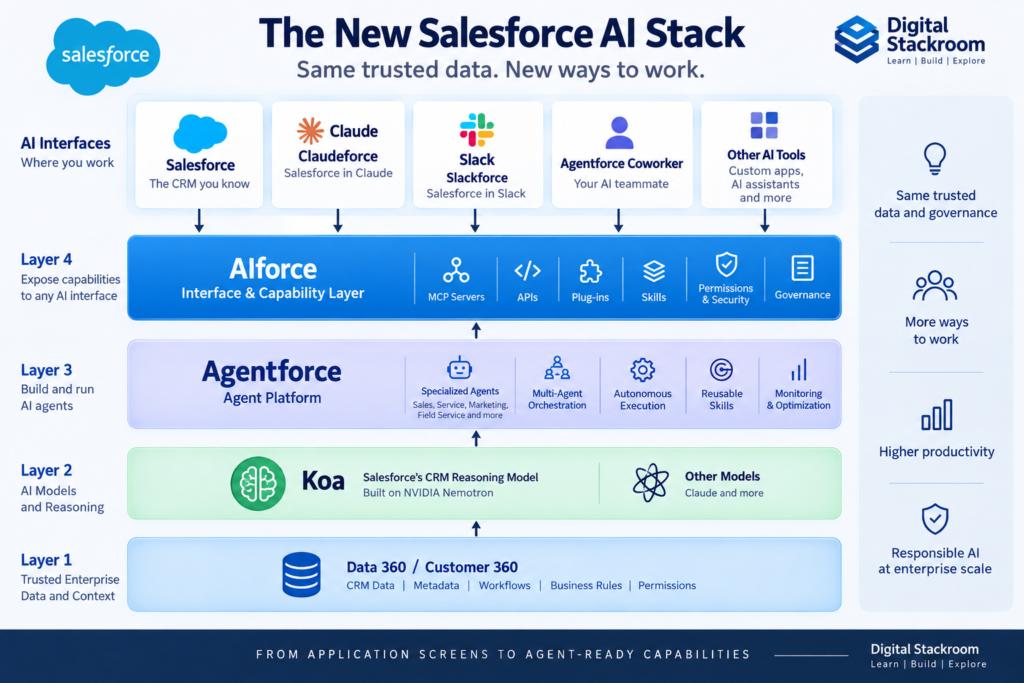
Layer 1 — Enterprise Data and Business Context
At the foundation are Salesforce systems such as:
- Data 360
- Customer 360
- CRM metadata
- workflows
- permissions
- business rules
This is the trusted enterprise context.
Salesforce describes Data 360 and Customer 360 as providing the data, semantic intelligence, permissions and business processes that agents need.
Layer 2 — AI Models and Reasoning
Different models can provide the intelligence.
Examples include:
- Claude
- Salesforce Koa
- other supported enterprise models
The model reasons about the task.
Layer 3 — Agentforce
Agentforce creates and coordinates agents that use that reasoning to perform work.
Layer 4 — AIforce
AIforce exposes Salesforce capabilities through:
- MCP
- APIs
- plug-ins
- skills
- developer tools
Layer 5 — User Interfaces
Employees may interact through:
- Salesforce
- Claude
- Slack
- Agentforce Coworker
- custom applications
- other AI tools
The result is an architecture where the traditional Salesforce browser interface is no longer the only doorway into Salesforce.
Why MCP Matters to Salesforce’s Strategy
One of the most important technologies behind this shift is the Model Context Protocol, or MCP.
The basic idea is to give AI systems a standardized method for discovering and using external tools and data.
Salesforce’s Headless 360/AIforce architecture uses MCP alongside APIs, skills and other developer interfaces to expose Salesforce capabilities to authorized agents.
Why does this matter?
Previously, connecting a new AI assistant to enterprise systems could require:
- custom APIs
- authentication logic
- duplicated permissions
- tool definitions
- custom mappings
- bespoke integrations
If standardized agent interfaces mature, enterprises could potentially expose a capability once and make it reusable by multiple AI experiences.
That changes the architecture from:
AI product → custom integration → Salesforce
toward:
AI product → governed capability layer → Salesforce
The difference could become significant as organizations deploy dozens of AI agents.
What Is Agentforce Coworker?
Agentforce Coworker is Salesforce’s employee-facing AI teammate.
It sits closer to the user than a specialized backend agent.
Salesforce says Coworker can:
- search enterprise information
- analyze business data
- surface insights
- trigger flows
- activate specialized agents
- perform actions
It can also operate across interfaces including Salesforce, Slack, Claude, Microsoft Teams and other environments.
This creates an interesting pattern.
A user may talk to Coworker.
Coworker may then call a specialized Agentforce agent.
That agent may access Salesforce capabilities exposed through the platform.
In other words, the user does not necessarily need to know which agent actually completed the task.
What Is Slackforce?
Slackforce applies a similar concept to Slack.
Instead of requiring employees to leave a conversation and navigate Salesforce, Salesforce wants Slack to become an operational interface for CRM work.
The company says Slackforce Surfaces can generate interactive views using live Salesforce and Slack data.
Slackbot can also reason across Slack conversations and Salesforce business context, while Slack CRM enables users to create or update Salesforce information from Slack.
This indicates a broader Salesforce strategy:
the application interface is becoming less important than the capabilities behind it.
The user may interact with the same underlying business system through:
- CRM screens
- Slack
- Claude
- an AI coworker
- a custom agent
What Is Koa?
Koa is another important part of the Dreamforce 2026 announcements, but it operates at a completely different layer.
Koa is Salesforce’s first CRM-specific reasoning model, built using NVIDIA Nemotron.
Salesforce says it post-trained the model using synthetic enterprise scenarios based on nearly three decades of CRM experience. The training scenarios cover tasks such as lead generation, opportunity qualification and service-case resolution. Salesforce says no customer data was used to train Koa.
Koa is designed specifically for Agentforce.
That means Salesforce is no longer relying solely on general-purpose frontier models for CRM reasoning.
The company is also building its own specialized model.
As of September 21, 2026, Koa is available to select Agentforce pilot customers, with Salesforce targeting general availability in U.S. regions in Winter 2026.
Claudeforce vs Koa
This creates an interesting model strategy.
Salesforce can use:
Claude
for frontier general-purpose reasoning,
while also developing:
Koa
for specialized CRM reasoning.
These are not necessarily mutually exclusive.
Different workloads could eventually use different models depending on requirements such as:
- reasoning complexity
- cost
- latency
- security
- specialization
- regulatory needs
- tool use
This model flexibility is increasingly important in enterprise AI.
Organizations may not want one model running every workload.
AIforce vs Agentforce vs Claudeforce Comparison
| Capability | AIforce | Agentforce | Claudeforce |
|---|---|---|---|
| Primary purpose | Expose Salesforce capabilities to AI interfaces | Build and run enterprise AI agents | Bring Salesforce into Claude |
| Main user | Developers, architects, enterprise AI teams | Businesses deploying AI agents | Claude + Salesforce users |
| Executes autonomous work | Indirectly through exposed capabilities | Yes | Claude can perform governed Salesforce actions |
| Uses Salesforce permissions | Yes | Yes | Yes |
| MCP support | Core architecture component | Can consume platform capabilities | Salesforce MCP server included |
| Main interface | Any supported AI interface | Salesforce and connected surfaces | Claude |
| Relationship to Salesforce UI | Decouples capabilities from fixed UI | Runs agents regardless of UI | Allows work from Claude |
| Current role | Interface/capability layer | Agent platform | Partner integration |
The biggest mistake would be treating these three as competing editions of the same product.
They solve different problems.
The Real Dreamforce 2026 Shift: Salesforce Is Becoming Headless
The most important strategic change may be architectural rather than product-specific.
For decades, enterprise applications were built around screens.
You opened:
Salesforce → account → opportunity → record → action
AI changes that interaction model.
A user can instead say:
“Show the deals most at risk this quarter, explain why, create follow-up tasks, and draft outreach for each account.”
The user is no longer navigating records.
The AI is reasoning across capabilities.
Salesforce’s Headless 360 strategy—now AIforce—is designed around this transition. Salesforce says the goal is to transform applications into reusable enterprise capabilities that authorized AI agents can discover and invoke.
That may be more consequential than any single Dreamforce feature.
What This Could Mean for SaaS
Traditional SaaS economics have historically been tied to application seats.
A user pays for access to:
- a CRM
- project-management software
- analytics software
- support software
But if AI increasingly becomes the interface, users may spend less time inside individual applications.
The application still provides enormous value—but the UI may no longer be where that value is consumed.
The future could increasingly look like:
AI interface → enterprise capabilities → multiple SaaS systems
rather than:
user → individual SaaS application
That does not mean traditional SaaS disappears.
It means the competitive advantage may shift toward:
- trusted data
- APIs
- workflow engines
- permissions
- business logic
- governance
- agent-ready capabilities
This is one reason Salesforce’s AIforce strategy deserves attention beyond the Salesforce ecosystem.
What Changes for Salesforce Developers?
Salesforce developers historically built:
- Lightning components
- Apex
- flows
- APIs
- integrations
Those skills remain relevant.
But the new architecture adds another set of considerations:
- MCP servers
- skills
- agent actions
- tool discovery
- prompt/context design
- AI authorization
- agent orchestration
- evaluation
- observability
Developers may increasingly build capabilities for agents rather than only interfaces for humans.
Salesforce says its Headless Toolkit provides MCPs, APIs, plug-ins, skills and developer tools for creating AI experiences on top of its architecture.
What Changes for Salesforce Administrators?
Admins could become even more important.
Why?
Because AIforce emphasizes reusing existing Salesforce controls.
That includes:
- permissions
- sharing rules
- workflows
- business logic
- governance
Salesforce says AIforce requests inherit existing permissions rather than requiring an entirely new access-control model.
But that also creates responsibility.
A poorly configured permission may become more consequential when an AI system can execute actions at scale.
Admins should increasingly think about:
What can this user see?
and also:
What can an agent acting for this user do?
Enterprise Security: Why Governance Becomes More Important
The promise of agentic AI is that agents can take action.
That is also the risk.
A system that only answers questions has limited operational impact.
A system that can:
- change opportunities
- approve workflows
- send messages
- modify customer data
- trigger automation
requires much stronger governance.
Salesforce says AIforce routes actions through existing Salesforce permissions and business rules and provides Zero Data Retention for model-provider interactions in supported configurations.
But organizations still need to design:
- least-privilege access
- approval boundaries
- audit logs
- human review
- sensitive-action restrictions
- agent testing
- exception handling
AIforce provides a framework.
It does not eliminate the need for governance.
MCP Does Not Remove Integration Risk
Standardization helps, but MCP is not a security shortcut.
If an AI system can invoke enterprise tools, architects still need to consider:
- tool permissions
- authentication
- prompt injection
- unintended actions
- data exposure
- auditability
- tool chaining
- failure recovery
The easier it becomes to connect AI to enterprise capabilities, the more important it becomes to define which capabilities should actually be available.
The goal should not be:
“Expose everything to the agent.”
It should be:
“Expose only the capabilities needed for the task.”
Who Should Use AIforce?
AIforce becomes particularly interesting when an organization wants Salesforce capabilities available outside the traditional Salesforce interface.
Examples:
- custom AI assistants
- third-party AI platforms
- AI productivity tools
- developer-built agents
- conversational applications
- cross-platform enterprise workflows
AIforce is therefore primarily an architecture decision.
Who Should Use Agentforce?
Agentforce is the more direct choice when the organization needs Salesforce-native AI agents.
Examples:
- customer-service agents
- sales agents
- employee assistants
- workflow agents
- long-running business-process agents
Agentforce remains the primary environment for building and operating Salesforce’s digital workforce.
Who Should Use Claudeforce?
Claudeforce makes the most sense when Claude is already a major enterprise AI interface.
For example:
A salesperson spends much of the day in Claude.
Instead of opening Salesforce separately, they could ask Claude:
- Which deals are at risk?
- What changed in this account?
- Prepare me for tomorrow’s customer meeting.
- Update the opportunity.
- Create follow-up tasks.
The Salesforce integration provides the governed CRM context behind those actions.
Who Should Use Agentforce Coworker?
Coworker is aimed at employees who want a general Salesforce-aware AI teammate.
It is particularly useful when users do not want to think about which specialized agent to invoke.
Coworker can serve as the front door to an organization’s broader Agentforce workforce.
What Enterprises Should Evaluate Before Adopting the New Stack
The product strategy is compelling, but enterprises should evaluate it carefully.
1. Availability
Some capabilities remain in beta or pilot stages.
For example, Salesforce in Claude is currently beta, while Koa is still in pilot with broader availability planned later.
2. Cost
Agentic workloads may use consumption-based pricing.
Salesforce currently offers Agentforce options including Flex Credits, conversation-based pricing and user licensing.
Organizations should model agent usage before deploying at scale.
3. Permissions
Review current Salesforce access controls before giving agents additional capabilities.
4. Auditability
Determine how actions are logged and investigated.
5. Human Approval
Identify which actions should still require a person.
6. Model Choice
Determine when Claude, Koa or another supported model is appropriate.
7. Failure Handling
Agents will sometimes fail.
Production workflows need:
- retries
- escalation
- rollbacks
- human takeover
A Practical Enterprise Adoption Strategy
Rather than enabling everything at once, organizations can test the architecture in phases.
Phase 1 — Read-only AI
Allow the system to retrieve and summarize Salesforce information.
Examples:
- account summaries
- pipeline analysis
- case research
Phase 2 — Low-risk actions
Allow actions such as:
- creating internal tasks
- drafting emails
- updating low-risk fields
Phase 3 — Specialized agents
Introduce Agentforce agents for repeatable workflows.
Phase 4 — External AI interfaces
Use AIforce to make capabilities available through Claude, Slack or custom applications.
Phase 5 — Multi-agent workflows
Coordinate specialized agents across longer-running business processes.
This staged model helps organizations learn where AI creates value before exposing critical workflows.
What Dreamforce 2026 Actually Changed
Dreamforce did not simply add several AI features to Salesforce.
It clarified Salesforce’s architecture for the agentic era.
Before:
Salesforce was primarily an application that users opened.
Now Salesforce increasingly wants to become:
a governed enterprise capability platform that AI systems can access from wherever employees work.
The product names map to that architecture:
Data 360 / Customer 360
provide context.
↓
AI models such as Claude or Koa
provide reasoning.
↓
Agentforce
provides agents and execution.
↓
AIforce
exposes Salesforce capabilities beyond the traditional UI.
↓
Claudeforce / Slackforce / Coworker / custom interfaces
become the places where users interact.
Once viewed this way, Salesforce’s growing list of AI product names becomes much easier to understand.
Frequently Asked Questions
Is AIforce replacing Agentforce?
No.
AIforce is positioned as an interface and capability layer, while Agentforce remains Salesforce’s AI-agent platform.
Is AIforce completely new?
Not entirely.
Salesforce Help says Headless 360 was rebranded to AIforce in September 2026, although Dreamforce significantly expanded the strategy and integrations around it.
What is Claudeforce?
Claudeforce is the Salesforce–Anthropic partnership connecting Claude with Salesforce data, workflows, business logic and governed actions.
How many skills does Salesforce in Claude have?
Salesforce says the initial Salesforce in Claude experience includes 37 prebuilt sales skills.
Is Salesforce in Claude generally available?
As of September 2026, Salesforce says Salesforce in Claude is available to customers in beta.
What is Koa?
Koa is Salesforce’s CRM-focused reasoning model for Agentforce, built using NVIDIA Nemotron and post-trained for enterprise CRM workflows.
Is Koa available now?
Koa is currently available to selected pilot customers. Salesforce says broader U.S. availability is expected in Winter 2026.
What is Agentforce Coworker?
Coworker is Salesforce’s employee-facing AI teammate that can search enterprise context, analyze information, take actions and activate specialized Agentforce agents.
Final Thoughts
The most useful way to understand AIforce vs Agentforce vs Claudeforce is by separating interfaces, agents and models.
AIforce is the capability and interface layer.
Agentforce is the agent platform.
Claudeforce brings Salesforce into Claude.
Agentforce Coworker provides a general AI teammate.
Slackforce brings Salesforce into Slack.
Koa provides Salesforce-specific CRM reasoning.
The bigger story is what sits underneath those product names.
Salesforce is betting that enterprise software will increasingly become headless.
Instead of forcing users to navigate individual SaaS applications, AI interfaces may invoke capabilities across multiple systems while permissions, workflows and governance remain behind the scenes.
If that model succeeds, the most valuable enterprise software may no longer be defined by the quality of its screens.
It may be defined by the quality of the data, workflows, permissions and actions that AI agents can safely use.
For teams evaluating AIforce vs Agentforce vs Claudeforce, the right choice depends on whether they need an AI interface layer, an agent execution platform, or a Claude-based Salesforce experience.
That is the real architectural shift behind Salesforce’s Dreamforce 2026 announcements.