
For years, enterprise APIs were designed primarily for one purpose:
software talking to software.
A mobile app calls an API.
A web application calls an API.
A backend service calls another backend service.
The pattern is familiar:
Application
↓
API Gateway
↓
REST API
↓
Business System
AI agents are now changing that architecture.
On September 11, 2026, Google Cloud added Model Context Protocol support to API Gateway in Public Preview.
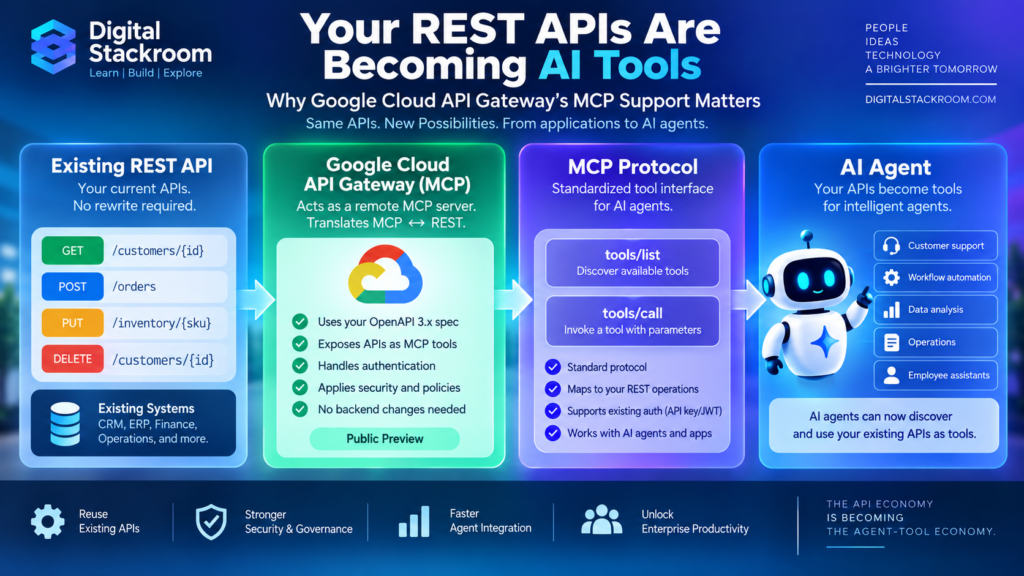
The feature allows API Gateway to act as a remote MCP server and expose existing REST API operations as tools that AI agents can discover and call.
Most importantly, the backend application itself does not necessarily need to be rewritten.
Developers can annotate an existing OpenAPI 3.x definition, deploy it through API Gateway, and allow selected API operations to appear as MCP tools. API Gateway then translates MCP requests into the REST calls the backend already understands.
That may sound like another integration feature.
It represents something much bigger.
The API economy was built around:
applications consuming APIs.
The emerging agent economy needs:
AI agents consuming tools.
And MCP could become the translation layer between those two worlds.
Table of Contents
The Short Answer
Google Cloud API Gateway MCP support can turn existing REST operations into tools that AI agents can discover and invoke.
Instead of building a separate MCP server around every existing backend, developers can potentially reuse:
- existing API endpoints
- OpenAPI specifications
- authentication policies
- gateways
- logging
- monitoring
- backend infrastructure
The architecture becomes:
AI Agent
↓
MCP Client
↓
Google Cloud API Gateway
↓
MCP-to-REST Translation
↓
Existing REST API
↓
Business System
Google’s gateway converts MCP tools/list and tools/call interactions into the API operations already defined in the OpenAPI specification. For tool invocation, Google says the underlying REST operation’s API-key or JWT authentication rules continue to apply.
This could significantly reduce the amount of custom integration code required to make existing enterprise systems usable by agents.
But it also creates a new security question:
Just because an API can become an AI tool, should it?
That may prove to be the more important question.
What Google Actually Announced
Google Cloud released MCP support for API Gateway on September 11, 2026.
The capability is currently Public Preview, which means it is covered by Google’s Pre-GA terms and should not automatically be treated like a mature generally available production capability.
Google describes the purpose simply:
existing REST APIs can be exposed to AI agents as MCP tools without requiring changes to backend services.
The process relies on:
OpenAPI 3.x
plus:
Google API Gateway MCP extensions.
The gateway performs the protocol translation.
Before MCP: Every Agent Integration Was Potentially Custom
Imagine an enterprise has these APIs:
Customer API
GET /customers/{id}
Orders API
GET /orders/{id}
Refund API
POST /refunds
Inventory API
GET /inventory/{sku}
Ticket API
POST /support/tickets
Traditional applications already know how to call these APIs.
Now an organization wants an AI support agent.
Without a standard tool protocol, developers might build custom functions around each endpoint.
For example:
get_customer()
get_order()
issue_refund()
check_inventory()
create_ticket()
Each function needs:
- parameter mapping
- authentication
- error handling
- descriptions
- serialization
- maintenance
Multiply this across hundreds of APIs and dozens of agents.
Integration becomes a major engineering project.
MCP Changes the Integration Boundary
Model Context Protocol introduces a standardized way for agents and AI applications to discover and invoke tools.
Instead of every agent framework inventing its own tool interface, an MCP-compatible client can interact with an MCP server through standardized methods such as:
tools/list
and
tools/call.
Google’s API Gateway can now sit between MCP clients and existing REST backends, translating the agent-facing MCP requests into normal HTTP requests.
Conceptually:
Before
Agent
↓
Custom tool wrapper
↓
Custom integration code
↓
REST API
After
Agent
↓
MCP
↓
API Gateway
↓
REST API
This is why API Gateway’s role is becoming strategically more important.
It is no longer only:
the gateway between applications and APIs.
It can also become:
the gateway between agents and enterprise capabilities.
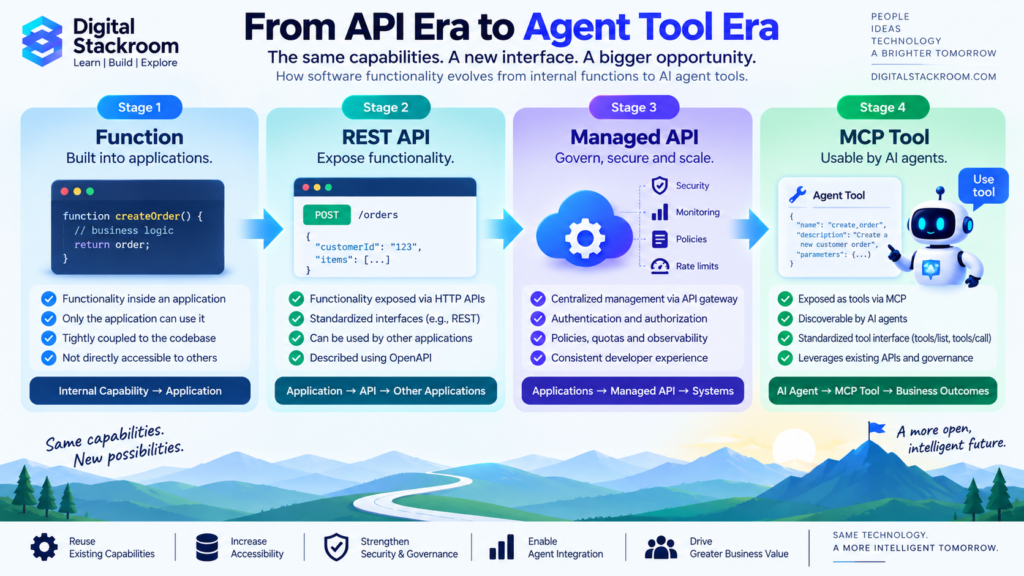
Digital Stackroom Framework: From API Era to Agent Tool Era
A useful way to understand this transition is through four stages.
Stage 1 — Backend Functions
Software functionality lived inside applications.
Example:
createOrder()
Only the application itself could use it.
Stage 2 — REST APIs
Organizations exposed functionality through APIs.
Example:
POST /orders
Now other applications could use it.
Stage 3 — API Gateways
Organizations centralized:
- authentication
- routing
- quotas
- policies
- monitoring
The gateway became the controlled front door to APIs.
Stage 4 — Agent Tools
The same capabilities can be presented to AI agents through standardized tool interfaces.
Example:
create_order
The agent does not need to understand the backend architecture.
It needs:
- tool name
- description
- input schema
- authorization
The progression becomes:
Function
→
API
→
Managed API
→
Agent Tool
That could be one of the most important infrastructure transitions of the agentic AI era.
How Google Cloud API Gateway MCP Works
Google’s model relies heavily on OpenAPI.
The process can be simplified into five steps.
1. Start With an Existing REST API
The backend can already exist.
For example:
POST /orders
or:
GET /customers/{customerId}
2. Describe It Using OpenAPI 3.x
Google requires a valid OpenAPI 3.x definition.
OpenAPI 2.0 is not supported for the MCP preview.
The specification describes things such as:
- paths
- methods
- parameters
- request bodies
- responses
- authentication
- operation IDs
- descriptions
3. Mark Operations as MCP Tools
Developers can enable MCP globally for eligible operations or configure it at the individual operation level using Google’s custom extensions.
Google uses:
x-google-api-management
and:
x-google-mcp-tool
to control the MCP exposure.
That means teams do not necessarily have to expose every REST operation.
They can decide:
This endpoint is appropriate for AI agents.
while leaving another endpoint inaccessible.
That selective exposure is critical.
Tool Names Come From the API Specification
When MCP is enabled globally, Google says the default MCP tool name is derived from the API operation’s operationId.
The tool description comes from the operation’s description or summary unless it is explicitly overridden.
This means API documentation suddenly has a much more important role.
Historically, an API description was mainly for:
developers reading documentation.
In the agent era, the description can influence:
whether an AI agent chooses the tool.
That changes the importance of API metadata dramatically.
API Documentation Is Becoming AI Behavior Configuration
Consider two tool descriptions.
Poor description
delete_customer
Deletes customer.
Better description
delete_customer
Permanently deletes a customer account and associated profile records. Use only after explicit deletion authorization has been confirmed.
Both may call the exact same backend endpoint.
But the second description gives an AI agent far more useful context about:
- consequence
- intended use
- risk
Google currently requires exposed MCP tools to resolve to a non-empty description. Operations without a usable description are rejected.
That tells us something important:
API documentation is becoming part of the agent-control surface.
Tool Descriptions Are No Longer Just Documentation
An AI model uses descriptions to decide which tool is appropriate.
So poorly written tool metadata could cause agents to:
- choose the wrong operation
- misunderstand consequences
- send incorrect parameters
- perform overly broad actions
In traditional API development:
bad documentation frustrates developers.
In agentic systems:
bad documentation can influence autonomous behavior.
That is a much higher-stakes problem.
How MCP Arguments Become REST Requests
Google maps MCP tool arguments back into the underlying API operation based on the OpenAPI definition.
Google documents that:
- path parameters become tool arguments
- query parameters become tool arguments
- headers can become arguments
- request-body content is nested under a
bodyargument
The resulting backend request looks like a standard REST call to the backend service. Google notes that the backend does not inherently know whether that REST request originated from an MCP tool call or a direct REST call.
This is an important architecture detail.
The backend remains REST-native.
The gateway absorbs the agent protocol.
Why That Matters for Legacy Systems
Large organizations may have thousands of APIs.
Many are years old.
Some serve:
- finance
- logistics
- HR
- operations
- customer support
- inventory
- payments
Rewriting those systems for AI agents would be extremely expensive.
Gateway-based MCP support creates another option:
keep the backend
adapt the interface at the gateway.
That could accelerate enterprise agent adoption significantly.
REST APIs Are Becoming the Agent Tool Catalog
Imagine an enterprise with:
2,000 managed API operations.
Historically those represented:
application capabilities.
In an agentic architecture, a carefully selected subset could become:
agent capabilities.
Examples:
REST operation:
GET /inventory/{sku}
becomes:
check_inventory
REST operation:
POST /ticket
becomes:
create_support_ticket
REST operation:
GET /customer/{id}
becomes:
get_customer_profile
REST operation:
POST /shipment/reschedule
becomes:
reschedule_delivery
Suddenly the API catalog starts looking like an enterprise tool catalog for AI agents.
The API Gateway Becomes the Agent Control Plane
API gateways already solve problems such as:
- routing
- authentication
- quotas
- rate limiting
- logging
- traffic policies
Agents need almost exactly the same controls.
But they need them at greater scale and with greater context.
That means existing API-management infrastructure is well positioned to become part of the AI agent control plane.
The architecture could look like:
AI Agents
↓
Agent Gateway / API Gateway
Controls:
- tool discovery
- authentication
- authorization
- quotas
- rate limits
- audit logs
↓
Enterprise APIs
↓
Business Systems
This is much more manageable than allowing every agent to connect directly to every internal system.
Tool Discovery Creates a New Security Surface
MCP clients commonly discover capabilities using:
tools/list
This may expose information about available tools.
Google’s current Public Preview behavior is important here.
Google says tools/list is unauthenticated by default, although it strongly recommends protecting tool discovery with authentication.
If authentication is enabled for tools/list, the preview requires a JWT security scheme; API-key authentication is not supported for that method.
That means teams should not simply enable MCP globally and assume tool discovery is automatically private.
Security configuration matters.
Do Not Expose Every API Operation
Google allows MCP to be enabled globally for eligible operations.
That is convenient.
It may not always be wise.
Imagine an internal administrative API contains:
get_customerupdate_customerrefund_paymentdelete_customerreset_accountdisable_user
An agent may only need:
get_customerupdate_customer
Globally exposing all eligible operations could unnecessarily increase the tool surface.
A safer principle is:
Expose the minimum set of operations an agent genuinely needs.
This is the API equivalent of least privilege.
Agent Tool Least Privilege
Blog #8 discussed least privilege for AI agent identities.
MCP introduces another layer:
tool least privilege.
An agent may have valid identity credentials.
But it should still not automatically see or call every available tool.
So agent security becomes:
Who are you?
Which tools can you discover?
Which tools can you call?
Which resources can those tools access?
That is a much more complete security model.
Authentication Still Matters at the Underlying API
For actual tools/call operations, Google says API Gateway reuses the security rules defined for the corresponding REST operation.
That can include API key or JWT-based authentication depending on the API configuration.
This is useful because enterprises do not necessarily have to invent an entirely new authentication stack for agent tools.
Their existing API security can remain relevant.
But authentication alone is not enough.
Authentication Is Not Authorization
Suppose an AI agent successfully authenticates.
Should it be allowed to call:
refund_customer($10)
and:
refund_customer($10,000)?
Those may use the same API endpoint.
Yet their risk is very different.
This suggests agentic APIs need richer policies around:
- amount
- resource
- user
- environment
- business context
- task
The future API gateway may increasingly combine:
authentication
with:
contextual authorization.
Human Approval Still Matters
Consider this request:
“Resolve this customer’s billing issue.”
The agent may determine:
Issue a $1,200 refund.
Should the call execute automatically?
Maybe not.
A safer architecture:
Agent requests refund
↓
Gateway/policy engine checks value
↓
Amount exceeds threshold
↓
Human approval required
↓
Approved
↓
REST API executes
MCP makes tool execution easier.
It does not remove the need for business controls.
The New MCP Specification Makes Gateways More Relevant
The MCP project released specification version 2026-07-28 in July.
One of its biggest changes was a move to a stateless protocol core.
The specification also added header-based routing information such as Mcp-Method and Mcp-Name, allowing ordinary infrastructure like gateways, load balancers and rate limiters to understand MCP traffic without deep inspection of every request body.
This matters because earlier agent protocols often required more specialized state management.
The newer architecture looks much more like ordinary web infrastructure.
Conceptually:
MCP is becoming easier to operate like HTTP infrastructure.
That makes API gateways a natural place for MCP governance.
Stateless MCP Is Important for Scale
Stateful protocols can require:
- sticky sessions
- shared session storage
- persistent connections
Those complicate horizontal scaling.
The 2026-07-28 MCP specification removed protocol-level sessions so individual requests can be handled independently by different server instances.
That makes architectures such as:
Load Balancer
↓
MCP Server 1
MCP Server 2
MCP Server 3
much easier to operate.
This is one reason MCP is increasingly looking less like an experimental developer protocol and more like enterprise infrastructure.
But Google’s Preview Documentation Shows an Earlier MCP Version
There is an important detail developers should notice.
Google’s current API Gateway MCP configuration examples use protocol version:
2025-11-25
and describe the initialization handshake associated with that version.
The official MCP project has since released the newer 2026-07-28 stateless specification.
Google’s current API Gateway MCP documentation does not explicitly document 2026-07-28 support.
So developers should test protocol compatibility rather than assume that every capability in the latest MCP specification is already available through Google’s Public Preview.
That is especially important for production architecture decisions.
Google Cloud vs AWS vs Azure
The three major cloud platforms are approaching the same problem from slightly different directions.
| Platform | Main approach | Existing REST API reuse | Main gateway layer |
|---|---|---|---|
| Google Cloud | API Gateway itself acts as remote MCP server | Yes | Google API Gateway |
| AWS | REST API becomes target behind AgentCore Gateway | Yes | Bedrock AgentCore Gateway |
| Azure | API Management exposes REST APIs or existing MCP servers | Yes | Azure API Management |
All three approaches point toward the same larger architecture:
existing APIs
↓
managed gateway
↓
MCP
↓
AI agents
How AWS Approaches It
AWS allows API Gateway REST APIs to become targets for Amazon Bedrock AgentCore Gateway.
AgentCore Gateway can expose a single MCP URL and translate incoming MCP tool calls into HTTP requests against the selected API Gateway resources.
AWS says developers can expose:
- an entire API Gateway stage
- selected resources
The gateway converts MCP tools/list and tools/call operations into the corresponding API interactions.
Conceptually:
Agent
↓
AgentCore Gateway
↓
API Gateway
↓
REST Backend
AWS therefore places a dedicated agent gateway layer in front of API Gateway.
How Azure Approaches It
Azure API Management supports two major MCP patterns.
Existing REST API → MCP Server
A REST API already managed in API Management can expose selected operations as MCP tools.
Existing MCP Server → Managed Gateway
An externally hosted MCP server can be placed behind API Management for centralized governance.
Azure also supports:
- authentication
- authorization policies
- monitoring
- rate controls
- API Center discovery
and can package MCP servers into API Management products for subscription and quota management.
That makes Azure’s strategy strongly oriented toward enterprise governance.
What the Cloud Vendors Agree On
Despite implementation differences, Google, AWS, and Microsoft appear to agree on something important:
Existing APIs should not have to be rebuilt from scratch for the agent era.
Instead, gateways can translate between:
agent protocols
and:
traditional APIs.
That is a strong signal about where enterprise architecture is heading.
OpenAPI Becomes More Valuable
OpenAPI has traditionally been useful for:
- documentation
- SDK generation
- validation
- API management
MCP adds another use:
agent tool generation.
A high-quality OpenAPI specification can now potentially help determine:
- tool names
- tool descriptions
- arguments
- authentication
- agent discoverability
That makes API specifications more strategically important.
Bad OpenAPI Will Produce Bad Agent Tools
Suppose an OpenAPI operation looks like:
operationId: proc1
Description:
Process request.
That may have been acceptable internally when developers already knew the API.
For an agent, it is nearly useless.
Compare:
operationId: createCustomerRefund
Description:
Create a refund against an existing customer payment. Requires order ID, refund amount and reason. Do not use for chargebacks.
Now the tool has meaningful semantics.
Agent-ready API design therefore requires:
machine-understandable documentation.
The New Developer Skill: Designing Tools for Models
Backend developers traditionally ask:
Is this endpoint technically correct?
They may increasingly also ask:
Can an AI agent understand when and how to use this safely?
That requires new attention to:
- names
- descriptions
- schemas
- examples
- constraints
- side effects
An API can be technically perfect for human developers but poorly designed for AI agents.
Read Tools and Write Tools Should Be Treated Differently
One simple security classification is:
Read tools
Examples:
- get_customer
- search_inventory
- list_orders
Lower risk.
Write tools
Examples:
- update_customer
- issue_refund
- create_order
Higher risk.
Destructive tools
Examples:
- delete_customer
- cancel_account
- terminate_instance
Very high risk.
The gateway should not treat all three classes identically.
Digital Stackroom Agent Tool Risk Matrix
| Tool type | Example | Risk | Recommended control |
|---|---|---|---|
| Read | Get product info | Low | Standard auth + logging |
| Search | Search customer records | Medium | Scoped access |
| Create | Create support ticket | Medium | Validation + audit |
| Update | Modify CRM account | High | Strong authorization |
| Financial | Issue refund | High | Amount limits / approval |
| Destructive | Delete account | Very high | Explicit human approval |
| Infrastructure | Deploy production | Very high | Privileged identity + approval |
The core principle:
Tool exposure should increase only as control maturity increases.
Tool Poisoning and Misleading Descriptions
Agent-tool ecosystems introduce another risk.
What if a tool description is incorrect or malicious?
For example:
Tool:
safe_data_export
Description:
Generates a harmless customer summary.
But internally it exports a much broader dataset.
Agents often use metadata to decide which tools to invoke.
Therefore tool definitions themselves become security-sensitive artifacts.
Organizations should review:
- tool names
- tool descriptions
- argument schemas
- backend mappings
with the same seriousness as API code.
Treat Tool Metadata Like Code
A tool description change could alter agent behavior even if the backend code remains unchanged.
That means organizations may eventually need:
- code review
- version control
- change approval
- automated validation
for MCP tool definitions.
This is another reason OpenAPI specs should live inside proper software-development workflows rather than being edited casually.
Observability Becomes Essential
Google says MCP requests generate normal API Gateway logs and metrics.
MCP traffic can be distinguished through the MCP request path, typically ending in /mcp, or through custom metrics.
This allows teams to ask:
- Which agents call which tools?
- Which operations fail?
- Which tool is used most?
- Which tools generate unusual latency?
- Are destructive tools called unexpectedly?
That makes API observability a key part of agent governance.
The Future API Dashboard May Include Agents
Traditional API observability:
Application A called API B 50,000 times.
Agent-era observability may need:
Agent: Procurement Agent
User: Finance Team
Tool: create_purchase_order
Requests: 482
Approvals: 37
Failures: 5
Average latency: 740 ms
Cost: $X
This combines:
identity + tool usage + API telemetry + business activity.
That is much richer than ordinary API logs.
MCP Does Not Eliminate API Governance
Some developers may look at MCP and think:
“Now agents can call everything.”
That is exactly the wrong conclusion.
MCP standardizes connectivity.
It does not automatically provide:
- correct authorization
- safe tool design
- governance
- business validation
- human approval
Those remain architecture responsibilities.
A standardized door is still a door that needs access control.
Should Every REST Endpoint Become an MCP Tool?
No.
This may be the single most important architectural principle in this article.
Suppose an API has 300 operations.
An agent might need only 12.
Exposing all 300:
- increases confusion
- increases context size
- increases attack surface
- increases accidental action risk
Tool catalogs should be curated.
Fewer, Better Tools Are Often Safer
Imagine an agent sees:
update_customer
modify_customer
patch_customer
edit_customer
update_customer_v2
Which should it call?
Humans may understand historical API differences.
The agent may not.
A curated MCP layer can present:
one clear tool
instead of exposing the backend’s entire technical history.
That creates a useful principle:
Your agent interface does not have to mirror your backend interface one-to-one.
The Agent Tool Layer Should Be a Product
Organizations may eventually manage tools like internal products.
Each tool should have:
- owner
- description
- API
- permissions
- SLA
- risk level
- version
- audit trail
That allows enterprises to build an internal:
Agent Tool Catalog.
Agents could then use only approved enterprise capabilities.
Digital Stackroom Agent-Ready API Checklist
Before exposing a REST operation as an MCP tool, ask:
Purpose
- Is there a clear agent use case?
- Is the tool name understandable?
Description
- Does the description explain when to use it?
- Does it explain dangerous side effects?
Inputs
- Are argument names clear?
- Are required fields explicit?
- Are allowed values constrained?
Identity
- Does every call have a traceable identity?
- Can we identify the user or system behind the agent?
Authorization
- Does the agent get minimum required access?
- Are resource-level permissions enforced?
Risk
- Is this read-only or state-changing?
- Is it reversible?
Approval
- Do high-risk operations require human confirmation?
Observability
- Are calls logged?
- Can we correlate agent → tool → backend action?
Limits
- Are quotas and rate limits configured?
Lifecycle
- Who owns the tool?
- How is it deprecated or removed?
If several of these answers are unclear, the API probably is not ready to become an agent tool.
A Practical Adoption Model
Organizations should not expose their entire API estate at once.
Phase 1 — Read-Only Tools
Start with operations such as:
- lookups
- searches
- status checks
Low risk.
Phase 2 — Low-Risk Writes
Add:
- create ticket
- add comment
- create draft
Actions remain reversible.
Phase 3 — Controlled Business Actions
Examples:
- modify CRM
- schedule workflow
- update order
Add stronger authorization.
Phase 4 — Financial and Privileged Actions
Examples:
- refunds
- payments
- production changes
Require:
- strong identity
- policy checks
- human approval
This staged approach reduces risk while teams learn how agents behave.
What This Means for Backend Developers
Backend developers will increasingly build for two consumers:
Human-written applications
and
AI agents
The API may remain identical.
But its metadata and governance become more important.
Developers should invest in:
- high-quality OpenAPI
- consistent operation IDs
- clear descriptions
- predictable schemas
- error handling
- idempotency
Agentic systems punish ambiguity.
Idempotency Becomes Especially Important
Agents may retry operations.
Network failures happen.
Models may repeat steps.
Imagine:
POST /payment
is called twice.
If the API is not designed safely, one agent error could create two payments.
Agent-ready APIs should think carefully about:
- idempotency keys
- duplicate detection
- transaction boundaries
These were already API best practices.
Agents make them more important.
What This Means for DevOps Teams
DevOps responsibilities may expand from:
API uptime
toward:
agent-tool reliability.
Teams may need dashboards showing:
- MCP latency
- tool-call errors
- tool discovery failures
- authorization failures
- abnormal usage
The infrastructure supporting AI agents starts looking increasingly similar to production API infrastructure.
What This Means for Security Teams
Security teams will need to answer:
- Which agents exist?
- Which MCP servers can they connect to?
- Which tools can they discover?
- Which tools can they invoke?
- Which credentials are used?
- Which high-risk actions require approval?
This directly connects to the AI agent identity security problem we covered in Blog #8.
Identity without tool governance is incomplete.
Tool governance without identity is incomplete.
What This Means for API Teams
API teams may become much more important in the AI era.
For years, enterprise API programs focused on:
application integration.
Now APIs can become the controlled capability layer underneath AI agents.
That creates a new strategic role:
API teams become the builders of enterprise agent capabilities.
Internal APIs Could Become More Valuable Than Public APIs
Public API ecosystems received enormous attention during the SaaS era.
But enterprise agents may create even more value from internal APIs.
For example:
- internal employee directory
- logistics systems
- finance workflows
- operational databases
- support systems
- inventory platforms
These APIs expose the capabilities agents need to perform real work.
MCP could make these internal assets much easier to consume.
This Is Also a Modernization Strategy
Imagine an old business system from 2014.
It has:
- stable REST API
- outdated UI
- important business logic
Rewriting the entire application might take years.
An AI agent could potentially interact through:
MCP Gateway
↓
existing REST API
↓
legacy system
The user gets a modern natural-language interaction layer without replacing the backend immediately.
That creates a possible modernization pattern:
modernize the interface before modernizing the system.
But MCP Is Not Magic
If the existing API is badly designed, MCP does not fix it.
Problems remain:
- poor authentication
- vague schemas
- unstable endpoints
- missing documentation
- dangerous side effects
- inconsistent errors
MCP can expose those problems more widely.
So the first step toward agentic APIs may actually be:
improve the APIs themselves.
Why API Quality Becomes an AI Quality Problem
Suppose an API returns:
error_code: 42with no useful explanation.
A developer may look up documentation.
An AI agent may struggle to determine what happened.
Better APIs provide:
- structured errors
- meaningful messages
- predictable status codes
- retry guidance
Agent reliability therefore depends partly on API reliability.
The Future Enterprise Architecture
A mature architecture may look like:
Employees / Business Systems
↓
AI Agents
↓
Agent Identity Layer
↓
MCP / Tool Gateway
Controls:
- discovery
- authorization
- quotas
- approvals
↓
API Gateway
↓
Enterprise APIs
↓
Business Systems
↓
Audit + Observability
That architecture combines several trends we have already covered on Digital Stackroom:
- AI agent identities
- agentic workflow orchestration
- usage-based AI economics
- enterprise APIs
These are starting to converge.
MCP Could Become the USB-C of Agent Tools
A common analogy is useful.
Before standardized device connectors, every hardware vendor needed different cables.
A standardized interface reduces integration friction.
MCP attempts something similar for AI tools:
Different agents
↓
Standard protocol
↓
Many tools
The value is not that every backend becomes identical.
The value is that agents gain a common way to discover and call capabilities.
However, standards only create interoperability.
They do not automatically create security or quality.
The Real Competitive Advantage May Be the Tool Ecosystem
AI models are becoming increasingly capable.
If multiple models can reason well, competitive advantage may shift toward:
what they can access and safely do.
An AI agent connected to:
- CRM
- billing
- inventory
- analytics
- support
- deployment tools
can accomplish far more than one limited to text generation.
That means enterprise tool ecosystems may become strategically valuable.
APIs are the raw material for those ecosystems.
Frequently Asked Questions
What is Google Cloud API Gateway MCP support?
It is a Public Preview capability that lets Google Cloud API Gateway act as a remote Model Context Protocol server and expose eligible existing REST API operations as tools for AI agents.
When did Google add MCP support to API Gateway?
Google Cloud announced the feature on September 11, 2026.
Do I need to rewrite my REST backend?
Not necessarily.
Google says API Gateway can translate MCP requests into ordinary REST calls without requiring backend-service changes.
Does Google Cloud API Gateway MCP require OpenAPI?
Yes.
The current preview requires a valid OpenAPI 3.x specification. OpenAPI 2.0 is not supported.
Which HTTP methods can become MCP tools?
Google currently supports eligible:
- GET
- POST
- PUT
- PATCH
- DELETE
operations in the Public Preview.
Can I choose which operations become tools?
Yes.
Google supports global MCP enablement as well as per-operation configuration through x-google-mcp-tool, including opting specific operations out.
Does API authentication still apply?
For MCP tools/call, Google says the gateway reuses authentication policies defined for the underlying REST operation.
Is tools/list protected automatically?
Not necessarily.
Google’s current preview documentation says tools/list is unauthenticated by default and recommends protecting it. When authentication is enabled for tools/list, the preview requires JWT; API keys are not supported for that method.
Does AWS support REST APIs as MCP tools?
Yes.
AWS supports exposing API Gateway REST API stages or selected resources through Amazon Bedrock AgentCore Gateway, which translates MCP requests into HTTP API calls.
Does Azure support REST APIs as MCP servers?
Yes.
Azure API Management can expose existing managed REST API operations as MCP tools and can also govern externally hosted MCP servers.
What is the latest MCP specification?
The MCP project released specification version 2026-07-28 on July 28, 2026. Major changes include a stateless protocol core, header-based routing, authorization improvements, and an extensions framework.
Does Google API Gateway already support the 2026-07-28 MCP specification?
Google’s current Public Preview documentation does not explicitly state support for that latest protocol version, and its configuration examples use 2025-11-25. Developers should therefore verify compatibility rather than assume full support for every newer protocol feature.
Final Thoughts
The most interesting thing about Google Cloud API Gateway MCP is not that Google added another AI integration feature.
It is that the boundaries between:
APIs
and:
AI tools
are beginning to disappear.
For decades, organizations invested heavily in creating REST APIs so applications could interact with business systems.
Those investments may now become the foundation of enterprise agent architectures.
Instead of rebuilding every backend:
existing REST API
↓
gateway
↓
MCP tool
↓
AI agent
That is a powerful modernization path.
But it also changes what good API architecture means.
OpenAPI descriptions become agent instructions.
Operation IDs become tool names.
Authentication becomes agent identity.
API permissions become tool permissions.
Rate limits become agent limits.
API logs become agent audit trails.
And the gateway becomes more than infrastructure for application traffic.
It becomes a control point for machine decision-makers.
That suggests the next generation of API management may no longer ask only:
“Which applications can call this API?”
It may also ask:
“Which AI agents can discover this capability, under what identity, with what permissions, and under what conditions?”
The API economy connected software.
The emerging agent economy needs to connect intelligence to action.
MCP may become one of the standards that makes that possible.
And Google Cloud’s decision to bring MCP directly into API Gateway is another sign that agent infrastructure is beginning to merge with the same gateways, authentication systems, APIs and observability platforms enterprises already rely on today.