
Enterprise AI is moving beyond chat.
AI agents can now:
- call APIs
- read enterprise databases
- update CRM records
- modify cloud resources
- create tickets
- send messages
- execute code
- trigger workflows
- interact with other agents
That creates a security problem traditional identity systems were never designed around.
For decades, enterprises mostly managed two broad categories of identity:
humans
and
applications/workloads.
Applications were often represented through service accounts, API keys, workload identities, application registrations, or other machine credentials.
AI agents blur that model.
An agent may:
- act independently
- act temporarily for a particular user
- switch between tools
- delegate work to another agent
- change its plan during execution
- request different permissions depending on the task
That makes AI agent identity security fundamentally different from simply creating another service account.
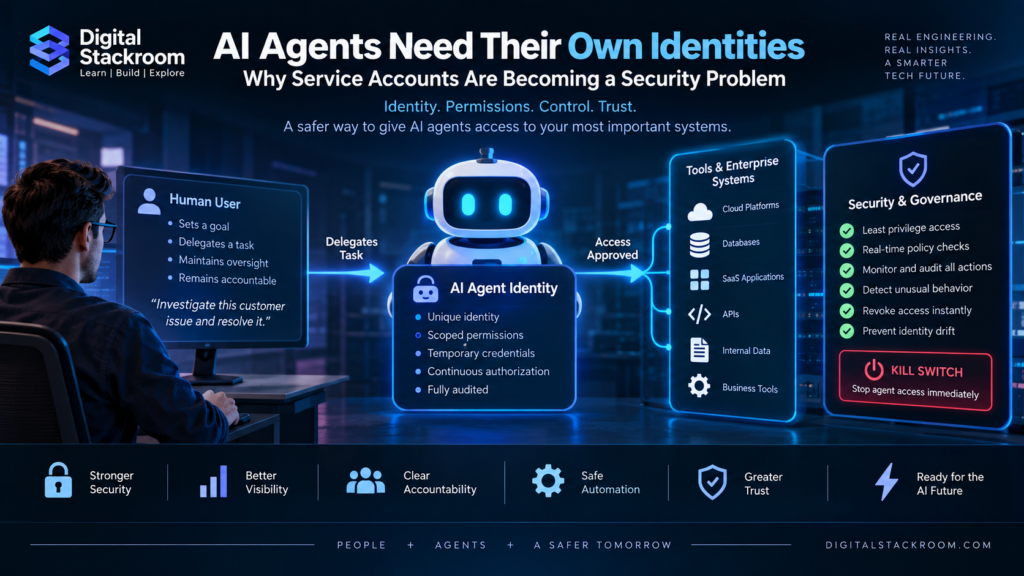
The emerging security model looks more like this:
Human or business process
↓
delegates a task
↓
AI agent receives its own identity
↓
the agent receives narrowly scoped permissions
↓
credentials are issued temporarily
↓
every tool call is evaluated and logged
↓
permissions expire, change, or can be revoked immediately
Major technology vendors are now building specifically for this model.
CrowdStrike introduced an Agentic Identity Provider in September 2026 designed to establish AI agents as distinct identities and broker limited access dynamically. Microsoft now offers Entra Agent ID as a first-class identity system for AI agents. Google Cloud Agent Identity gives agents cryptographically verifiable identities, while AWS AgentCore Identity provides managed authorization mechanisms for agents connecting to external systems.
This is an important shift.
The future of enterprise identity may no longer be:
human identities + machine identities
but:
human identities + workload identities + agent identities.
Table of Contents
The Short Answer
Traditional service accounts are usually designed for predictable software.
An application does something like:
service A → database B
using a known permission set.
AI agents are different.
An agent may receive a goal such as:
“Investigate this customer issue and resolve it.”
To complete that objective, the agent might decide to:
- read the CRM
- search internal documentation
- inspect a support ticket
- query an order database
- issue a credit
- update the CRM
- notify the customer
The route is not necessarily known in advance.
If that agent uses a broad shared service account, every possible action may inherit the same identity and permissions.
That creates several problems:
- attribution becomes difficult
- permissions can become excessive
- credential sharing increases blast radius
- credentials can remain valid longer than the task
- agent-to-agent delegation becomes hard to trace
- revoking one compromised agent may affect other workloads
A purpose-built agent identity creates a better separation:
Who requested the work?
Which agent performed it?
What authority was delegated?
Which resource was accessed?
Why was the action allowed?
When should that access expire?
Those questions are becoming central to enterprise AI security.
Human Identity vs Service Account vs AI Agent Identity
| Area | Human Identity | Traditional Service Account | AI Agent Identity |
|---|---|---|---|
| Represents | Person | Application/workload | Individual AI agent |
| Typical behavior | Human-driven | Predictable software process | Dynamic/autonomous task execution |
| Permissions | Role/user based | Usually predefined | Ideally task/context dependent |
| Credential duration | Session or user lifecycle | Often long-lived | Prefer short-lived |
| Delegated authority | User directly acts | Usually acts independently | May act for user or itself |
| Tool usage | User manually selects | Predefined integrations | Agent may dynamically select tools |
| Accountability | Clear user | Application/account | Agent + sponsoring user/system |
| Lifecycle | Hire to termination | Application deployment lifecycle | Creation, task, delegation, retirement |
| Main risk | Account compromise | Secret leakage / overprivilege | Autonomous misuse at machine speed |
| Best security model | IAM + MFA + conditional access | Workload IAM | Dedicated agent identity + continuous authorization |
The important point is not that service accounts are inherently insecure.
They remain appropriate for many conventional applications.
The problem is using traditional shared or static machine identities for systems whose behavior is increasingly dynamic and autonomous.
Why Service Accounts Worked for Traditional Software
Traditional applications are relatively predictable.
Imagine an invoicing service.
It needs to:
- read orders
- generate invoices
- write invoice records
Its access needs may barely change for years.
A service account is a reasonable solution.
You create:
invoice-service
and grant it:
orders.read
invoices.read
invoices.write
The application performs a known function using a known permission set.
Security teams can reason about that workload fairly easily.
AI agents break several assumptions behind this model.
Why AI Agents Are Different
An AI agent is closer to a dynamic decision-maker.
Instead of receiving explicit instructions such as:
call API X
the agent may receive an objective such as:
“Prepare the customer renewal and resolve anything that could block it.”
The agent can decide which tools are needed.
That might involve:
CRM
↓
support system
↓
billing
↓
↓
document repository
↓
contract management
The agent’s permissions therefore become part of its reasoning environment.
The question is no longer only:
Can the application call this API?
It becomes:
Should this agent be allowed to perform this action, for this user, on this resource, at this moment, for this task?
That is a much richer authorization problem.
The Security Industry Is Already Moving Toward Agent Identities
Several major platforms have independently moved in the same direction.
Microsoft Entra Agent ID
Microsoft now lists Entra Agent ID as generally available.
It introduces specialized identities for AI agents and allows organizations to authenticate, authorize, govern, protect, monitor, and audit those agents separately from conventional users and applications. Microsoft also supports concepts such as agent sponsors and specialized policy controls.
An important idea here is accountability.
An agent can have its own identity while still maintaining a relationship to:
the user
or
the system
responsible for it.
That provides much stronger attribution than simply letting the agent reuse somebody else’s credentials.
Google Cloud Agent Identity
Google has also introduced purpose-built Agent Identity.
Google’s model assigns a cryptographically verifiable identity to individual agents and explicitly distinguishes these identities from conventional service accounts.
Google documents that agent identities are not shared between workloads by default, cannot be impersonated in the same way as traditional service accounts, and avoid developer-generated long-lived service-account keys. Agent credentials can also be bound cryptographically to the agent.
Google’s Agent Identity auth manager handles several outbound authentication models, including:
- user-delegated OAuth
- machine-to-machine OAuth
- API keys
- agent-owned cloud identity
The system separates:
the agent’s identity
from:
the credentials needed to access a particular external system.
That separation is important.
An agent does not necessarily need to possess every downstream secret itself.
AWS AgentCore Identity
AWS is solving another part of the same problem through Amazon Bedrock AgentCore Identity.
In September 2026 AWS introduced a managed consent portal that allows users to authorize agents to access third-party tools such as GitHub, Salesforce, and Slack without every developer having to build custom OAuth callback and session-binding infrastructure.
This reflects another key distinction:
agent-owned authority
versus
user-delegated authority.
Sometimes an agent acts as itself.
Sometimes it should operate only under explicit authority from a particular human.
Those should not automatically use the same identity model.
CrowdStrike Agentic Identity Provider
CrowdStrike introduced its Agentic Identity Provider in September 2026.
The system is designed around creating trusted identities for AI agents and issuing access based on current context rather than simply allowing an agent to inherit broad static credentials. CrowdStrike also emphasizes linking agent actions back to the human or system behind the work.
This is effectively an extension of Zero Trust:
Do not permanently trust the agent simply because it authenticated once.
Instead:
identify → authorize → observe → reevaluate
continuously.
The Real Problem: Identity Inheritance
Consider this scenario.
An employee has permission to:
- read all customer accounts
- issue refunds
- modify contracts
- export reports
They ask an AI agent:
“Review the Acme account and prepare everything needed for renewal.”
The easiest implementation is:
let the agent use the employee’s credentials.
But that creates a major security issue.
The agent now potentially inherits everything the employee can do.
The actual task may require only:
- read Acme account
- read open support cases
- draft renewal notes
Yet the agent could technically:
- issue refunds
- modify unrelated accounts
- download unrelated customer data
- trigger other privileged workflows
This is the difference between:
user authorization
and:
task authorization.
Agent security increasingly needs both.
The Principle of Delegated Least Privilege
A stronger model would work like this:
Employee:
“Prepare the Acme renewal.”
↓
Policy system understands task
↓
Agent receives temporary authority:
crm.account.read: Acme
support.cases.read: Acme
renewal.draft.create
↓
Agent performs the task
↓
Permissions expire
The agent never receives the employee’s entire identity.
It receives only the authority needed to complete that task.
This is delegated least privilege.
It may become one of the most important concepts in AI agent identity security.
Attack Scenario 1: The Shared Service Account
Imagine 50 enterprise agents all use:
ai-agent-service@company.com
That account can access:
- CRM
- internal documents
- billing system
- ticketing system
One agent becomes compromised through malicious instructions.
Security sees:
ai-agent-service@company.com
performing suspicious actions.
But which agent was responsible?
Which user triggered it?
Which workflow initiated the request?
Which permission should be revoked?
A shared identity destroys much of that context.
With individual agent identities, security could see:
agent-renewal-024
acting for:
employee-784
under:
renewal-task-901
That dramatically improves investigation.
Attack Scenario 2: Long-Lived API Keys
Developers often connect agents to external tools using API keys.
That is convenient.
It is also dangerous when keys become:
- hard coded
- stored in configuration files
- copied between environments
- reused by several agents
- forgotten after testing
If the key is compromised, the attacker may retain access long after the original agent session ends.
Google’s Agent Identity auth manager is one example of a platform attempting to reduce this exposure by brokering and storing external credentials instead of forcing agents or developers to manage them directly.
The broader design principle is:
Agents should request credentials, not own permanent secrets whenever possible.
Attack Scenario 3: Excessive Agency
OWASP identifies Excessive Agency as an important risk for LLM-based systems.
The problem occurs when an AI system receives more:
- functionality
- permissions
- autonomy
than it actually needs.
For example, an agent designed only to read documents might connect using an identity that can also:
- edit
- upload
- delete
files.
The problem is not necessarily malicious AI.
The problem is excessive authority.
This is why tool permission design matters just as much as model safety.
Attack Scenario 4: Identity Drift
Permissions rarely stay perfectly clean.
Employees change teams.
Applications evolve.
Temporary access becomes permanent.
Old accounts remain active.
AI agents can inherit the same identity debt.
Orchid Security describes this as identity drift and has introduced controls specifically designed to detect it for agent deployments. It also introduced application-level kill switches intended to terminate agent access quickly.
An agent created six months ago for:
read-only reporting
may gradually accumulate:
- write access
- additional applications
- broader scopes
- stale credentials
Eventually its actual privilege is very different from its intended purpose.
Agent identity therefore needs continuous review.
Attack Scenario 5: Agent-to-Agent Delegation
Agentic systems increasingly use multiple agents.
For example:
Manager Agent
↓
delegates to
Research Agent
↓
delegates to
CRM Agent
↓
calls Salesforce
Who owns the Salesforce action?
The original human?
The manager agent?
The CRM agent?
All three?
A serious agent-identity architecture must preserve this chain.
An audit record should ideally answer:
Human sponsor
→ orchestrating agent
→ delegated agent
→ tool
→ resource
→ action
Without that lineage, multi-agent systems become extremely difficult to govern.
Attack Scenario 6: A Compromised Agent Acting at Machine Speed
A compromised human account is dangerous.
A compromised autonomous agent can be more dangerous in one specific way:
speed.
An attacker-controlled agent may be able to:
- enumerate resources
- call APIs
- manipulate records
- move data
- invoke additional tools
far faster than a person could manually.
F5’s September 2026 Workforce AI Security announcement specifically focuses on applying policy controls to actions performed by agents on behalf of employees.
That points toward a broader principle:
Agent activity needs runtime authorization, not only login-time authentication.
Authentication Is Not Enough
Traditional identity systems often ask:
“Who are you?”
Agent systems also need to ask:
“What are you trying to do?”
and:
“Should you still be allowed to do it?”
An AI agent might authenticate successfully at 09:00.
At 09:05 it reads a customer record.
At 09:06 it receives malicious instructions hidden inside a document.
At 09:07 it tries to export 50,000 records.
The identity did not change.
The risk context did.
A stronger control plane should therefore evaluate:
- identity
- task
- user
- resource
- requested action
- current risk
- location/environment
- historical behavior
before sensitive operations.
AI Agent Identity Security Needs Continuous Authorization
A useful mental model is:
Traditional model
Authenticate once
↓
receive session
↓
use permissions
Agent model
Identify agent
↓
understand sponsor/task
↓
evaluate requested action
↓
issue limited authority
↓
perform action
↓
observe behavior
↓
reevaluate
↓
expire or revoke
This is closer to continuous authorization than conventional application authentication.
The AI Agent Identity Lifecycle
This is our original Digital Stackroom framework.
An agent identity should move through ten stages.
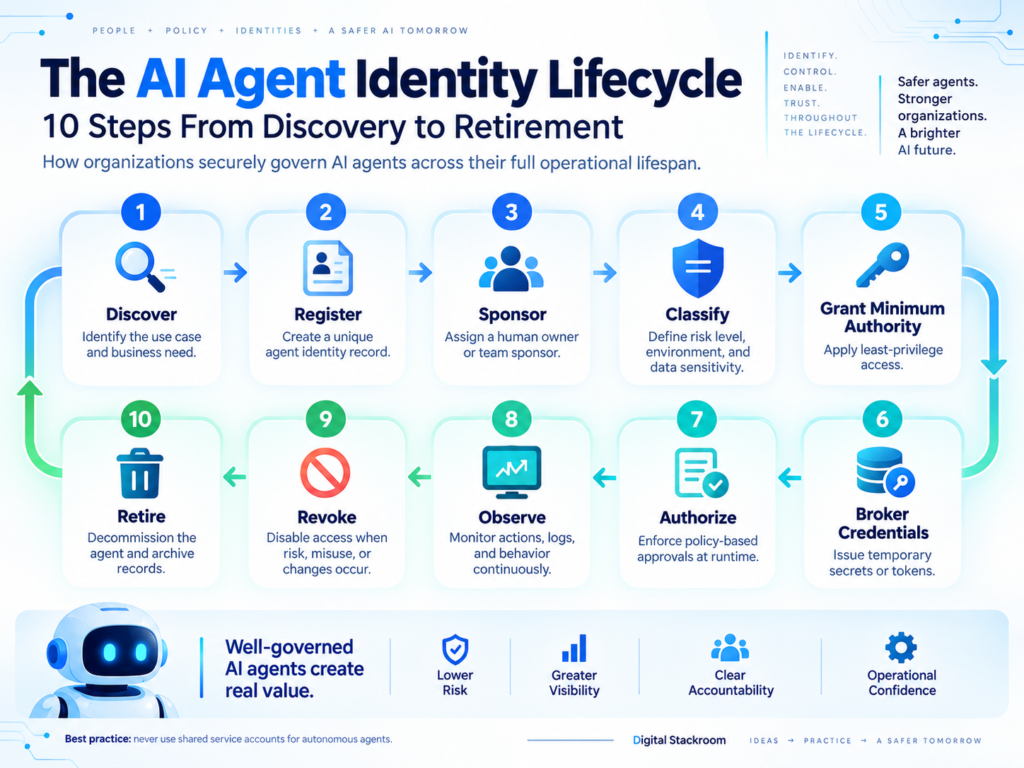
1. Discover
Know the agent exists.
You cannot secure agents that nobody has inventoried.
Record:
- agent name
- environment
- owner
- framework
- model
- tools
- business purpose
2. Register
Assign the agent a unique enterprise identity.
Avoid:
shared-agent-account
Prefer:
finance-reconciliation-agent-prod-03
The identity should represent the agent itself.
3. Assign a Sponsor
Every production agent needs an accountable human or business owner.
That sponsor should be responsible for:
- business purpose
- requested permissions
- lifecycle review
- decommissioning
Microsoft’s agent identity model explicitly includes owner/sponsor concepts, reflecting this emerging need.
4. Classify the Agent
Not all agents carry equal risk.
Classify by:
Read-only assistant
Transactional agent
Privileged operations agent
Coding/deployment agent
Security agent
Multi-agent orchestrator
The level of autonomy should influence the level of control.
5. Grant Minimum Authority
Start with no access.
Then add only what the agent requires.
Prefer:
customer.read
over:
customer.admin
Prefer:
invoice.create
over:
billing.full_access
Avoid granting broad privileges simply because development becomes easier.
6. Broker Credentials
Where possible, the agent should not permanently store downstream credentials.
Use:
- short-lived tokens
- credential brokers
- workload federation
- OAuth delegation
- managed secret systems
Google Cloud’s Agent Identity model demonstrates this pattern by separating the agent identity from credential acquisition for external systems.
7. Authorize Every Important Action
Authentication should not automatically authorize every subsequent decision.
For high-risk actions, evaluate:
agent
- user
- task
- resource
- context
before allowing execution.
8. Observe and Audit
Log:
- requested action
- agent identity
- sponsoring identity
- target system
- permission used
- result
- timestamp
- delegated agents
The objective is to recreate the entire decision chain after an incident.
9. Revoke Quickly
Organizations need a way to stop an agent immediately.
A kill switch should:
- block new authentication
- revoke active credentials where possible
- stop tool access
- prevent delegation
- preserve logs
Orchid’s announcement of agent-focused application kill switches reflects exactly this emerging operational requirement.
10. Retire
When an agent is no longer used:
- disable identity
- revoke credentials
- remove permissions
- delete stale integrations
- archive audit data
- transfer or close ownership
Agent identities should have a lifecycle just like employee identities.
The Architecture Enterprises Should Be Moving Toward
A secure architecture could look like this:
Human / Business System
↓
Task Delegation
“Resolve invoice discrepancy.”
↓
Agent Identity
invoice-agent-42
↓
Identity Policy Engine
Checks:
- sponsor
- task
- agent risk
- requested resource
↓
Credential Broker
Issues short-lived access
↓
Agent Gateway / Tool Layer
Controls:
- Salesforce
- ServiceNow
- GitHub
- databases
- cloud APIs
↓
Target System
↓
Audit + Detection
Every action tied back to:
human → agent → permission → resource
This architecture separates:
reasoning
from
identity
from
authorization
from
credentials.
That separation is extremely important.
The LLM should not become the security boundary.
Never Let the Model Decide Its Own Permissions
An agent can decide:
“I need the CRM tool.”
It should not be able to decide:
“Therefore give me CRM administrator access.”
Permission decisions belong outside the model.
A trusted policy layer should determine:
- which tools exist
- which actions are available
- which scopes are permitted
- when approval is needed
The agent proposes an action.
The security system decides whether it can happen.
Own Authority vs Delegated Authority
This is another distinction enterprise architects should make explicit.
Agent-Owned Authority
The agent acts as itself.
Example:
Infrastructure monitoring agent
It may have permission to:
- read metrics
- open incidents
No human identity needs to be involved.
User-Delegated Authority
The agent acts for a specific person.
Example:
“Send an email to my customer.”
The agent should act under authority delegated by that user.
AWS and Google both now document mechanisms around user consent or delegated OAuth for this kind of agent access.
These models should not be confused.
The Agent Kill Switch
Every enterprise AI platform should answer one simple question:
How do we stop this agent right now?
If the answer requires:
- finding source code
- rotating a shared API key
- redeploying infrastructure
- waiting for a developer
the security architecture is incomplete.
An effective kill switch should disable:
identity
not merely:
application process.
Why?
Because killing the application does not necessarily revoke:
- OAuth tokens
- API keys
- cloud sessions
- delegated credentials
Stopping execution and revoking authority are two different operations.
Agent Identity Is Also an Observability Problem
Imagine a security dashboard showing:
john@company.com accessed payroll
That is useful for a human.
Now imagine:
agent-service-account accessed payroll
Less useful.
Instead, security teams increasingly need telemetry like:
Agent: Payroll Analyst Agent #27
Sponsor: Finance Operations
Acting for: John
Objective: Prepare payroll variance report
Resource: Payroll database
Permission: payroll.read
Action: SELECT
Result: Allowed
Delegation chain: Finance Orchestrator → Payroll Agent
Identity becomes part of observability.
Security Teams Need an Agent Inventory
One of the first controls organizations should establish is surprisingly simple:
know every production agent.
Create an inventory containing:
| Field | Example |
|---|---|
| Agent ID | sales-renewal-014 |
| Business owner | Revenue Operations |
| Technical owner | AI Platform Team |
| Environment | Production |
| Model | Approved enterprise model |
| Tools | CRM, email, documents |
| Data classification | Confidential |
| Permission level | Transactional |
| Human approval required | Refunds above threshold |
| Last review | 2026-09-01 |
| Expiration/review date | 2026-12-01 |
Agent sprawl could become the next version of service-account sprawl.
Service Accounts Are Not Going Away
It would be wrong to conclude:
Service accounts are obsolete.
They are not.
A service account remains appropriate when:
- workload behavior is deterministic
- access requirements are stable
- application boundaries are clear
- no user delegation is required
- lifecycle is controlled
For example:
Nightly backup job
or
ETL pipeline
may work perfectly well with conventional workload identity.
The problem arises when organizations treat an autonomous agent like an ordinary background process.
When Should an Agent Get Its Own Identity?
A dedicated identity becomes increasingly important when the agent:
- performs transactions
- acts for multiple users
- accesses sensitive data
- uses multiple enterprise applications
- delegates to other agents
- dynamically chooses tools
- has write/delete permissions
- runs autonomously
- can initiate financial or operational changes
The more authority and autonomy the agent has, the stronger the case for a first-class identity.
A Practical AI Agent Identity Security Checklist
Before putting an agent into production, ask:
Identity
- Does this agent have a unique identity?
- Is it separate from developer/service accounts?
- Is there a clearly assigned sponsor?
Permissions
- Does it have only necessary access?
- Are permissions scoped to resources?
- Are write/delete actions restricted?
Credentials
- Are credentials short-lived where possible?
- Are secrets centrally brokered?
- Are API keys hard-coded anywhere?
Delegation
- Can we identify the user the agent is acting for?
- Is delegated permission narrower than the user’s full authority?
Runtime Security
- Are sensitive actions continuously authorized?
- Can suspicious behavior trigger restrictions?
Observability
- Is every tool call logged?
- Can we reconstruct agent-to-agent delegation?
Lifecycle
- Is there a review date?
- Can the identity expire automatically?
- Do we have a kill switch?
If several answers are no, the agent probably is not ready for sensitive production access.
Seven Rules for Secure Agent Identity
For teams that want a simpler framework:
Rule 1
One important agent, one identity.
Avoid broad shared agent accounts.
Rule 2
Agents should borrow authority, not inherit entire identities.
Rule 3
Prefer temporary credentials over permanent secrets.
Rule 4
Permission should match the task, not the maximum capability of the user.
Rule 5
Every action should be attributable.
Human → agent → resource.
Rule 6
Privileges should be continuously reevaluated.
Rule 7
Every agent must be killable.
Quickly.
Why Agent Identity Could Become a Major Cybersecurity Market
Identity and access management is already one of the largest categories in enterprise security.
Agentic AI creates a new identity population.
Organizations may eventually manage:
10,000 employees
but also:
100,000 AI agents and agent instances.
Those agents may appear and disappear dynamically.
That creates demand for:
- agent identity providers
- credential brokers
- secrets management
- PAM
- access governance
- API security
- agent gateways
- runtime authorization
- behavior analytics
- agent inventory
- agent lifecycle management
Microsoft, Google, AWS, CrowdStrike, F5, and specialized security companies are already moving into pieces of this architecture.
This could become one of the most commercially important infrastructure layers around enterprise AI.
The Bigger Shift: Identity Is Becoming Part of AI Architecture
Early enterprise AI discussions focused heavily on:
Which model should we use?
Then attention shifted toward:
Which data can the model access?
The next question may be:
Who exactly is the agent when it takes an action?
That seems simple.
It is not.
Identity determines:
- access
- accountability
- delegation
- trust
- auditing
- compliance
- incident response
As agents become capable of doing real work, identity moves from an infrastructure detail to a core component of AI architecture.
Frequently Asked Questions
What is an AI agent identity?
An AI agent identity is a dedicated digital identity representing an AI agent when it authenticates to applications, APIs, cloud systems, or other agents.
It allows organizations to distinguish the agent from the human or application that created it.
Why not just use a service account for an AI agent?
A service account can work for narrowly defined agents.
But broad or autonomous agents often require more granular attribution, delegation, short-lived credentials, lifecycle controls, and dynamic authorization than conventional service-account designs provide.
Does every AI agent need a separate identity?
Not necessarily every experimental or low-risk agent.
Dedicated identities become increasingly important as an agent gains:
- autonomy
- production access
- sensitive data access
- transaction capability
- multi-user use
- delegation capability
What is delegated agent access?
Delegated access means an agent performs an action on behalf of a particular user but receives only the authority required for that action rather than inheriting the user’s entire permission set.
What is an agent kill switch?
An agent kill switch is a control that rapidly stops the agent’s ability to authenticate or access enterprise systems.
Ideally it should revoke authorization and credentials—not merely stop the running process.
Are Microsoft and Google building dedicated AI agent identity systems?
Yes.
Microsoft now provides Entra Agent ID, while Google Cloud provides Agent Identity and related credential-management capabilities. Both are explicitly designed around the distinct requirements of AI agents.
Does AWS support identity for AI agents?
Yes.
Amazon Bedrock AgentCore Identity includes capabilities for connecting agents to external systems and managing end-user authorization. AWS introduced a managed consent portal in September 2026.
Is this only a cybersecurity problem?
No.
Agent identity affects:
- AI architecture
- cloud architecture
- compliance
- observability
- governance
- developer experience
- incident response
It sits at the intersection of AI and enterprise infrastructure.
Final Thoughts
The rise of autonomous AI agents creates an identity problem that traditional application security only partially solves.
Service accounts were designed primarily for predictable workloads.
AI agents can be:
- dynamic
- delegated
- autonomous
- multi-tool
- multi-agent
- short-lived
That makes AI agent identity security a new architectural requirement.
The secure model is increasingly clear:
give the agent its own identity
↓
tie it to an accountable sponsor
↓
grant minimum authority
↓
use temporary credentials
↓
authorize sensitive actions continuously
↓
log the complete delegation chain
↓
revoke access immediately when necessary
The organizations that get this right will not simply have safer agents.
They will be able to deploy more capable agents because security teams can understand:
who the agent is, what it can do, why it has access, and how to stop it.
That may ultimately be what determines whether agentic AI remains a limited experiment or becomes trusted enterprise infrastructure.